We Are Fighters: Maduro Sends a Message from His New York Prison
One week after his arrest, ousted Venezuelan president Nicolás Maduro reassured that he is in good condition inside the federal prison in Brooklyn, where he is being held along with his wife.
Maduro’s son relayed a message from him in a video released Saturday by Venezuela’s ruling party, in which he stated: “We are fine. We are fighters.”
-
After Maduro’s arrest… could Don Roe become a substitute for the Monroe Doctrine?
-
US strikes on Venezuela and the arrest of Maduro: support, condemnation, and international mediation offers
Maduro and his wife, Cilia Flores, have been detained at the Brooklyn federal prison since appearing before a U.S. court on Monday, where they pleaded not guilty to the charges brought against them, including drug trafficking. Their next hearing is scheduled for March 17.
Maduro was arrested during an operation carried out by U.S. special forces, accompanied by airstrikes on Caracas that resulted in the deaths of 100 people, according to Venezuelan authorities.
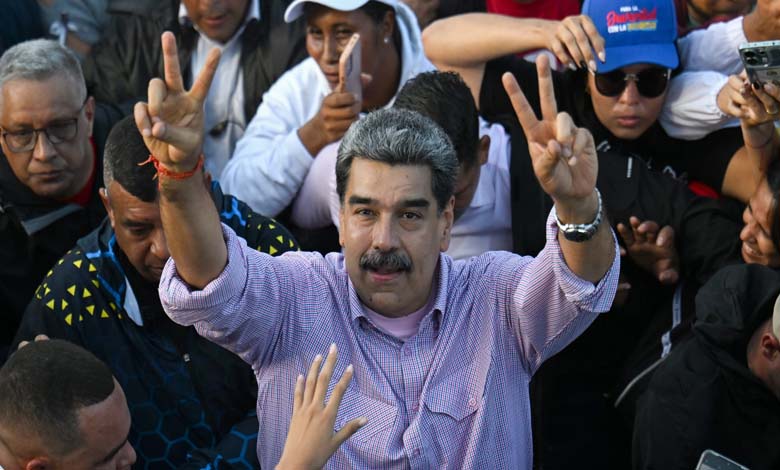
On Saturday, around one thousand Maduro supporters demonstrated in the streets of Caracas, holding signs reading “We want their return” and chanting “Maduro and Cilia are our family!”
-
Trump Seizes Oil Tanker off Venezuela: Pressure on Maduro Intensifies
-
The Cartel War reaches the depths of the Caribbean: Trump reveals Maduro’s offer
“There is a people here who are fighting,” said Yosleidis Arroyo, 36, during the demonstration.
Calls for daily protests in support of the ousted socialist leader have continued since the U.S. military operation on January 3 that led to his arrest and transfer to New York.
However, Saturday’s turnout remained limited despite repeated calls to demonstrate, and no prominent figure from the ruling United Socialist Party of Venezuela addressed the crowd.
The protest coincided with the anniversary of Maduro’s inauguration for a third term, following the 2024 election, which the opposition denounced as fraudulent.
State television broadcast footage of Acting President Delcy Rodríguez visiting an agricultural fair in the Petare district of Caracas, where a small pro-Maduro rally was also held. Rodríguez stated: “We will not rest for a single moment until the president returns. We will rescue him; of course we will.”
-
Fingers on the Trigger in the Caribbean: Maduro Confronts Trump’s Destroyers
-
From America First to Manifest Destiny: an ideological shift within the MAGA movement
Close contacts
Despite Maduro’s arrest, the administration of U.S. President Donald Trump has left the door open to possible cooperation with the transitional authorities that took power after him. Talks have begun to restore diplomatic relations severed in 2019 during Trump’s first term.
Trump confirmed Washington’s interest in exploiting Venezuelan oil following Maduro’s ouster and signed an executive order to protect revenues from Venezuelan oil sales.
On Friday, Venezuela announced that it had begun talks with U.S. diplomats. For its part, Washington confirmed that American diplomats had visited Caracas to discuss the reopening of the embassy.
A U.S. State Department official told Agence France-Presse on Saturday that the diplomats had left Caracas on Friday “as planned,” adding that “the Trump administration remains in close contact with the transitional authorities.”
-
Powerful explosions shake Caracas as Venezuela denounces U.S. attack
-
In 2026… Pending Items on Trump’s Foreign Agenda
Trump announced on Friday that he had canceled a second wave of attacks against Venezuela after the new leadership in Caracas expressed its willingness to cooperate with Washington.
Despite pledging cooperation with the Trump administration, Rodríguez emphasized on Thursday that her country “is neither subordinate to nor under the control of” Washington.
On Saturday, the U.S. State Department urged its citizens not to travel to Venezuela and called on those already there to “leave the country immediately,” citing an “unstable” security situation.
In a statement, the department referred to information indicating that “armed groups, known as colectivos, are setting up roadblocks and searching vehicles for evidence of U.S. nationality or support for the United States.”
Caracas responded with a statement asserting that “the American warning is based on nonexistent narratives aimed at creating the perception of a danger that does not exist,” adding that “Venezuela enjoys absolute calm, peace, and stability.”
-
A base for Iran and Hezbollah… A new accusation from Washington against Venezuela
-
After the airstrikes… the United States unveils Southern Javelin against drug trafficking
Release of prisoners
On Saturday, Trump wrote on his Truth Social platform: “Venezuela has begun, astonishingly, to release its political prisoners. Thank you!”, referring to Thursday’s announcement by the speaker of parliament and brother of the acting president, Jorge Rodríguez, regarding the release of “a large number of detainees.”
Dozens of families of imprisoned opposition figures and activists are now living in a state of anticipation and hope of reuniting with their loved ones.
Relatives of detainees are holding round-the-clock sit-ins outside prisons such as the notorious El Helicoide, run by intelligence services, or El Rodeo 1 in eastern Caracas, where AFP correspondents observed families lighting candles, praying, and holding signs bearing the names of their imprisoned relatives.
The opposition and non-governmental organizations have confirmed the release of 21 prisoners so far, out of an estimated total of between 800 and 1,200 detainees.
-
Ford in Latin America: a new escalation from Washington against Venezuela
-
Anti-smuggling operation or violation of sovereignty? U.S. airstrikes intensify across the Caribbean
-
Venezuelan fighter jets fly near a US destroyer: a provocation over the Caribbean