The United States escalates pressure on the Muslim Brotherhood in the Middle East: designation of the movement and its branches in Lebanon, Egypt, and Jordan

In a significant escalation, the United States has intensified its efforts to counter the influence of the Muslim Brotherhood in the Middle East by designating the movement’s branches in Lebanon, Egypt, and Jordan as terrorist organizations. This step forms part of a broader U.S. strategy aimed at reducing the group’s ability to operate financially and politically, cutting off its international support, and limiting its regional expansion, while protecting local societies from the exploitation of religious and political influence.
The U.S. designation imposes strict restrictions on any dealings with the movement or its branches and criminalizes the provision of financial or material support under U.S. law. It also includes the freezing of the organization’s members’ assets and enables the United States to monitor their international activities, particularly in Europe and North America, where the group maintains extensive networks of influence.
-
The United States designates the Muslim Brotherhood branches in Lebanon, Egypt, and Jordan as terrorist organizations
-
The United States tightens the noose on Lebanon’s Muslim Brotherhood with the harshest classifications : who is al-Jamaa al-Islamiya?
Political dimensions of the designation
The inclusion of the Muslim Brotherhood’s branches in Lebanon, Egypt, and Jordan on terrorism lists reflects Washington’s recognition of the group’s role in undermining internal stability and supporting armed groups in certain parts of the Middle East. In Lebanon, for instance, the Brotherhood’s branch is viewed as a tool of political influence through which the movement seeks to exert control over state institutions and impose its ideological agenda, raising concerns about the exploitation of internal unrest to advance its objectives.
In Egypt, the U.S. designation follows years of government measures against the Muslim Brotherhood, as the Egyptian state rejects any political activity by the group or support for its affiliated organizations, considering its actions aimed at overthrowing the political system and the civil state. In this context, the U.S. decision represents reinforcement of domestic efforts and international political backing for Egyptian sovereignty and stability.
-
The United States and the designation of the Muslim Brotherhood as a terrorist organization… Three steps needed to strengthen the process
-
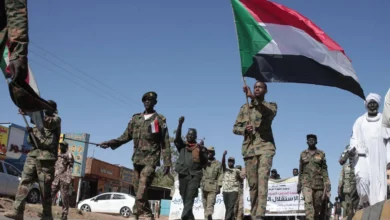
The United States is pursuing the Brotherhood’s Ahmed Haroun… What is the Sudanese army’s stance?
In Jordan, the Brotherhood’s branch poses a potential threat to internal stability due to its broad popular and political influence. Historically, the movement has relied on charitable and social channels to consolidate its presence, making the U.S. designation a preemptive step to curb any attempts to influence national policies or exploit social issues for political ends.
Security and financial dimensions
The U.S. designation of the Brotherhood’s branches enhances the ability of security agencies to monitor financial flows and ensure that international funding does not reach the movement. This comes amid growing concerns over the financing of terrorist or quasi-terrorist activities under the guise of charitable associations or educational institutions. The designation also strengthens intelligence cooperation between Washington and the three countries, enabling the exchange of information on funding networks and the movement of individuals linked to the organization.
-
72 years since the dissolution of the Muslim Brotherhood: the story behind Egypt’s Revolutionary Command Council decision
-
Classifying the Muslim Brotherhood as a Terrorist Organization: A U.S. Move Targeting International Pursuit
In addition, the designation helps limit the Brotherhood’s influence on domestic policies, particularly during periods of political and economic crisis, when the movement may seek to exploit tensions to achieve political gains at the expense of national stability.
Implications of the designation for international relations
The designation of the Muslim Brotherhood as terrorist organizations reflects the United States’ commitment to confronting what it views as ideologically driven threats to the region. It also sends strong signals to European countries and U.S. allies in the Middle East regarding the need to adopt a clear stance against financing and supporting the Brotherhood and to reduce its capacity to exert influence through international networks.
-
The Noesis project in Texas: how the Muslim Brotherhood circumvents its ban
-
Trump’s decision blows up the Muslim Brotherhood from within: factional warfare over the organization’s funds in London
Although political in nature, the U.S. move carries significant legal implications, as it exposes any engagement with the movement within the United States or through its institutions to legal accountability. This, in turn, places additional pressure on the three countries to prevent the group from exploiting international financial or legal channels to strengthen its influence.
U.S. efforts to designate the Muslim Brotherhood and its branches in Lebanon, Egypt, and Jordan represent tangible support for the national policies of these states and an expression of Washington’s commitment to confronting organizations that threaten internal and regional stability. The designation disrupts funding networks, restricts the group’s political maneuverability, and undermines its instruments of influence within local societies. At the same time, the decision reflects a deep awareness on the part of the United States of the nature of the threat posed by the Muslim Brotherhood to political and security stability in the Middle East, and underscores the importance of international cooperation in countering groups that seek to transform social and political conflicts into tools for ideological expansion.
-
2025: The Year of the International Siege of the Muslim Brotherhood – An Unprecedented Clampdown to Curb the Movement’s Influence
-
The Muslim Brotherhood in 2025… A Year of Decline and International Constriction
-
The Muslim Brotherhood’s infiltration in America: a silent strategy eroding society from within
-
Congress opens fire: the Muslim Brotherhood placed on the US terrorism list
-
The Muslim Brotherhood as a Global Terrorist Organization: US House Committee Approves Bill