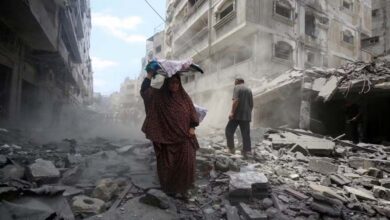
A Box for Bones: In Gaza, a Palestinian Man Gathers His Family’s Remains Piece by Piece
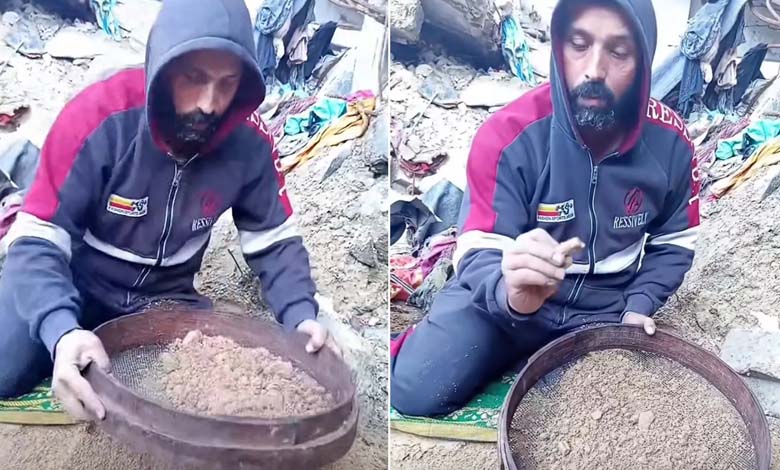
Amid rubble that has become his family’s grave, Mahmoud Hammad digs with his bare hands in search of the bones of those he lost, clinging to a fragment of hope that may bring him back to his wife and children buried under Israeli bombardment in the Gaza Strip.
In recent days, Mahmoud says he has been “fortunate.” Small bones appeared before him, which he believes belong to the fetus his pregnant wife was carrying when an Israeli airstrike targeted the family building more than two years ago, killing his wife and their five children.
-
Israel kills four Palestinian militants in Gaza
-
Gaza between shelling and rubble: death renewed beneath the debris
Mahmoud placed the bone fragments in a box where he gathers everything he has found after months of digging alone through the ruins, using pickaxes, shovels, and his bare hands.
“I will not find them all,” he told The Associated Press in a broken voice.
According to Gaza’s Ministry of Health, about 8,000 people remain buried beneath the rubble of homes destroyed by Israeli bombardment during the war that erupted following Hamas’s October 7, 2023 attack, which has resulted in more than 70,000 Palestinian deaths.
While air and ground strikes raged, recovering most bodies in Gaza was nearly impossible. Since the ceasefire agreement last October, recovery efforts have intensified despite a severe shortage of heavy equipment.
-
Emerging from underground: Israeli manhunt for five gunmen in southern Gaza
-
Unprecedented Israeli Acknowledgment of a Heavy Death Toll in Gaza
Live Together or Die Together
At around 11:30 a.m. on December 6, 2023, an Israeli strike hit a six-story building housing the Hammad family and his brother’s family in the Al-Sabra neighborhood of Gaza City.
Mahmoud, 39, had just left his apartment heading upstairs, while his wife Naama, nine months pregnant, and their five children, aged 8 to 16, were finishing breakfast.
In the days before the strike, the Israeli army had dropped leaflets ordering residents to evacuate to the southern half of the territory. Mahmoud refused to leave.
His wife and children temporarily moved to her parents’ home in Jabaliya in northern Gaza, while he remained alone in the apartment.
-
Hamas’s plan ahead of disarmament talks: integrating its police forces in Gaza
-
Gaza without hostages… Israel searches for answers for the day after
However, Naama insisted on returning. He tried to persuade her otherwise, but on December 5 he found her and the children at his door.
“Either we live together… or we die together,” she told him. “They died… and I remained,” Mahmoud said.
His brother, his brother’s wife, and their four children were also killed.
Mahmoud was taken to a nearby clinic suffering from fractures to his chest, pelvis, and knee, along with internal bleeding.
Neighbors managed to retrieve the body of his eldest son, Ismail, and two of his brother’s children. The others remained beneath the rubble.
-
A meticulously crafted ruse: the details of a nerve-racking operation that brought back an Israeli soldier from Gaza
-
Head of the Gaza Administration Committee announces the opening of the Rafah crossing next week
Digging Through the Ruins
After partially recovering, Mahmoud returned to the devastated site and built himself a simple shelter beside it.
“I stayed with them… my wife and my children… in the rubble. I spoke to them every day. Their scent was there, and I felt connected to them,” he said.
He asked civil defense teams for help, but no one came, either due to ongoing bombardment or lack of machinery. He began digging alone.
He dismantled collapsed ceilings and walls into small stones, filling dozens of sacks that now surround the site like a barrier.
-
Buffer zone or Israeli annexation? The yellow line threatens Gaza
-
Israel issues first evacuation order in Gaza since the ceasefire
In March 2024, he found remains he believes belong to his family: “Small bones with bits of flesh… some had been eaten by animals.”
In late 2024, he reached his brother’s third-floor apartment and found his brother’s body and that of his wife. He buried them in a temporary cemetery established by residents during the war.
Since last October, he has resumed digging, descending nine meters underground until reaching his own ground-floor apartment. He focused on the eastern side, where his wife had been in her final moments.
-
Gaza: dawn strikes test what remains of displaced people’s patience
-
The yellow line on the ground differs from the maps… images reveal the terror in Gaza
“They were eating muhallabieh in the living room,” he recalled.
Using a sieve, he found tiny bone fragments. He sent photos via WhatsApp to a doctor, who told him they appeared to belong to an infant, including part of a jawbone.
Mahmoud believes they are the remains of the daughter they had been expecting, whom they planned to name Haifa, after his brother’s wife who had been killed weeks before the strike.
“We had prepared her clothes, her crib, and her room. Everyone was waiting for her arrival,” he said.
-
Invitations and announcement of participants: developments in the Gaza Peace Council
-
Washington close to forming a Palestinian committee to administer the Gaza Strip
A Glimmer of Hope
Finding these fragments restored a small glimmer of hope: “This is proof that I am getting closer to my wife and my other children.” “When I gather enough remains, I will give them a proper burial.”
61 Million Tons of Rubble
Zaher Al-Wahidi, head of records at the Ministry of Health, said that since the ceasefire began, more than 700 bodies have been recovered from beneath the rubble.
Each body is added to the war’s death toll, which now exceeds 72,000 according to the ministry.
-
Circulating formation of the Gaza Administration Committee: 15 members headed by Ali Shaath
-
Gaza submerged by destruction and rain
The war began after Hamas’s October 7, 2023 attack on southern Israel, which killed around 1,200 people and resulted in the capture of 251 hostages, all of whom were later released.
Israeli bombardment has destroyed or damaged 81 percent of Gaza’s 250,000 buildings, including schools, hospitals, and homes, according to a United Nations analysis of aerial imagery.
Gaza is now considered one of the most devastated places on earth, with 61 million tons of rubble — equivalent to 15 Great Pyramids of Giza or 25 Eiffel Towers, according to the United Nations.
Debris removal efforts are hindered by restrictions on the entry of bulldozers and heavy machinery.
In more than half of the territory, under Israeli military control, rescue operations are impossible, as the army continues demolitions and ground-leveling operations, reducing the chances of finding the missing.
-
Shelter in Gaza: a battle for survival after the war
-
Israel and the ban on relief organizations in Gaza: a UN alarm and calls to reverse the decision
-
Israeli media reveal approval of three countries to send forces to Gaza