A difficult challenge: execution of Palestinian prisoners tested before the Israeli Supreme Court
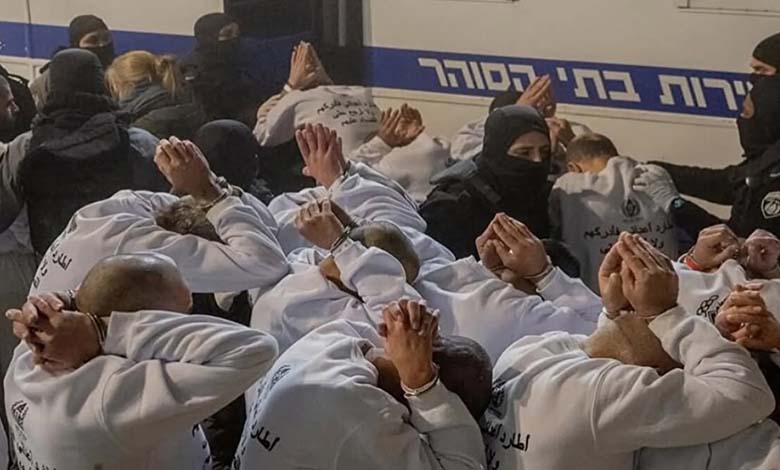
After its final approval by the Knesset, the law providing for the execution of Palestinian prisoners now faces the challenge of withstanding review by the Cour suprême d’Israël, which Israeli legal experts expect may call for its annulment.
In the third and final reading, the bill submitted by the “Jewish Power” party, led by National Security Minister Itamar Ben-Gvir, was approved by 62 Knesset members, while 48 opposed it and one abstained.
Israeli Prime Minister Benjamin Netanyahu voted in favor of the bill, while opposition leader Yair Lapid and former Chief of Staff Benny Gantz voted against it.
Withstanding legal scrutiny
The law must now withstand review by the Israeli Supreme Court, which legal experts believe may demand its cancellation.
Arab lawmakers condemned the law. The Hadash–Ta’al parliamentary bloc announced that it would submit a petition, together with the Adalah Center, to the Supreme Court to have the law overturned.
They stated: “We strongly condemn the Knesset’s approval on Monday of the law on the execution of prisoners. This law is not merely a punitive tool, but an official declaration of the institutionalization of racism and the transformation of the judicial system into an instrument of political and ethnic repression.”
They added: “This law was clearly designed to apply only to Palestinians, using definitions that ensure the prosecution of Palestinian convicts while excluding settlers and Jews who commit murder and acts of terrorism against Palestinians. This blatant discrimination proves that Palestinian blood is treated as expendable in the alleged ‘rule of law’ system.”
Israeli legal experts say the law will not withstand a petition before the Supreme Court because of its explicit wording stating that it applies only to Palestinians, as well as the clause denying the possibility of appeal.
According to lawyers, the law also contradicts international treaties signed by Israel, as it applies to Palestinians living in territories occupied by Israel in the West Bank and half of the Gaza Strip.
Israel’s Channel 12 quoted Dr. Amir Fuchs of the Israel Democracy Institute as saying that “there will be a constitutional problem.”
He added: “Nowhere in the democratic world is there a mandatory death penalty; there must always be judicial or prosecutorial discretion when seeking such a sentence.”
He continued: “Courts tend to invalidate such provisions, because even in democratic countries that impose the death penalty, it is not automatic.”
Referring to the fact that it applies only to Palestinians, he added: “This clause cannot withstand legal review because of the issue of discrimination, especially in the context of a crime punishable by death.”
The Association for Civil Rights in Israel filed a petition with the Supreme Court against the law, noting that the death penalty is inherently unconstitutional due to the severe and irreversible violation of the right to life.
The petition states that “the law creates two parallel tracks, both designed to apply only to Palestinians. In military courts — which have jurisdiction over Palestinians in the West Bank — the law imposes a mandatory death penalty with an extremely narrow exception, allows it to be imposed by a simple majority (instead of unanimity), and strips the military commander of the authority to grant clemency, thereby depriving the accused of fundamental safeguards and the ability to prove innocence.”
The petition also challenges the legal authority of the Knesset to impose its legislation beyond its sovereign borders, asserting that “the Knesset has no authority to enact laws applicable in the West Bank, which is an occupied territory under international humanitarian law and falls under the sole legislative authority of the military commander. Any attempt to bypass this constitutes an unlawful de facto annexation.”
The petition further states that “the law gravely violates human rights, is incompatible with democratic values, and was enacted for retaliatory and racially discriminatory motives,” warranting its annulment.
Given the law’s immediate entry into force and the serious human rights violations it may cause, the association asked the Court to issue an injunction suspending the law and to schedule an urgent hearing.
Suhad Bishara, director of the legal unit at the Adalah Center, said the law “legitimizes deliberate, cold-blooded killing in circumstances where the convicted person poses no real danger. It is legislation based on ethnic discrimination that directly violates the principle of equality.”
She added: “Applying Israeli domestic law to residents of the West Bank constitutes a clear violation of international law, as the Knesset, under the Hague Convention, has no authority to legislate for populations under occupation.”
The Israeli newspaper Haaretz reported that “the law is now in effect in any area effectively controlled by Israel, including the West Bank and 53 percent of the Gaza Strip.”
What do we know about the law?
The law stipulates that the Minister of Defense shall order the commander of Israeli army forces in the region to amend the security regulations applicable in the West Bank so that any resident of the region, except an Israeli citizen or a resident of Israel, who intentionally causes the death of a person in the context of a terrorist act shall be sentenced only to death, unless the military court finds special circumstances justifying a life sentence.
It also stipulates that the commander of Israeli forces in the region has no authority to pardon, commute, or cancel a death sentence issued for this offense.
The law specifies that it applies only to Palestinians and not to Jews accused of killing Palestinians, and that “anyone who causes the death of a person with the aim of denying the existence of the State of Israel in circumstances of a terrorist act shall be sentenced either to death or to life imprisonment.”
According to the law, execution shall be carried out by hanging within 90 days of the final ruling, with the Prime Minister authorized to request a postponement for special reasons for a total period not exceeding 180 days.
The law also does not authorize the government to order the release of any person convicted, suspected, or accused of an offense punishable by death.
It provides for amendments to prison regulations concerning the conditions of solitary confinement for those sentenced to death, restrictions on access to them, and the confidentiality of the execution.
The explanatory notes to the law state: “Penal Code No. 5737-1977 provides for life imprisonment for the crime of murder. Experience has shown that this sentence does not deter terrorists, many of whom assume their sentence will be significantly reduced in exchange deals. Many have returned home and resumed terrorist activities after their release. Since imprisonment is not sufficiently deterrent, it is proposed to establish the death penalty for terrorists who commit murder, in order to prevent further terrorist acts.”