After Maduro’s arrest… could Don Roe become a substitute for the Monroe Doctrine?
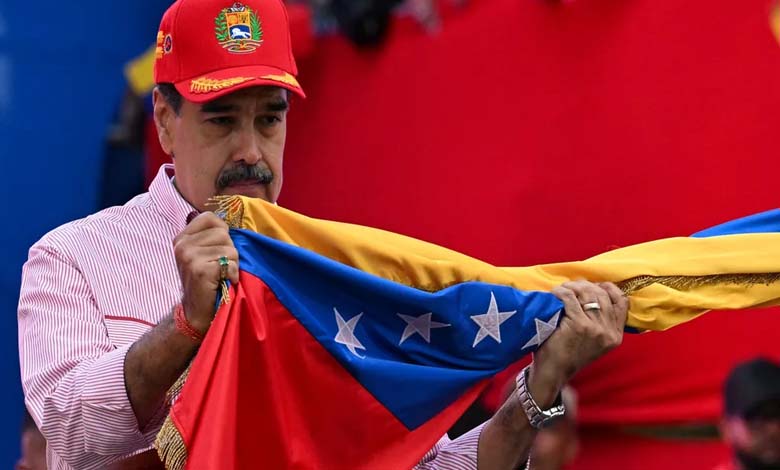
Why has the Monroe Doctrine resurfaced now? The question emerged after the arrest of Venezuela’s president, which Donald Trump justified by invoking the doctrine — a move that sparked wide debate.
While explaining the U.S. military operation that led on Saturday to the arrest of Venezuelan President Nicolás Maduro, President Donald Trump referred to the Monroe Doctrine, a principle that has shaped U.S. foreign policy for nearly two centuries.
The original aim of the doctrine, formulated in 1823 by the fifth U.S. president, James Monroe, was to oppose any European intervention or expansion in the Western Hemisphere. Since then, it has repeatedly been used by later presidents to justify U.S. involvement in the region, according to the Associated Press.
“Don Roe”
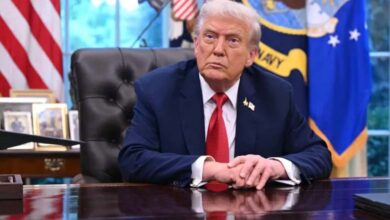
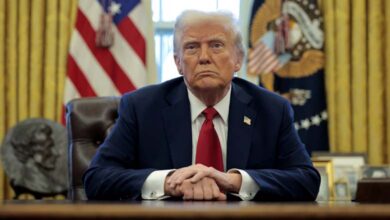
On Saturday, the forty-seventh U.S. president cited this influential doctrine as one of the partial justifications for arresting a foreign leader and bringing him to trial in the United States. Trump even joked that some now call it the “Don Roe Doctrine.”
Political scientists say this reference reflects a recurring pattern in U.S. history: the Monroe Doctrine is continually reinterpreted and adapted to fit current foreign-policy priorities — including Trump’s assertion that Washington will temporarily run Venezuela’s affairs until a suitable replacement for Maduro is found.
Below is a look at the Monroe Doctrine, how it has been invoked over time, and how it influenced Trump’s decision-making, according to the Associated Press.
What is the Monroe Doctrine?
The Monroe Doctrine was proclaimed in 1823 in an address by President James Monroe to Congress. Its goal was to prevent European powers from recolonizing newly independent states in the Western Hemisphere, while the United States pledged not to interfere in European affairs.
At the time, many Latin American nations had only recently gained independence from European empires. Monroe wanted to stop Europe from regaining control and to assert American influence across the hemisphere.
Jay Sexton, a history professor at the University of Missouri, notes that Venezuela has long been central to the doctrine’s applications, explaining that crises in the country have often served as a pretext to broaden its interpretation.
Sexton — author of “The Monroe Doctrine: Empire and Nation in Nineteenth-Century America” — says Venezuela has historically been a spark for many developments tied to the doctrine, from the late nineteenth century through Trump’s first administration.
He adds that, in the nineteenth century, Venezuela was divided and conflict-ridden, with strained relations with foreign powers while also seeking ties with U.S. rivals.
From the “big stick” to the Cold War
The Monroe Doctrine initially received little attention in Europe, but it later became a justification for repeated U.S. military interventions in the region.
Its first real test came when France installed an emperor in Mexico in the 1860s, only to withdraw under U.S. pressure after the Civil War.
In 1904, President Theodore Roosevelt expanded the doctrine through what became known as the “Roosevelt Corollary,” granting the United States the right to intervene in unstable Latin American countries. It was later used to support Panama’s separation from Colombia and to secure U.S. control over the Panama Canal.
During the Cold War, the doctrine was invoked as a defense against communism — from the 1962 demand that Soviet missiles be removed from Cuba to the Reagan administration’s opposition to the left-wing Sandinista government in Nicaragua.
An old doctrine with new pretexts
Gretchen Murphy, a professor at the University of Texas, says Trump’s reference to the Monroe Doctrine aligns with how his predecessors used it — including Roosevelt, who, she argues, claimed it could be broadened to justify interventions designed not to protect Latin American countries from Europe, but to monitor them and ensure their governments served U.S. commercial and strategic interests.
Murphy, author of “Hemispheric Imaginings: The Monroe Doctrine and Narratives of U.S. Empire,” believes Trump is repeating this familiar pattern: invoking the Monroe Doctrine to justify interventions that undermine genuine democracy and advance a range of interests, including economic ones.
What did Trump say about the Monroe Doctrine?
Trump defended Maduro’s arrest by arguing that Venezuela, under his rule, hosted “foreign adversaries” and possessed offensive weapons threatening U.S. interests — calling this a blatant violation of long-standing U.S. foreign-policy principles.
He added that under the new national-security strategy, no one would question U.S. dominance in the Western Hemisphere anymore.
“We want to surround ourselves with good neighbors, with stability, with energy. There is tremendous energy in that country,” he said.
Are we witnessing a “Trump corollary”?
The U.S. administration defended Washington’s temporary management of Venezuela as an extension of the “America First” philosophy, incorporating what it called the “Trump Corollary to the Monroe Doctrine” into its national-security strategy to restore American supremacy in the region.
Sexton notes that U.S. presidents have long wrapped their political agendas in new interpretations of the doctrine, predicting that this trend may evolve into what could be considered an independent “Trump Doctrine.”
Possible repercussions
Analysts believe the military operation that resulted in Maduro’s arrest — and any prolonged U.S. involvement that follows — could trigger divisions within Trump’s political base, especially among those who oppose “endless wars.”
Sexton warns that such an intervention could turn into a complex crisis that contradicts promises to withdraw from foreign conflicts — potentially placing the Trump administration before a new domestic political test.