Hamas presents a new proposal regarding its weapons… and reveals the candidate to administer Gaza
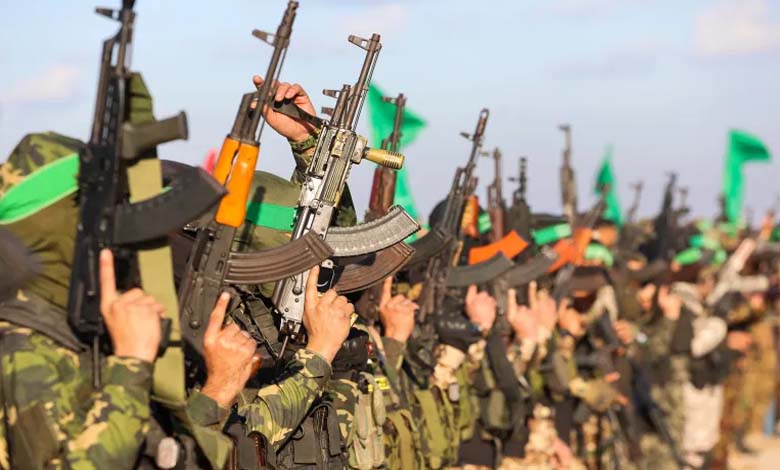
Hamas has put forward a new proposal concerning the future of its weapons as part of ceasefire negotiations.
A senior Hamas official told the Associated Press that the movement is willing to discuss “freezing or storing” its weapons arsenal as part of a ceasefire agreement with Israel, offering a possible formula to resolve one of the most sensitive issues in the agreement brokered by the United States.
The statement, made by Bassem Naim, a member of Hamas’s political bureau, comes as both sides prepare to move into the second — and more complicated — phase of the agreement.
Naim told the Associated Press: “We are open to a comprehensive approach to avoid further escalation or any clashes or future explosions.”
The agreement reached last October ended a two-year Israeli war on the Gaza Strip, sparked by Hamas’s attack on 7 October 2023.
Since the truce took effect in October, Hamas and Israel have carried out multiple prisoner exchanges, with hostages freed in return for Palestinian detainees. The remains of a single hostage are still held in Gaza — an Israeli police officer killed in the 7 October attack — as both sides prepare for phase two.
The new phase aims to outline the future of war-torn Gaza. It is considered more difficult, as it addresses issues such as deploying an international security force, forming a Palestinian technocratic committee in Gaza, withdrawing Israeli forces from the territory, and disarming Hamas.
An international body led by US President Donald Trump is expected to oversee implementation of the agreement and the reconstruction of Gaza.
Israel’s demand that Hamas lay down its arms remains extremely difficult, Israeli officials calling it a key requirement that could hinder progress on other fronts.
Hamas’s ideology remains deeply rooted in what it calls “armed resistance” against Israel, and its leaders have rejected calls to surrender despite more than two years of war that have left large parts of Gaza in ruins and killed tens of thousands of Palestinians.
Naim said Hamas maintains “its right to resistance,” but added that “the movement is ready to lay down its weapons as part of a process aimed at establishing a Palestinian state.”
He provided few details on how this could be achieved but suggested a long-term truce of five to ten years to allow for discussions.
Regarding its weapons, he said: “We can discuss freezing, storing, or abandoning them, with Palestinian guarantees that they will not be used at all during the ceasefire or the current truce.”
It is unclear whether the offer will meet Israel’s demand for complete disarmament, as many questions remain.
The ceasefire is based on a 20-point plan presented by Trump with international guarantor states last October.
The plan, adopted by the UN Security Council, outlined a general path forward but remained vague regarding details and timelines, requiring difficult negotiations involving the United States and guarantor countries such as Qatar, Egypt, and Turkey.
One of the most urgent issues is the deployment of the international force. Some countries — including Indonesia — have expressed readiness to contribute, but its composition and mandate remain undefined.
Regarding this force, Naim said it could monitor the agreement at the borders but should not operate inside Palestinian territory.
He added: “We welcome an international force that monitors violations and prevents escalation, but we do not accept that it exercises any authority inside the Gaza Strip.”
In a sign of progress, Naim revealed that Hamas and the Palestinian Authority have agreed on the president of the new technocratic committee. He is a Palestinian minister from Gaza who lives in the West Bank, believed to be Health Minister Majed Abu Ramadan.
Israel and Hamas have accused each other of repeated violations during the first phase.
The Palestinian Ministry of Health says more than 370 Palestinians have been killed in Israeli strikes since the truce began. Israel says the strikes were carried out in response to “Palestinian violations.”
Israel reports that around 200 Hamas fighters remain in tunnels in areas under its control.
Naim said the movement “was not aware” of these fighters when the ceasefire was signed and that communication with them is “completely cut off.”
He added that Israel rejected solutions proposed by Hamas and imposed additional conditions for their surrender. Tel Aviv says it has killed dozens of them.
Naim also accused Israel of failing to meet its commitments, including insufficient humanitarian aid deliveries and not reopening the Rafah crossing.
The 7 October attack resulted in more than 1,200 Israelis killed and over 250 abducted. It remains the deadliest attack in Israel’s history.
The Israeli war on Gaza has killed more than 70,000 Palestinians, displaced around two million people, and destroyed vast areas of the territory.
Asked whether the attack was worth such a heavy human toll, Naim replied: “History does not begin on 7 October,” describing it as a “defensive act” in response to “policies spanning decades.”