Icons on tracks: The story behind the names of American tanks
Since the roar of the first tank echoed across the battlefield, these machines have never been mere instruments of war. They have become steel archives, carrying the names of men who shaped history.
With every new generation of American tanks, the symbolic bond between steel and the commanders whose careers outlived their eras was renewed, turning their names into moving icons on tracks, bearing the legacy of the battles they fought or the doctrines they shaped.
How did the tradition of naming tanks after generals begin?
This tradition did not originate in the United States but in the United Kingdom.
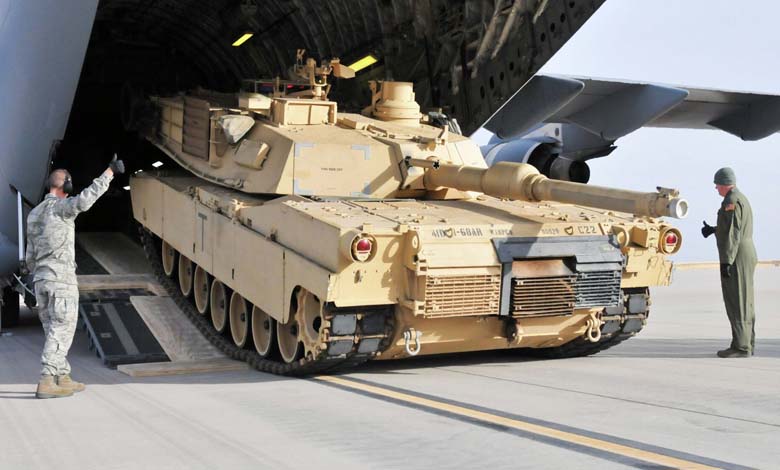
The American main battle tank M1 Abrams entered service in 1980. Thanks to its extensive upgrades and ongoing modernization, it is almost certain to remain the primary U.S. tank into the 2040s, giving it a service life that may reach sixty years or more, according to The National Interest. That is roughly two decades longer than the thirty-eight years served by General Creighton Abrams, who commanded U.S. forces during the final phase of the Vietnam War.
Abrams, a heavy cigar smoker who died days before turning sixty, would likely have regarded a tank bearing his name as a significant honor, especially one with such an impressive operational record.
The M1 Abrams was also the newest in a long line of American tanks named after prominent generals.
Do all tanks carry the names of generals?
According to The National Interest, not all tanks are named after generals, but every vehicle named so far has borne the name of a high-ranking military figure.
This tradition began with the development of the M3, largely thanks to the British. At the time, the U.S. Army did not feel the need to give its ground vehicles personal names. The American version of the French Renault FT was simply designated M1917, followed by the light tank M1, the combat car M1, and the light tank M2.
Things changed when the British, in urgent need of tanks, purchased the medium M3 and gave it a name.
There were two versions of the M3: one with an American turret, named Lee by the British after Confederate General Robert E. Lee; the other with a British turret, named Grant after Union General Ulysses S. Grant.
The exact reason for choosing Lee and Grant is unclear, but it is evident that the British wanted to honor American military commanders—though not those who had fought against them, like Nathanael Greene, Horatio Gates, or Henry Knox.
The British continued this approach by naming the light M3 (and later the M5) after Confederate cavalry commander J. E. B. Stuart, famed for his daring mounted operations. The name fit well, as the tank excelled in reconnaissance missions.
The medium M4 received the now legendary name Sherman, after Union General William Tecumseh Sherman. Following America’s entry into World War II, Sherman tanks became essential on the battlefields of Africa, Italy, and Europe, and even in Eurasia, where they reached the Soviet Union through the Lend-Lease program.
The last World War II tank named after an American general was the M24 light tank, named in honor of General Adna R. Chaffee Jr., known as the father of the U.S. Armored Force.
The tradition continues
The U.S. Army later embraced this practice, naming tanks after generals. The first was the M26 Pershing, which entered service in the final months of World War II and then in the Korean War, named after General John J. Pershing, commander of the American Expeditionary Forces in World War I.
The heavy M103 did not receive a name, but the Army honored General George S. Patton by naming the M46, M47, and M48 tanks after him. The M60, though not officially called Patton, is widely considered a continuation of that series.
In the 1950s, the light tank M41 Walker Bulldog was named after General Walton Walker. Previously known as the “little bulldog,” it was renamed after Walker’s death in a jeep accident, particularly because he himself had been nicknamed “the bulldog” for his determined leadership during the Korean War.
The Army later returned to the Civil War era when it named the air-droppable armored vehicle M551 Sheridan after General Philip Sheridan.
The Bradley: the exception that proves the rule?
Tanks are unique among U.S. Army ground vehicles in consistently receiving names. Most other vehicles are identified only by numerical designations.
Yet the M2 Bradley infantry fighting vehicle was named after General Omar Bradley, even though it is not a tank. The exact reasoning is unclear, but it is believed that
Bradley’s death in 1981 coincided with a long period of technical criticism surrounding the vehicle, which lasted seventeen years. The name may have helped ease public and political pressure.
Finally, the assault vehicle M10 Booker—later canceled—was another exception. It was named after two soldiers who were not generals. This may have been a deliberate effort to persuade lawmakers that it was not truly a “light tank,” since tanks are usually named after generals.