International force for Gaza: key details still unresolved after the Doha meeting
Details surrounding the international stabilization force for Gaza remain unresolved, despite the approaching date for announcing its establishment and operational mechanisms.
The anticipated meeting between US President Donald Trump and Israeli Prime Minister Benjamin Netanyahu on December 29 in Florida is expected to be decisive on this issue.
According to the Israeli newspaper Yedioth Ahronoth, “uncertainty prevails following the Gaza force summit, as the United States seeks concrete commitments.”
-
Rainwater floods Gaza’s largest hospital
-
They Were Celebrating Inside a Tunnel in Gaza… Video of Deceased Hostages Sparks Anger Against Netanyahu
The paper quoted Western diplomats as saying that “essential details of the proposed stabilization force in Gaza remain unresolved, including its mandate, deployment areas, and rules of engagement, while Washington aims to deploy it as early as January.”
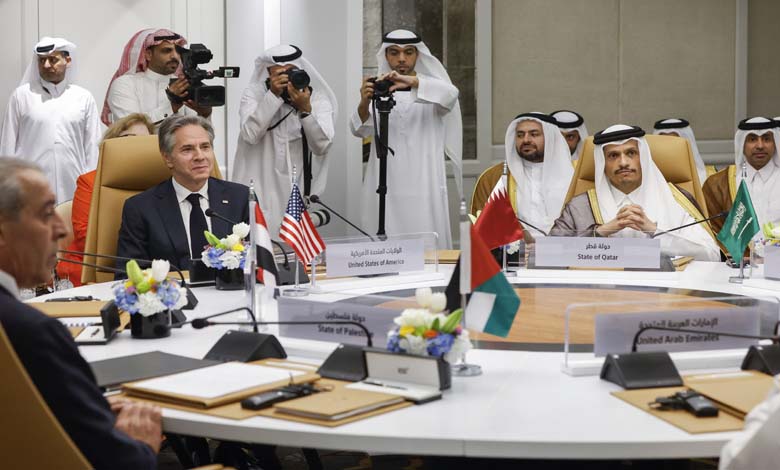
On Wednesday, the US Central Command (CENTCOM) chaired a meeting in Doha attended by representatives from around 45 invited countries to discuss the establishment of an international stabilization force tasked with overseeing the ceasefire in Gaza.
Israel was not invited to the meeting, as it would not be part of the force to be deployed in areas from which the Israeli army would withdraw during the second phase of the Trump plan to end the war in Gaza.
-
Trump Plans to Appoint a U.S. General to Lead the International Force in Gaza
-
Control and surveillance: What are American AI companies doing in Gaza?
Meeting details
Yedioth Ahronoth reported that “the United States presented its initial plans for the force and asked participating countries to specify their potential contributions, whether in troops, funding, or training. Another meeting is scheduled for January.”
Western diplomats also indicated that “the structure of the international stabilization force remains unclear, and Washington is still assessing the readiness of countries to take part. Roles have not yet been definitively assigned.”
The newspaper added that “European Union representatives proposed expanding the current training program for the Palestinian police in the West Bank to include members of the international stabilization force to be deployed in Gaza in the future.”
-
Gaza buried under 68 million tons of rubble… and a shocking reconstruction timeline
-
Netanyahu criticizes Washington’s efforts to deploy an international force in Gaza
It further noted that “countries under consideration for potential contributions include Indonesia, Azerbaijan, Pakistan, and Bangladesh. Italy has also expressed interest, but may focus on training rather than troop deployment.”
Reports suggest that the United States is holding talks with between 15 and 20 countries regarding possible support for the force.
Some countries remain concerned about the risk of direct confrontations with armed groups in Gaza or with Israeli forces.
Rules of engagement, armament guidelines, deployment locations, and training sites have yet to be finalized.
-
A critical phase begins… Mediators reveal developments in the second phase of the Gaza agreement
-
Rising tensions in Gaza revive questions about the durability of the truce
Yedioth Ahronoth stated that “Turkey was not invited to the meeting due to Israeli objections,” while noting that “although US officials have not ruled out Turkish participation in the international stabilization force, reports indicate that Ankara is exerting active pressure on other countries to refrain from participating.”
The newspaper added that “officials expect the formation of the force to begin in January. It is likely to train in a third country in the region before being initially deployed in the Rafah area, within what is known as the ‘yellow line,’ an area defined by Israel and under Israeli military control.”
It also reported that “the United States hopes to appoint an American general as commander, with General Jasper Jeffers, who previously oversaw the ceasefire monitoring team in Lebanon, among the leading candidates.”
-
US pressure pushes Israel to bring debris-removal equipment into Gaza
-
Gaza hospitals face severe shortages of medical supplies as Israeli attacks continue
Fifteen countries absent
Meanwhile, the Israeli newspaper Haaretz reported, citing informed sources, that Azerbaijan does not intend to participate in the international stabilization force in Gaza, despite its diplomatic relations with Israel.
The paper said that “according to a list obtained by Haaretz from diplomatic sources, Azerbaijan was not the only country to decline the invitation to the Doha conference. Around fifteen invited countries refrained from sending representatives, including Turkmenistan and Tajikistan from Central Asia, several European countries such as Belgium, Romania, and Estonia, as well as East Asian countries including South Korea and Nepal.”
It added that “countries that attended the conference included Germany, the United Kingdom, France, Morocco, Bahrain, Jordan, Egypt, Saudi Arabia, Kazakhstan, Uzbekistan, Greece, Cyprus, Yemen, Bosnia and Herzegovina, and Kosovo.”
-
Behind the scenes of the international force in Gaza: full details revealed
-
Gaza Agreement… 5 U.S. steps expected after the UN Security Council resolution