Orechnik: a Russian deterrence message to Europe at 8,000 miles per hour
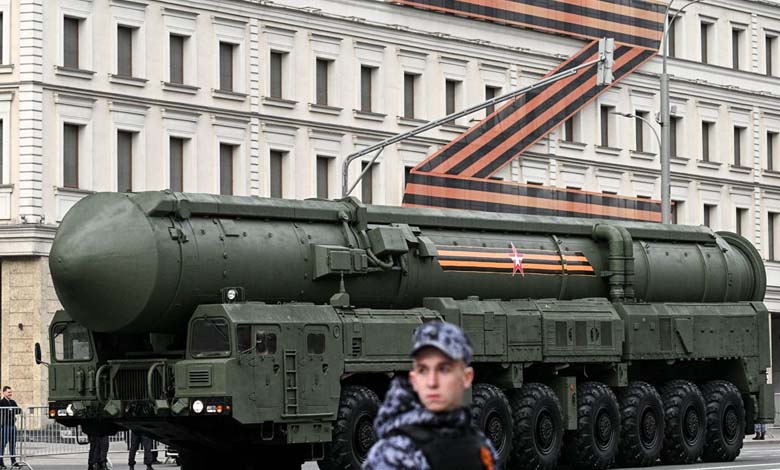
Days after European leaders agreed to provide post-war security guarantees to Ukraine, Russia sent a direct message to Europe by launching a missile into Kyiv, near the Polish border, capable of carrying nuclear warheads.
The message arrived “loud and clear” through the sky at a speed of 8,000 miles per hour, according to The New York Times.
-
The “Orechnik” Surprise: The Russian “Terrifying” Missile Pulses with a Western Heart
-
The world’s first autonomous fighter: a technological leap and an ethical dilemma
Early Friday morning, and for only the second time since the start of Russia’s military operation in Ukraine, Moscow fired an Orchnik missile capable of carrying nuclear warheads. The weapon is a hypersonic, medium-range ballistic missile that had until recently been banned under an international treaty.
The missile struck a military site in western Ukraine and reportedly caused only limited damage, leaving no more than two insignificant craters in the frozen ground. However, analysts and political officials argue that the real target of the attack went far beyond Ukraine and was aimed at Kyiv’s European allies.
-
Strategic Bombers: A US-Russia-China race on the front line
-
Flying Chernobyl: Russia Preparing to Test Doomsday Missile
The site hit lies about 40 miles from the Polish border. Poland is a member of NATO, as are the United Kingdom and France, both of which announced this week their readiness to deploy forces to Ukraine to ensure peace after the war ends.
If such a deployment were to take place, those forces would most likely be stationed in the very region targeted by Russia on Friday, according to the American newspaper.
-
Nuclear War Message: The Soviet Dead Hand Confronts America’s Doomsday Missile
-
Russia’s Summer of Fury: How Will Putin Respond to Spider Web?
Moscow has repeatedly stated, including in remarks by the Russian Foreign Ministry’s spokeswoman on Thursday, that any NATO forces on Ukrainian soil would be considered legitimate military targets. By launching the Orchnik missile, whose range covers most of Europe, Moscow demonstrated how it could carry out that threat both inside and beyond Ukraine.
The message was further intensified by the missile’s ability to carry nuclear warheads, at a time when strong European support for Ukraine has prompted President Vladimir Putin to say that Europe has effectively declared war on Russia.
-
Broadcasting the Apocalypse Signal: Mysterious Messages Hint at a Russian Superweapon
-
Russian Invisibility Cloaks: Optical Illusion or Deadly Trap?
A weapon aimed at Europe
Sergei Markov, a political analyst close to the Kremlin, said that the Orchnik missile is not a weapon for war against Ukraine, but rather a weapon of war against Europe, noting that Moscow already employs many other types of weapons in its attacks on Ukraine.
Russia’s Ministry of Defense said the strike was a response to an alleged attempt to target one of President Putin’s residences last month. Ukrainian officials, however, stated that Russia had “fabricated this attack” as part of a pattern of inventing pretexts to continue its strikes whenever U.S.-led peace talks move in directions that do not satisfy the Kremlin.
Regardless, Markov and other analysts stressed that Friday’s strike was not actually linked to any attack on a presidential residence.
-
Putin Invites Arab Leaders to Participate in the First Russian-Arab Summit in October
-
Weapon Tests Precede Russian Official’s Visit… Kim’s Messages to Allies and Enemies
They explained that it was directly connected to the security commitments agreed upon by European governments in Paris earlier this week. In addition to Britain and France announcing plans to establish “military centers” inside Ukraine after fighting ends, Germany said it would send forces to NATO countries bordering Ukraine.
Such commitments are extremely sensitive for the Kremlin, given Russia’s historical grievances against the West, its security concerns over NATO’s expansion, and its belief in spheres of influence that grant it special leverage in Eastern Europe.
For this reason, Markov said, the strike was carried out close to the border.
-
A Message and a New Tactic… Kursk, Russia, Redefines War and Truce
-
Ukraine ‘Truce’: Russia Responds to US Proposal
Welcoming the attack, former Russian president Dmitry Medvedev said it should bring Russia’s adversaries back to their senses, likening it to an injection of antipsychotic medication.
Some Russian analysts also suggested that the launch of the Orchnik missile carried a message to the administration of U.S. President Donald Trump.
Putin has repeatedly stated that Russia is in a position of strength in the war and that its army is prepared to fight until all objectives are achieved. According to these analysts, the Kremlin wants the Trump administration to understand that the war will end only if the United States and Ukraine’s European allies pressure Kyiv into making concessions.
-
Russian drones plunge Ukraine into darkness, an attack deepening winter hardships
-
Battle of Huliaipole… Russian Superiority Tightens the Noose on Ukraine
Putin has praised the Orchnik missile as a symbol of Russia’s military power and technological innovation, describing it as an unstoppable weapon in Moscow’s arsenal. The missile reaches speeds exceeding Mach 10, and Ukraine lacks air defense systems capable of intercepting it.
European and Ukrainian officials have described the missile’s use as a dangerous escalation in Moscow’s war, at a time when the United States is pushing to end the conflict. They also see it as a warning directed at all of Europe, as many leaders believe that if Ukraine were to fall to Russia, other countries could follow.
-
A year after it sank… a report reveals the nuclear secret of a Russian ship
-
Why did Europe abandon the Russian assets plan?
A strategic warning
Dmitry Stefanovich, a researcher at Moscow’s Institute of World Economy and International Relations, said the strike served as “a reminder to the entire continent of the existence of an option to deliver a strategic strike against almost any target, with limited warning, short flight time, and a low probability of interception.”
He added that the level of threat is heightened by Moscow’s ability to launch medium-range ballistic missiles from multiple locations, including neighboring Belarus.
-
Negotiations under fire: escalation in Ukraine precedes US–Russian talks
-
Russians seize the Pokrovsk lines: operational openings and potential objectives
Belarus, considered a close ally of Moscow, has hosted Russian tactical nuclear weapons since December 2023. Last month, the Kremlin released a video claiming to show the deployment of the Orchnik system in Belarus, raising serious concerns among its NATO neighbors, particularly Poland, Lithuania, and Latvia.
The missile launched on Friday is believed to have originated from another site, Kapustin Yar, near Astrakhan in southwestern Russia.
The Orchnik missile can carry conventional or dummy warheads, in addition to nuclear ones. A Ukrainian assessment indicated that the warheads used in Friday’s strike contained no explosives, suggesting that the launch was primarily intended as a political message.
-
Alliances beneath the depths: A joint British-Norwegian fleet to counter Russian submarines
-
“Shadow War”… Europe Plans an Attack on Russian “Ghosts”
Colonel Roman Kostenko, secretary of the defense and intelligence committee of the Ukrainian parliament, said that the submunitions released by the warhead were kinetic in nature, consisting of solid metal blocks without explosives, causing limited damage. However, their extreme speed gave them enough energy to penetrate buildings, vehicles, or human bodies.
Moscow first used the Orchnik missile against Ukraine in November 2024, in response to Kyiv’s use of long-range missiles supplied by the United States and the United Kingdom to strike military targets inside Russia.
In that strike as well, Russia equipped the missile with dummy warheads. Jeffrey Lewis, a nuclear weapons expert at Middlebury College, said that without nuclear warheads, the Orchnik appears to have limited military effectiveness.
-
“Strategic ‘Toretsk’ in Russian Hands… Ukraine Faces Supply Line Crisis”
-
Shahed-136: Russian drones now pose a threat to Ukrainian fighter aircraft
He added that using an expensive system, which Russia is unlikely to be able to produce in large numbers each year, to cause minimal damage underscores that the military impact was secondary to the political benefit of attempting to intimidate Europe.
According to Lewis, Putin is seeking to manipulate perceptions of nuclear risk to deter the West or discourage it from supporting Ukraine. However, with each launch of an Orchnik missile, the weapon loses some of its shock value.
-
Massive Russian attack on Kyiv… as Ukrainian drones strike oil facilities
-
Ukraine’s Funding at Risk: Russian Assets Threaten to Divide the European Union