Somali oil, Ankara’s reward for years of support
Türkiye Petrolleri Anonim Ortaklığı has launched one of the world’s deepest offshore drilling operations off the coast of Somalia.
The Turkish drilling vessel “Çağrı Bey” arrived on Friday off the coast of Mogadishu to begin Turkey’s first offshore oil exploration project outside its territory, marking a shift from soft power through financial aid to the direct exploitation of natural resources.
Turkish Energy Minister Alparslan Bayraktar described the start of drilling operations as the beginning of a new era for energy in Somalia, noting that the port of Mogadishu had previously hosted, in October 2024, a similar ceremony to receive the seismic research vessel “Oruç Reis.”
He said: “At that time, as today, an enthusiastic ceremony was held. Subsequently, our vessel Oruç Reis conducted seismic survey activities for seven months off the Somali coast, collecting three-dimensional seismic data covering a total area of 4,464 square kilometers across three different sites.”
Bayraktar explained that the seismic studies revealed a promising geological structure in the area, pointing out that Turkey ranks fourth globally among countries possessing deep-sea energy exploration fleets, thanks to its vessels “Fatih,” “Yavuz,” “Kanuni,” “Abdulhamid Han,” “Yıldırım,” and “Çağrı Bey.”
He added during the reception ceremony that the planned well would reach a depth of 7,500 meters, making it one of the deepest offshore drilling operations in the world.
Somalia’s Minister of Mineral Resources, Dahir Shire Mohamed, stated: “Today is a historic day for Somalia with the arrival of the Turkish oil exploration vessel. It represents new hope and a positive step toward benefiting from this resource.” The drilling operations are expected to last around ten months.
Turkey did not begin with oil, but with strategic anchoring. Since President Recep Tayyip Erdoğan’s historic visit to Somalia in 2011 during the famine, Ankara has built a unique model of engagement, establishing its largest military base outside its borders (“TURKSOM”) in Mogadishu, while Turkish companies operate the airport and the main port.
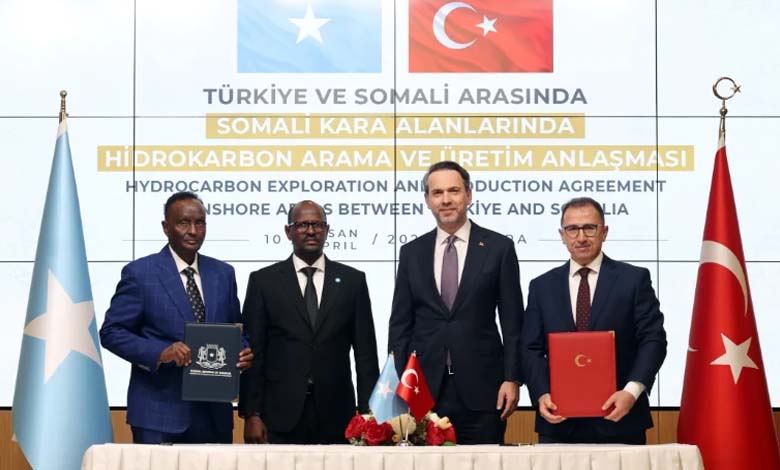
The defense and economic cooperation agreement signed in February 2024 grants Turkey the right to protect Somali territorial waters for ten years in exchange for a share of resource revenues, thereby legitimizing its military presence under the cover of resource exploitation.
The Turkish minister’s remarks about “one of the deepest drilling operations” (7,500 meters) carry multiple messages: Ankara seeks to demonstrate that it has become an “independent player” in energy technologies, capable of operating in deep waters without relying on major Western companies. The presence of a drilling vessel for ten months, protected by the Turkish navy, effectively amounts to establishing a Turkish “zone of influence” in the Indian Ocean.
While the Somali side sees this project as a “new hope” for escaping extreme poverty, analysts point to potential risks, as Somalia’s weak negotiating position may lead to profit-sharing terms that favor Ankara in order to offset the costs of military protection and previous investments.