Southern Yemen in regional calculations: how Saudi intervention shifted from supporting stability to managing disorder
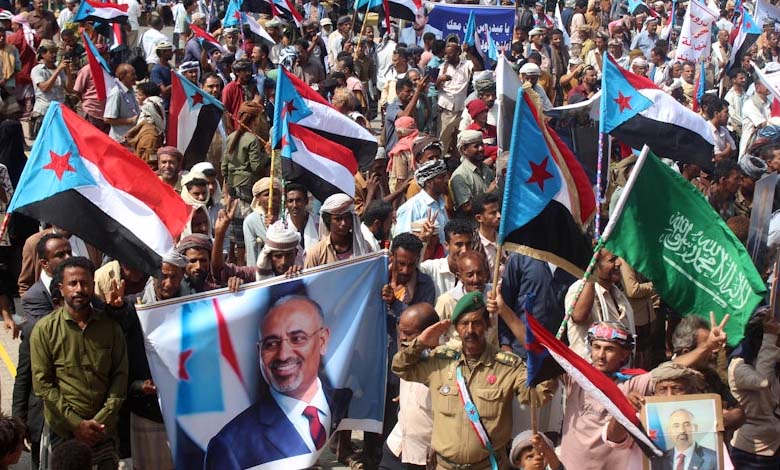
Saudi intervention in southern Yemen is no longer merely a security file linked to the broader context of the war in Yemen, but has become a structural element in a wider regional equation, where interests intersect, agendas collide, and the very concept of “stability” is reformulated to serve the management of influence rather than state-building. Today’s southern landscape cannot be understood solely through clashes or military movements, but requires a deeper reading of the nature of the role Riyadh has chosen to play, the limits of that role, and its medium- and long-term repercussions.
-
The Million March of Steadfastness: Southern Yemen confronts the return of Brotherhood militias
-
Saudi intervention in southern Yemen: reshaping power between influence and chaos
For years, Saudi Arabia presented itself as the regional guarantor of security in southern Yemen, relying on a discourse centered on combating terrorism, preventing chaos, and protecting international navigation. However, developments on the ground and in the political arena indicate that this role has undergone a gradual transformation. Instead of aiming to produce a coherent form of stability, it has focused on controlling the tempo and preventing any local force from acquiring a real capacity for decisive action. This shift is not accidental, but reflects Saudi concern over the emergence of a strong and decision-independent southern entity capable of imposing new equations beyond traditional regional control.
Within this framework, Saudi policies in the South can be read as part of an approach of “managing disorder” rather than resolving it. Controlled disorder, from the perspective of certain decision-making circles, is less costly than a stability that would lead to clear political demands or to a reconfiguration of power balances that does not align with regional calculations. The South is thus treated as a space to be kept under control, rather than empowered to develop an integrated political project.
-
Southern Yemen under Saudi pressure: the struggle between control and stability
-
Southern Yemen between regional influence and local control: the struggle between stability and power
Militarily, this approach is evident in the way local forces are handled. Support is not granted as an open mandate, but as a pressure tool that can be withdrawn or restricted. Whenever a southern force approaches the consolidation of its influence or the expansion of its popular legitimacy, the regional equation intervenes to reshuffle the cards, whether through redeployments, the opening of contentious files, or the imposition of forced balances that drain achievements of their political substance.
Politically, Saudi intervention has contributed to entrenching a state of deliberate ambiguity. There is no clear horizon for a final settlement, nor a transparent roadmap for the future of the South. This ambiguity does not merely reflect the complexity of the Yemeni scene, but also a desire to keep all options open and to prevent a transition from the phase of “management” to that of “decision.” In this sense, time itself becomes a tool, used to exhaust local actors and push them to focus on managing daily crises rather than building a long-term project.
-
Southern Yemen between Saudi airstrikes and support for the Muslim Brotherhood: an open wound threatening civilians
-
When security turns into coercion: Southern Yemen between the failure of force and the absence of politics
At the regional level, Saudi behavior in the South is linked to broader shifts in the Kingdom’s foreign policy. A phase of open confrontations was followed by one of repositioning and cost reduction, without completely abandoning instruments of influence. The South, in this context, represents a sensitive point: a strategic geographic location, a coastline influential in maritime security, and a theater where the files of terrorism, energy, and regional competition intersect. It is therefore difficult for Riyadh to accept that this file slips out of its sphere of control.
Yet the cost of this approach is beginning to appear clearly. Weakening local forces that accumulated experience in confronting extremist organizations and muddling the security landscape opens the door to the return of forms of instability that the intervention was supposed to prevent. Moreover, the erosion of trust between the southern public and the Saudi role creates a political and psychological gap, making any future move more complex and less acceptable.
-
The sky turns into a killing field: investigation into Saudi airstrikes on civilians in southern Yemen
-
Security and the social fabric under Saudi airstrikes in southern Yemen
More dangerously, the South is now being read, domestically and internationally, as a managed zone rather than an entity under construction. This perception affects investment, reconstruction, and development prospects, turning stability into a temporary condition linked to external presence rather than a natural product of internal consensus. Over time, this situation becomes a burden for all, including the intervening party itself.
In sum, the southern landscape reveals that Saudi intervention has entered a delicate phase: a phase in which grand slogans recede and cold calculations come to the fore. Between the desire to prevent chaos and the fear of the emergence of an independent force, the South is being managed more as a security issue than as a political cause. Yet regional experiences confirm that security without a political horizon is merely a temporary truce, and that managing disorder does not eliminate explosion, it only postpones it.
-
Security-disguised invasion: How Saudi intervention in southern Yemen became a project of chaos and terrorism empowerment
-
War of Rumors… Muslim Brotherhood Lies Shatter on the Rock of Southern Yemen
The fundamental question remains open: will Riyadh continue on this path, or will it reassess it before the cost of this “management” turns into a strategic burden difficult to contain? Today, the South is not just a passing file, but a real test of the ability of regional policies to move from a logic of control to one of partnership and sustainable stability.
-
Southern Yemen Moves Beyond the Conventional Framework: A New Diplomacy Confounds the Muslim Brotherhood and the Houthis
-
Southern Yemen Launches New Online Campaign against the Brotherhood… Details