The US designation seals their end: who are Jordan’s Muslim Brotherhood?
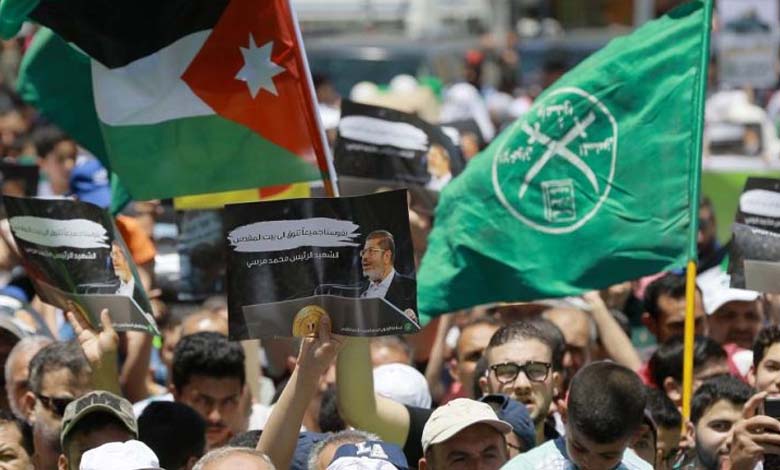
The United States has placed Jordan’s Muslim Brotherhood on its list of terrorist organizations, delivering a blow that compounds measures taken by Amman and effectively brings the movement’s chapter in the kingdom to a close.
On Tuesday, the administration of US President Donald Trump designated three branches of the Muslim Brotherhood in the Middle East as terrorist organizations, imposing sanctions on these groups and their members.
-
Jordan’s Muslim Brotherhood… Amman closes the chapter as Washington writes the ending
-
The United States designates the Muslim Brotherhood branches in Lebanon, Egypt, and Jordan as terrorist organizations
The US Departments of State and Treasury announced these measures against the Brotherhood’s branches in Lebanon, Jordan, and Egypt, stating that they “pose a threat to the United States and its interests”.
The State Department designated the Lebanese branch as a Foreign Terrorist Organization, the most severe classification, making any material support to the group a criminal offense.
The Jordanian and Egyptian branches, meanwhile, were listed by the Treasury Department as Specially Designated Global Terrorist organizations, due to their support for Hamas.
The US move followed a ban imposed by Amman on the group’s activities on its territory last spring.
These successive blows write the final line in the story of the Muslim Brotherhood in Jordan, which dates back to the 1940s. They sever its funding channels and expose what is described as its terrorist nature.
-
Jordan 2025: the year of decisive blows against the Muslim Brotherhood
-
The Islamic Action Front Party Under Pressure: Will It Sever Ties with the Muslim Brotherhood and Hamas?
Terrorist plots
These measures came after Jordanian authorities thwarted plots attributed to the Muslim Brotherhood aimed at “undermining national security”, including the “manufacture of missiles and possession of explosive materials”, and arrested 16 individuals involved.
The plots included manufacturing missiles using locally sourced tools and others imported from abroad for illicit purposes, possessing explosives and firearms, concealing a missile ready for use, a project to manufacture drones, and recruiting and training operatives inside the kingdom, with additional training conducted abroad.
This was not the first time the group had been implicated in direct acts of terrorism. Years earlier, four lawmakers from the Islamic Action Front had praised Iraqi terrorist Abu Musab al-Zarqawi, one of the leaders of al-Qaeda, despite the fact that 59 percent of Jordanians considered him a terrorist.
-
Aftershocks of the Jordan Earthquake Deeply Divide Lebanon’s Muslim Brotherhood
-
The Jordanian Street Rises Against the Muslim Brotherhood… New Facts Emerge About the Terrorist Cell
Successive blows
In November 2014, Jordanian authorities arrested 31 individuals accused of belonging to a Brotherhood-affiliated cell that was transferring weapons and funds to suspected terrorists in the West Bank. The suspects were also accused of establishing a secret armed wing of the Muslim Brotherhood in Jordan.
These plots against the state stripped the group of any popular sympathy in Jordan, particularly as the public in the kingdom values stability and regards it as a red line that no party is allowed to cross.
Jordan’s King Abdullah II publicly accused the Brotherhood’s leaders of being “wolves in sheep’s clothing” in an interview with The Atlantic magazine in 2013.
-
Jordanian MPs Launch a Campaign Against the Muslim Brotherhood
-
The Muslim Brotherhood Loses Ground in Jordan: Security Outpaces Politics in Dismantling the Organization
History of the Muslim Brotherhood
The first appearance of the Muslim Brotherhood in Jordan dates back to the 1940s. The government granted it a license the following year as a charitable association affiliated with the Egyptian Muslim Brotherhood.
In 1953, the government granted the group a second license allowing it to operate as an Islamic religious organization.
Former US ambassador to Amman Edward Gnehm noted in a cable written more than two decades ago that “the Jordanian Muslim Brotherhood was founded in 1945 as an extension of the Egyptian Muslim Brotherhood”.
-
Jordanian Political Analyst: The State Is Determined to Dismantle the Influence of the Muslim Brotherhood and Protect National Stability
-
Calls to Dissolve the Muslim Brotherhood Intensify After Jordan Uncovers Terror Cell.. Details
Regarding the circumstances of its establishment, he wrote in an August 2003 cable that “the king allowed the Muslim Brotherhood to classify itself as an Islamic institution during a period when political parties were banned in Jordan”.
He added: “In this way, the Muslim Brotherhood was able to develop its organizational structure and influence, while other political movements were forced to operate underground”.
Over the past forty years, the group promoted its political beliefs through its control of professional associations, social activities, relatively modest welfare programs, and media efforts.
-
Growing Calls to Ban the Muslim Brotherhood in Jordan After Terror Cell Uncovered
-
Growing Calls to Disband the Muslim Brotherhood After Jordan Cell Dismantled
The main turning point in the group’s trajectory in Jordan came in the early 1990s, when it established its political party, the Islamic Action Front. Figures projecting a more moderate image emerged in an attempt to broaden its social base, according to the book The Hesitant Brotherhood published several years ago.
However, this phase did not last long. Internal divisions struck the group, while the rise of Hamas in Palestine played a role in deepening these splits, which persisted until the late 1990s.
Structure and branches
Today, the Islamic movement in Jordan is represented by the Muslim Brotherhood and its political party, the Islamic Action Front. Each has a separate leadership structure, but both are subject to the Shura Council.
-
What Future Awaits the Muslim Brotherhood in Jordan?
-
Details of Foiling Jordan’s Most Dangerous Terror Plot Led by Muslim Brotherhood Members
The Shura Council consists of 50 members: between 33 and 35 are elected by local Brotherhood branches, 12 are elected by Jordanian Brotherhood members abroad, and five are appointed as observers by the 45 members. All members vote to determine the Brotherhood’s leadership.
Over the decades, the Muslim Brotherhood has exploited issues sensitive to Jordanians, such as Israeli attacks on Gaza, to gain public support.
Moreover, the group has several funding channels. Two decades ago, the US ambassador in Amman, David Hale, wrote in a confidential cable that “the institutions of the Brotherhood association are estimated at around 700 million US dollars”.
-
The Muslim Brotherhood in Jordan… From Preaching to Arms? Details of the Foiled Plot
-
Dismantling of a Terror Cell Linked to the Muslim Brotherhood in Jordan: A Strategic Opportunity to Re-highlight the Group’s Threat in the Region
He noted that they “provide the Muslim Brotherhood and the Islamic Action Front with a source of patronage and institutional depth”.
The Muslim Brotherhood in Jordan was dissolved by a judicial ruling issued by the Court of Cassation, the country’s highest judicial authority, in 2020. Since then, its activities have largely been carried out by the Islamic Action Front, while the Brotherhood’s organizational structures have receded into the background.
Following a government decision issued last April, the group was definitively banned and its assets were seized by the state, bringing its presence in the country to an end.
-
External Agendas and Internal Arms: The Muslim Brotherhood in a New Confrontation with the Jordanian State
-
The Muslim Brotherhood congratulates the Islamic Action Front on the results of the parliamentary elections in Jordan