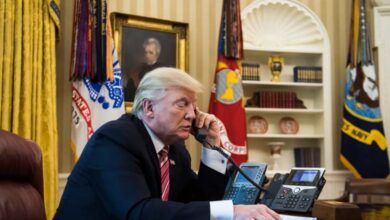
U.S. President Donald Trump threatened to destroy bridges and power stations in Iran
Iranian Foreign Minister Abbas Araghchi stated that targeting civilian structures, including unfinished bridges, would not force Iranians to surrender.
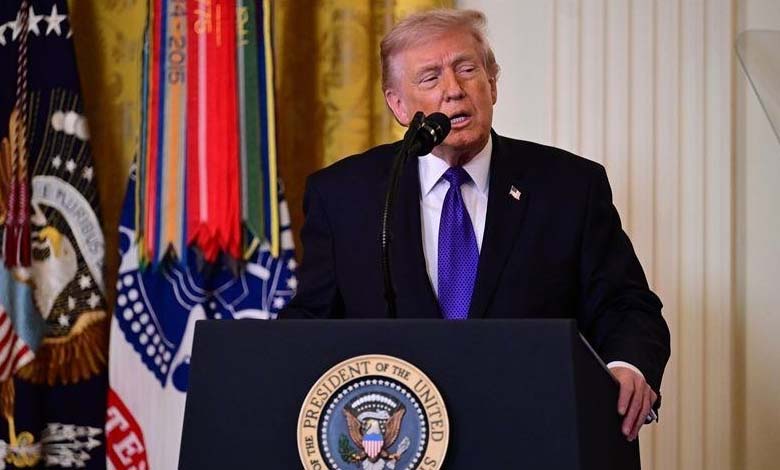
The U.S. president said that the United States “has not yet begun to destroy what remains in Iran,” reiterating his threats of more powerful strikes on Iranian infrastructure, particularly bridges and electrical power plants, as dozens of countries seek ways to restore the flow of vital energy supplies through the Strait of Hormuz.
Nearly five weeks after the outbreak of war following a joint U.S.–Israeli airstrike on Iran, the conflict continues to cause chaos across the region and turbulence in financial markets, increasing pressure on Trump to find a swift solution.
In recent days, the U.S. president has escalated his rhetoric to the point that signs of progress in negotiations conducted through mediators with Iran’s new leadership have nearly vanished.
He wrote on social media late Thursday that the U.S. military “has not even begun to destroy what remains in Iran. Bridges are next, then power stations,” adding that the Iranian leadership “knows what it must do, and must do it quickly!”
He had previously posted a video showing a U.S. strike on a newly built bridge between Tehran and the city of Karaj. The bridge was scheduled to open to traffic this year. According to official Iranian media, the U.S. attack killed eight people and injured 95 others.
In a statement, Abbas Araghchi said: “Targeting civilian buildings, including unfinished bridges, will not force Iranians to surrender.”
Satellite images showed smoke rising from the port of Qeshm, an Iranian island strategically located in the Strait of Hormuz, earlier this week.
More than 100 international law experts in the United States said Thursday that the conduct of U.S. forces and statements by senior American officials “raise serious concerns about violations of international human rights law and international humanitarian law, including potential war crimes.”
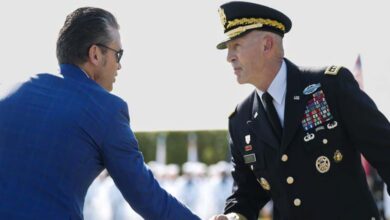
The experts’ letter specifically referred to a mid-March remark by Trump in which he said the United States could strike Iran “just for fun.” It also cited comments made in early March by Defense Secretary Pete Hegseth, who said that the United States does not fight according to “stupid rules of engagement.”
In a speech delivered on Wednesday, the U.S. president said he would intensify military operations without providing a specific timeline for ending the war. This prompted threats of retaliation from Tehran and caused stock markets to fall and oil prices to rise amid fears that the Strait of Hormuz would remain largely closed.
The United Kingdom chaired an online meeting involving around 40 countries to discuss ways to restore freedom of navigation, but it did not result in any specific agreement. However, an official said participants agreed on the need to enable all countries to use the waterway freely.
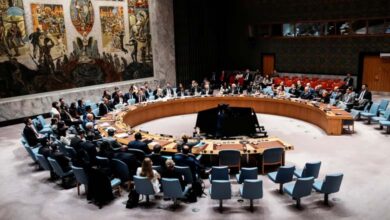
Diplomats said the Security Council would vote Saturday on a Bahraini plan to protect commercial navigation in and around the Strait of Hormuz, but China, which holds veto power, expressed strong opposition to any use of force.
China’s representative to the United Nations, Fu Cong, told the Security Council on Thursday that any military action “would legitimize the unlawful and indiscriminate use of force, inevitably leading to further escalation and grave consequences.”
Iran has effectively closed the strait, through which one-fifth of global oil trade previously passed, in response to the attacks launched by the United States and Israel on February 28.
Tehran has proposed an alternative vision for future control of the strait, stating that it is moving toward drafting a protocol with the Sultanate of Oman requiring ships to obtain permits and licenses.
The European Union’s foreign policy chief, Kaja Kallas, rejected Tehran’s plan, saying Iran cannot be allowed to impose fees on countries for the passage of ships. She wrote on social media: “International law does not recognize pay-to-pass schemes.”
Concerns are growing that the conflict could enable Iran to control energy supplies in the Middle East after demonstrating its ability to shut the Strait of Hormuz by targeting oil tankers and attacking Gulf states hosting U.S. forces.
Gulf countries affirm their right to self-defense but have refrained from responding militarily to repeated Iranian attacks over the past month in an effort to avoid escalation into a more destructive full-scale regional war.
Kuwait reported that its air defenses intercepted missiles and drones twice on Friday.
Thousands have been killed and tens of thousands injured across the Middle East since the war began. The head of delegation of the International Federation of Red Cross and Red Crescent Societies said Thursday that medical needs are rising significantly and supplies may soon run out.
Fuel shortages have already placed economic pressure across Asia and their effects are expected to reach Europe soon, while a report issued by two United Nations agencies warned that a severe economic slowdown could trigger a cost-of-living crisis in Africa.