Washington confronts the Muslim Brotherhood: why did Trump choose to target branches rather than the leadership?
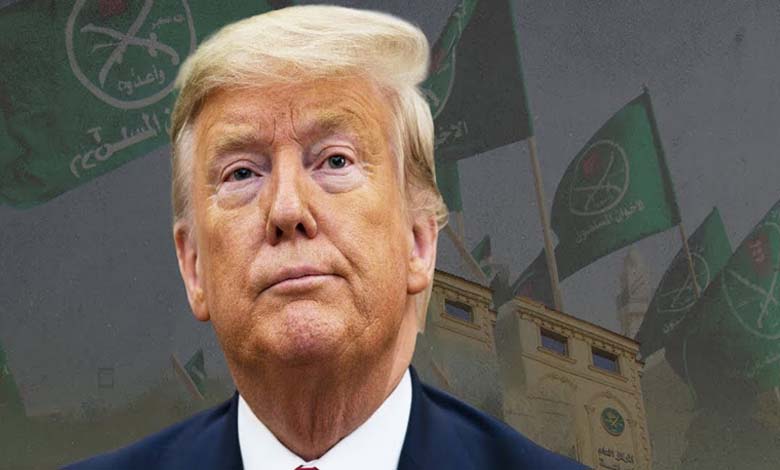
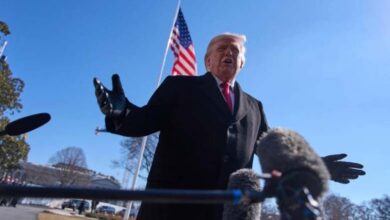
The recent executive order signed by U.S. President Donald Trump represents a notable shift in Washington’s approach toward the Muslim Brotherhood. According to its supporters, it offers a more precise tool for curbing the group’s influence in the Middle East.
-
Washington Moves Against the Muslim Brotherhood: New Bill Proposes Terrorist Designation
-
What does Florida’s designation of the Muslim Brotherhood as a terrorist organization mean?
However, proponents of this view argue that the step, despite its significance, remains incomplete unless it is accompanied by broader measures targeting the financial and organizational support networks that enable the Brotherhood to survive and adapt.
A report by The National Interest magazine notes that U.S. political circles have long been engaged in an extended debate over how to deal with the Muslim Brotherhood: whether to designate the entire movement as a terrorist organization or to view it as a fragmented entity with multiple dimensions.
Trump effectively ended this debate by adopting a selective approach that focuses on branches clearly meeting the legal criteria for “terrorism” under U.S. law, rather than treating the Brotherhood as a single, uniform organization.
-
The Muslim Brotherhood’s infiltration in America: a silent strategy eroding society from within
-
Congress opens fire: the Muslim Brotherhood placed on the US terrorism list
In public perception, the Muslim Brotherhood often appears as an opaque entity or an abstract idea. In reality, it is a vast network of local branches that share a common ideological reference while displaying significant differences in behavior and practice.
Some of these branches operate within formal political frameworks as recognized parties, others have engaged in armed activity, while some have confined themselves to charitable and social work, creating a broad spectrum that is difficult to reduce to a single classification.
This structural diversity, combined with the continuous evolution of the branches’ nature, has been one of the main obstacles to any U.S. attempt to designate the Brotherhood as a whole as a terrorist organization. The movement lacks a unified central headquarters, a global leadership with executive authority, or an organizational structure demonstrating direct control over all its branches across multiple countries.
-
The Muslim Brotherhood as a Global Terrorist Organization: US House Committee Approves Bill
-
The US Congress prepares to designate the Muslim Brotherhood as a Global Terrorist Organization
Although the Brotherhood, since its founding in 1928 by Hassan al-Banna, once possessed a clear central structure led by a “Supreme Guide” and maintained close ties with its regional branches, this architecture has gradually eroded over time.
As local political contexts became more complex, national branches evolved into quasi-independent entities, preserving the general ideological legacy while acting according to their own priorities and circumstances.
In this context, Washington appears to have reached a more realistic assessment of the situation, opting for an approach that does not treat the Brotherhood as a single label but instead focuses, under the executive order, on the branches most deeply involved in violence.
-
Financial and organizational blows… Will Trump’s decision deprive the Muslim Brotherhood of one billion dollars annually?
-
The repercussions of Trump’s strike against the Muslim Brotherhood… What to expect in Europe?
This strategy provides policymakers with a clearer pathway to designate groups on a case-by-case basis and to pursue a sustained campaign aimed at weakening the capabilities of designated branches and disrupting their operations.
The executive order identifies three branches as potential designation targets: the Islamic Group in Lebanon, the Muslim Brotherhood in Egypt, and the Muslim Brotherhood in Jordan.
The decision is based on specific allegations, including assistance by the Lebanese Islamic Group’s military wing in carrying out rocket attacks against Israel, encouragement by the Egyptian Brotherhood branch of violent acts against U.S. partners, and material support provided by the Jordanian branch to Hamas’s military wing.
-
American legal experts: Designating the Muslim Brotherhood as a terrorist organization is a step that requires further action
-
Texas designates the Muslim Brotherhood and CAIR as terrorist organizations: a profound American shift reshaping the domestic landscape of political Islam
The Islamic Group in Lebanon gained particular prominence following the October 7, 2023 attack on Israel, after claiming responsibility for a series of operations launched from southern Lebanon.
Its leaders have not concealed their closeness to Hamas, whether in public statements or in describing the relationship as an extension of a “long history of jihadist, political, and proselytizing activity.”
Analysts believe this alignment intensified following internal leadership changes that allowed factions more closely aligned with Hamas to rise, eventually leading to joint operations and direct field coordination.
-
Denial of Lineage: The Shadow of a Ban Haunts the Muslim Brotherhood in the U.S. and Europe
-
The Muslim Brotherhood… the Hidden Face Within Western Democracies
In Jordan, assessments point to a similar trajectory. Over the years, Hamas is believed to have strengthened its influence within the Brotherhood through financial and organizational support, resulting in the emergence of a loyal faction that dominates the movement’s decision-making institutions.
After the events of October 7, 2023, this proximity became visible in the streets through slogans and demonstrations supporting Hamas, before later taking on a more serious security dimension, with individuals linked to the Brotherhood reportedly involved in armed operations and attempts to manufacture weapons inside Jordan, according to authorities.
Supporters of the executive order argue that its strength lies in relying on existing U.S. legal tools for counterterrorism rather than creating new frameworks. Current laws allow for the punishment of any entity providing “material support” to designated organizations, which may include joint operations, facilitation of attacks, and funding and fundraising networks linked to Hamas.
-
Why America Needs a Thorough Investigation into the Muslim Brotherhood’s Activities
-
The Muslim Brotherhood and gloating over death: an ugly face and a corrupt ideology
These tools also allow for the designation of the relevant branches as foreign terrorist organizations and the imposition of broad sanctions on their leaders by placing them on global terrorism lists, enabling asset freezes and the pursuit of their financial networks.
Nevertheless, this approach emphasizes that targeting branches alone is insufficient. From this perspective, dismantling the influence of the Muslim Brotherhood requires going further by pursuing the broader infrastructure on which the movement relies, including charitable associations, non-governmental organizations, media outlets, and financial institutions that collectively form the support network ensuring the continuity of its activities.
-
Washington Expands Secret Mechanisms to Supply Weapons to Israel: Experts Warn of Catastrophic Consequences
-
The Muslim Brotherhood under scrutiny: a persistent threat concealed behind democratic slogans
The magazine concludes that, according to critics, the Muslim Brotherhood does not operate as a transient organization but seeks deep infiltration into the societies in which it operates, building a long-term presence that is difficult to dismantle. Therefore, any strategy aimed at containing or eliminating its influence must be comprehensive, sustained, and equipped with integrated tools commensurate with the scale and complexity of the network it has woven over decades.
-
Washington’s Messages to Khartoum: No Immunity for Warlords under the State’s Cover
-
The Muslim Brotherhood and the specter of designation: a senior U.S. official calls for a decisive step