Washington targets Iran’s weapons supply lines beyond Gulf waters
The interception by the US Navy of a vessel carrying military materials from China to Iran sends clear signals of Washington’s determination to disrupt Tehran’s armament efforts and its support for regional proxies.
The US Navy’s interception, in the waters of the Indian Ocean, of a ship transporting military equipment from China and bound for Iran represents a geopolitical and strategic development with far-reaching implications. It confirms an escalation in Washington’s approach to targeting Tehran’s weapons supply networks, as the confrontation is no longer confined to traditional territorial waters or the Gulf region, but has expanded to a global scale. This development conveys unambiguous messages about the United States’ resolve to obstruct Iranian efforts to acquire arms and to support its allies in the region.
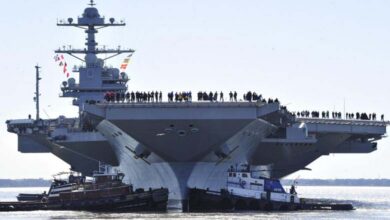
According to reports by the Wall Street Journal, the targeted operation took place off the coast of Sri Lanka, where US naval units boarded the vessel and seized its military cargo before allowing it to continue its voyage. Closely monitored by Washington, this step reflects the activation of a policy of pre-emptive disruption and a shift from surveillance to direct intervention aimed at breaking Iran’s military supply chain, thereby significantly increasing the cost of armament for Tehran.
The fact that the operation occurred hundreds of miles from Sri Lanka highlights the extensive reach of US intelligence and surveillance capabilities, confirming that the Indian Ocean has become a new arena in the indirect confrontation between the United States and Iran, far from the Strait of Hormuz and the usual hotspots of tension.
The use of US Navy special operations teams in this raid underscores the high-risk nature of the mission, which required precise intelligence planning and exceptionally accurate execution. The significance of the interception goes beyond the mere seizure of a shipment, affecting three key actors with regional and international weight. It sends a clear message that the United States will not tolerate illicit procurement and seeks to curb Tehran’s ability to arm and support its regional proxies, such as the Houthis, Hezbollah, and certain Iraqi factions, which are seen as threats to stability and freedom of navigation.
Intercepting a vessel originating from China places Beijing in a diplomatically sensitive position, underscoring that Washington is closely monitoring any covert military cooperation between the two countries. The United States is expected to use this incident to intensify pressure on China to restrain any potential military exports to Iran, warning against contributing to sanctions violations or undermining regional security.
The decision to allow the vessel to continue its journey after the seizure of the cargo reflects a calculated approach aimed at limiting direct diplomatic escalation with the ship’s owning state, whether China or a third party, while achieving the primary operational objective.
This incident confirms that the United States is now pursuing a tougher and more direct strategy to disrupt Iran’s military and naval capabilities. The shift of the confrontation into the Indian Ocean represents a qualitative escalation and confronts all parties with new challenges in managing complex tensions where global security and economic interests are deeply intertwined.