Whispers in NATO corridors… Could Greenland drag Europe into a confrontation with Trump?
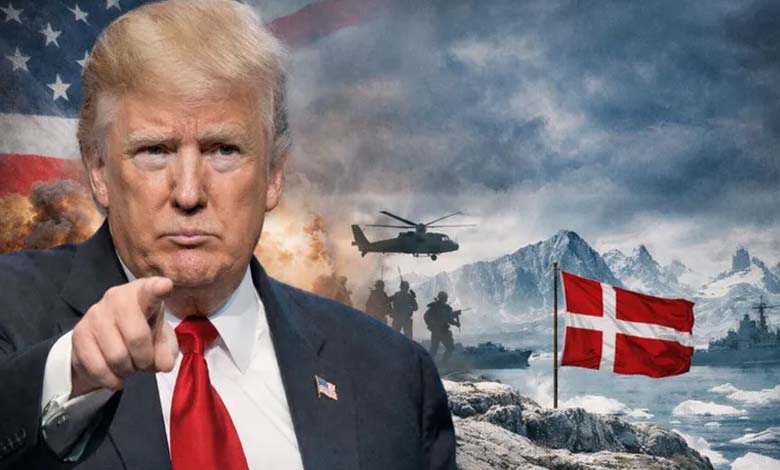
Concerns are growing in Europe over the direction taken by US President Donald Trump, prompting some officials to explore unconventional ways of responding to his policies.
Under the headline “Is it time to abandon Trump? Europeans quietly discuss last-resort options to save Greenland,” Politico published a report examining the options available to Europeans to counter Trump.
-
The US military accuses Iran of detaining a ship in the Gulf waters
-
The illusion of military victory: why Sudan is paying the price for the absence of politics
While a military confrontation between the United States and any European power would likely be very short-lived, the newspaper argues that there are other means that Greenland’s allies could use to pressure the US president if he refuses to reach a negotiated solution.
One of the most significant potential pressure points lies in the network of European military bases that Washington uses to project its global power, particularly in Africa and the Middle East.
-
Errors or an exhausted system? The puzzle behind the rise in U.S. military aircraft accidents
-
Russia Expands Its Military Influence in Africa: A Threat to U.S. and U.K. Interests via Port Sudan Base
Options for confrontation
According to officials and diplomats who spoke to Politico, these options are being discussed confidentially across the continent, outside formal debates within the European Union or NATO. The least escalatory options include:
– delaying or stalling decisions;
– applying political pressure within Washington;
– deploying allied forces to Greenland;
– launching media campaigns in the United States.
However, the possibility of cutting support for the US military deployment has also been raised, including radical proposals to reclaim control over American bases, according to one diplomat.
-
Russia Reduces Military Presence in Syria Following al-Assad’s fall
-
“Serious Mistake”… Russia Threatens “Military Response” to “German Missiles”
Beyond European military assets, the United States also relies on the Old Continent as a major trading partner, while European governments spend billions of dollars each year on the purchase of US-made weapons.
All of this represents potential leverage should European consumers decide to stop buying American products, the report notes.
Some officials believe, however, that the greatest risk lies in the fact that such an overt challenge could quickly escalate into a complete rupture of transatlantic relations.
-
Due to Gaza… US Soldiers Refuse to Serve in the Military
-
A Massive Military Parade… What is Victory Day and What is its Importance to Russia?
Others argue that the alliance has become more strained under Trump and that Europe must move beyond this phase.
The closest any leader has come to issuing a warning was through cautious but telling remarks by French President Emmanuel Macron.
Speaking to his ministers this week, Macron said: “We do not take statements regarding Greenland lightly. If the sovereignty of an allied European state were to be undermined, the consequences would be unprecedented. France is monitoring the situation with the utmost attention and will adopt a fully solidaristic stance with Denmark.”
-
“Dawn Forces”: A Military Arm of the Muslim Brotherhood
-
The military crisis between Ukraine and Russia has escalated
The easy path or the hard path?
This implicit warning from the French president came as the foreign ministers of Denmark and Greenland began talks with the Trump administration in Washington in search of a compromise over the future of the island, which has a population of 57,000.
After Wednesday’s talks with Vice President J. D. Vance and Secretary of State Marco Rubio, Danish Foreign Minister Lars Løkke Rasmussen sought to strike an optimistic tone, while acknowledging that no agreement was in sight.
He told the press: “The president has a desire to invade Greenland, and therefore we remain in fundamental disagreement.”
-
Battle for survival: the US Sky Guardian drone arms itself with intelligence
-
What weapons could Washington use in a potential attack on Iran?
European hesitation
The report points out that the main reason for Europe’s reluctance to take a firm public stance is its belief that Trump’s support is vital to providing Ukraine with credible security guarantees under any peace deal with Russia.
At the same time, many allies simply cannot imagine a world in which the United States seizes Greenland by force.
In this regard, one diplomat said: “This may be wishful thinking,” adding: “But we must be prepared for it.”
Another European official confirmed that governments are discussing how to respond effectively to potential US territorial ambitions.
-
Russia strikes Ukraine with Oreshnik in response to an alleged attempt to target Putin’s residence: what is the Oreshnik missile?
-
Battle of Huliaipole… Russian Superiority Tightens the Noose on Ukraine