Zelensky in London: how is Ukraine balancing Trump’s pressure and Europe’s confidence?
The Ukrainian file has once again become central to a political confrontation reshaping the balance of influence between Washington and Moscow.
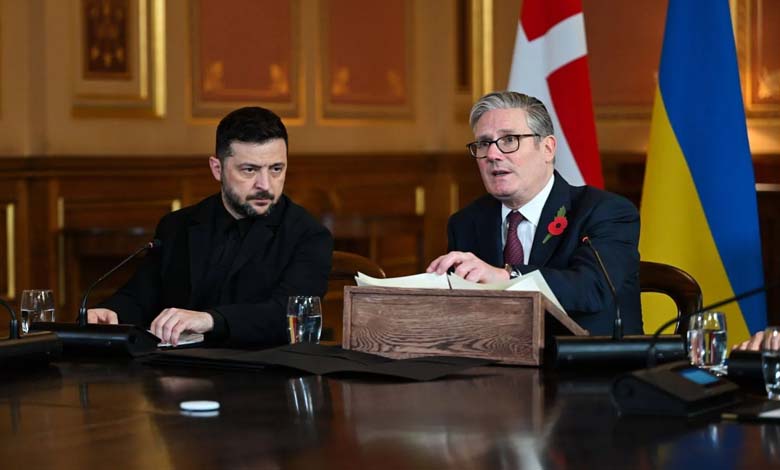
Ukrainian President Volodymyr Zelensky is scheduled to meet European leaders in London on Monday in a show of solidarity, after US President Donald Trump accused him of failing to read the latest peace proposal, while Moscow praised Washington’s new security strategy.
Trump criticized Zelensky on Sunday, following weekend negotiations in Miami between the American and Ukrainian delegations, which ended without resolving key issues related to security guarantees and territorial questions, amid ongoing concerns that the US proposal leans in Russia’s favor.
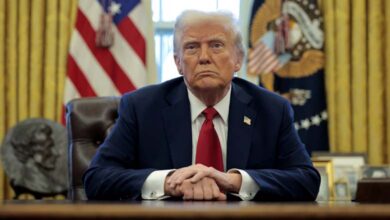
Trump stated: “We spoke with President (Vladimir) Putin, and we spoke with Ukrainian leaders, including President Zelensky, and I must say I was somewhat disappointed that President Zelensky has not yet read the proposal, and this was only a few hours ago.”
He added that Russia prefers annexing all of Ukraine, and that he believes Moscow is “pleased” with the peace plan, before noting: “I am not sure Zelensky is pleased with it.”
A sensitive moment
These remarks came as the Kremlin welcomed the new US national security strategy, a foreign policy shift toward a more confrontational stance toward Europe.
The new American document drops previous language describing Russia as a threat, arguing instead that European nations view Moscow as an “existential threat.” It places Washington as the central mediator in restoring “conditions for stability within Europe and strategic stability with Russia,” according to CNN.
On Sunday, Kremlin spokesman Dmitry Peskov appeared to endorse the strategy, saying that recent adjustments in US policy “align in many ways with our view,” and describing Trump as a “strong” leader.
Europe prepares to assess the situation
According to CNN, this shift comes at a critical time, as the United States leads peace talks concerning Ukraine while simultaneously adopting a tougher stance toward Europe, raising concerns about how this may affect negotiations.
These issues are expected to be discussed on Monday when Zelensky travels to London to meet French President Emmanuel Macron, British Prime Minister Keir Starmer, and German Chancellor Friedrich Merz.
Macron said that European leaders “will assess the situation and the ongoing negotiations within the framework of US mediation.”
Ukrainian officials reported that the Miami talks between US and Ukrainian negotiators reached a standstill on Saturday without progress, noting that key questions remained unanswered.
The Ukrainian ambassador to the United States, Olha Stefanishyna, said Saturday that after three days of discussions, “difficult issues remain,” but that “both sides continue working on realistic and acceptable solutions.”
She explained that the main challenges at this stage “concern territorial matters and guarantees,” adding: “More details will be provided once all information is consolidated.”
The marathon sessions began Thursday between US special envoy Steve Witkoff, President Trump’s son-in-law Jared Kushner, and Ukrainian officials Rustem Umerov and Andriy Hnatov.
Territorial and security guarantees have long posed major obstacles to any potential settlement. Kyiv maintains that a fair end to the war must include credible security commitments and cannot require it to surrender additional land.
Meanwhile, Russian President Vladimir Putin stated earlier this week that he intends to seize the eastern Donbass region “by any means.”
On Saturday, Macron said that Russia “is locking itself into an escalatory approach and is not seeking peace.”
He added: “We must continue to pressure Russia to force it toward peace,” stressing that “what is at stake in Ukraine is the security of Europe as a whole.”
Russian military escalation
Amid these political frictions, Russia launched one of its largest waves of drones and missiles in months.
Zelensky said Sunday that Russia had fired more than 1,600 attack drones, 1,200 guided bombs and around 70 missiles during the week, targeting vital infrastructure.
Ukraine’s Energy Ministry announced that the strikes hit energy facilities in several regions, cutting electricity for millions of residents in Odesa, Chernihiv, Kyiv, Kharkiv, Dnipro and Mykolaiv. Rolling power outages were implemented across the country.
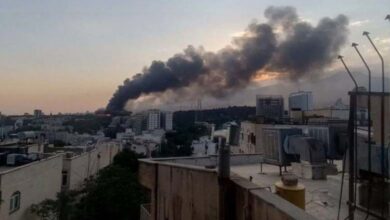
In response, Ukrainian forces said they struck Russia’s Ryazan refinery, one of the country’s largest, during an overnight attack, with no official reaction from Moscow yet.