The United States and Terrorism in Mali : A Crucial Test

Amid growing fears that terrorist groups may advance toward the capital Bamako, the United States must determine its next move in Mali.
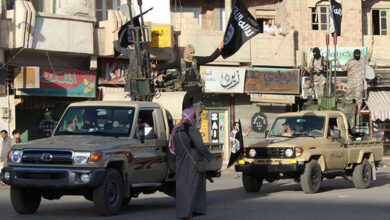
Since last September, the group Nusrat al-Islam, affiliated with Al-Qaeda, has been waging an intense economic war against Mali’s military junta by choking fuel supplies, severely disrupting daily life in Bamako.
According to Responsible Statecraft, residents of the capital stand in long lines to obtain gasoline, while Western powers have urged their nationals to leave the city.
-
Terrorism in Mali: Al-Qaeda Targets “Dozo” Hunters with Drones
-
Warnings of Escalating Terrorism in Mali After European Troops Withdraw
Possible Scenarios
Local media speculate that the capital – or even the entire country – may soon fall under terrorist rule.
The site highlights several possible scenarios through which the group could seize power. It may wait for a moment of extreme weakness to advance on the capital, hoping that desperate residents might accept or even welcome its rule as an alternative to the junta that has governed since 2020.
The group may also pursue a longer strategy: strangling the capital to provoke a military coup, fragment the army into rival factions, spark a popular uprising, or turn Bamako into a patchwork of militias. It may even believe that its road to power will take months or years rather than weeks.
-
Mali Between Fuel Crisis and Expanding Terrorism: Is Al-Qaeda Approaching the Gates of Bamako?
-
Terrorism Under the Hammer of Allies in Somalia
However, it remains unclear whether the faction is capable of governing Bamako or sustaining control. Researcher Boubacar Haïdara and other analysts note that basic demographic calculations make such an outcome unlikely.
Haïdara explains that with an estimated 6,000 fighters, the group would struggle to seize and hold a city of more than three million people, even if it concentrated all its forces – currently spread across several countries – in a single location.
He also questions why the group would bypass intermediate steps such as capturing administrative centers in regions where it already enjoys strong influence, opting instead to target the capital directly.
-
Terrorism in the Sahel: Mali Accuses Ukraine and Warns the West
-
Mali accuses Algeria of supporting “international terrorism”: diplomatic showdown at the UN
Earlier predecessors of the group controlled several cities in northern Mali in 2012 and 2013 before being expelled by a French military intervention. Since then, Sahelian terrorist organisations have refrained from openly taking control of major cities.
Even other rebel forces that captured capitals possessed significantly greater manpower, such as the Seleka coalition that swept into Bangui in the Central African Republic in 2013 with more than 20,000 fighters after advancing steadily across the country.
Another possible scenario is the continued deterioration of security and economic conditions without the collapse of the central government in the short term, as occurred in the Central African Republic in 2013, Somalia in 1991, and Afghanistan in 1992.
-
Political Divisions Cast a Shadow over Counterterrorism Efforts in Somalia
-
Somalia’s “Danab” Unit: From Counterterrorism to Accusations of Theft
A System that Still Holds
Mali under military rule is structurally weakened, yet its institutions continue to function to some extent. Certain components of the state apparatus remain operational.
The military leadership in Bamako is not entirely disconnected from other parts of the country, as evidenced by recent airstrikes against terrorist groups in the Timbuktu region, far from the capital.
While Nusrat al-Islam has managed to disrupt supply routes and force the army to withdraw from some positions, the state still possesses certain assets: formal control of cities and an air force.
-
Continued Terrorism Confrontation by Somalia Against Al-Shabaab
-
Somalia… Fiery Messages from the Presidency about the War on Terrorism
The junta also retains a measure of popularity in Bamako and beyond, thanks to state-owned and pro-government media promoting a pro-regime narrative.
Western powers, assessing potential responses, find themselves constrained. The legacy of the “war on terror” remains strong, and the prospect of Mali falling under
Al-Qaeda’s rule continues to alarm policymakers.
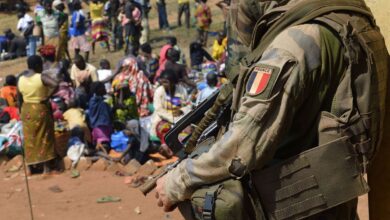
Yet the failures of that same war loom large. In the Sahel, French forces have been expelled from several countries, including Mali, after failing to contain the terrorism now encircling Bamako.
-
Al-Shabaab Nearing the End, Somali Army Defeats Terrorism
-
The war on terrorism in Somalia; Tools and 3 scenarios
Between Waiting and Caution
At the same time, the Western appetite for military intervention – particularly with ground troops – is minimal. The junta in Bamako would not welcome, or even tolerate, American, French or other European soldiers.
Washington may attempt to revive security cooperation with Mali. Recent months have shown signs of interest from President Donald Trump’s administration in establishing a contractual relationship with the junta, which urgently needs military equipment – a need Washington might seek to leverage.
-
Somalia: Political crisis and terrorism
-
Killing of Financial Leaders: A Major Blow to Al-Shabaab’s Funding Network in Somalia
Given the uncertainty surrounding the group’s intentions and timeline, and because full military intervention is unlikely to succeed, a “wait-and-see” approach appears the most politically and militarily reasonable option. Supporting the regime too openly risks dragging the United States into a complex conflict – the same mistake France made previously.
If Washington truly wants to help, increasing humanitarian aid for the millions of displaced, hungry, out-of-school, and unemployed people in the Sahel might be the most effective contribution.
This, however, contradicts Trump’s general approach. Nonetheless, the United States is far better positioned to alleviate human suffering than to determine who should govern Mali.
-
Washington urges citizens to leave Mali amid escalating jihadist attacks
-
Nioro under financial siege: Al-Qaeda’s expansion in Mali