The T-95 tank… Leaks revive the Soviets’ lost dream
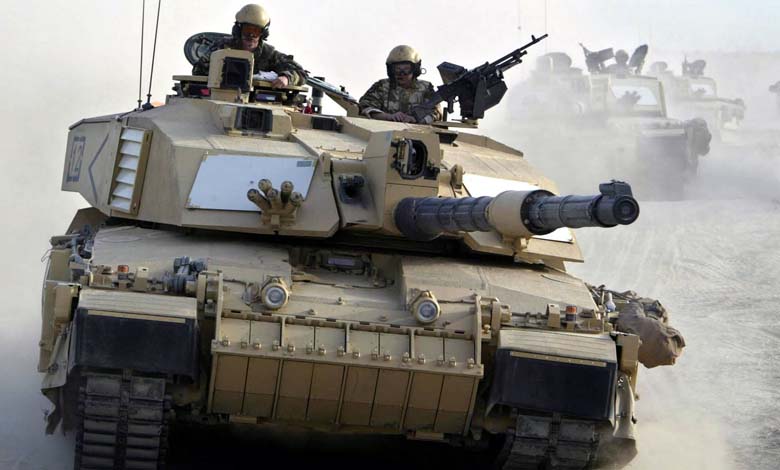
The leak of an original set of blueprints for the Soviet main battle tank “Object 195” has reignited wide debate around one of the most revolutionary military projects.
The 3D-design specialist “Ghostiez 3D” published new digital renderings, claiming they were “based on a genuine album of recently leaked blueprints”, thereby revealing deeper details about the tank popularly known as the T-95.
This tank had been intended as the first armored platform designed entirely from scratch to enter the Soviet Army since the T-64 was introduced in 1964.
The T-64 earned its historical significance by outperforming its Western counterparts by roughly twenty years: it had a powerful gun, advanced armor-piercing ammunition, and composite armor that Western tanks were unable to match until fifteen to twenty years later.
As the T-64 design evolved throughout the 1970s and 1980s, its famous derivatives appeared: the simpler and cheaper T-72, and the more expensive yet more mobile T-80. Both entered service in upgraded versions from 1973 and 1975.
Although the T-72 was less capable than the T-64 and T-80, its downgraded export variants demonstrated clear superiority during the conflicts of the 1980s, including the Lebanon War and the Iran–Iraq War.
However, the arrival of new Western tanks such as the German Leopard 2 and the American M1A1 Abrams helped narrow the capabilities gap. This pushed Moscow to launch the “Object 195” project, aiming to regain full and sustainable superiority by the late 1990s or early 2000s, much like the T-64 had done in the 1960s.
Just as the T-64 had brought a radical shift with its 152-mm gun compared to the Western 105-mm guns, the T-95 was expected to feature a massive 152-mm main gun, providing unprecedented penetration power.
The new tank was also planned to deliver extraordinary protection levels, with estimates suggesting that the thickness of its frontal armor could reach up to 1000 mm against anti-armor munitions.
The project adopted a revolutionary layout in which the three-man crew was isolated in a fully protected armored capsule, while the turret and main gun were operated remotely—extending the legacy of the T-64, the first tank to introduce an autoloader system.
This configuration would have allowed the tank to maintain an extremely low profile, even lower than the already compact T-64, thanks to the crew-capsule arrangement.
Despite its potential to become the most groundbreaking armored project since World War II, and although it reached the prototype stage, the collapse of the Soviet Union and the severe decline in Russian economic, industrial, and technological capabilities prevented its completion.
After the program was canceled in the early 2000s, the T-14 Armata project emerged in 2015 as an attempt to revive many of the “Object 195” concepts, albeit in a “less ambitious” form adapted to the limited resources of post-Soviet Russia, according to military analysts.
Nevertheless, the significant delays affecting the T-14 Armata program have cast doubts on its future by the mid-2020s—almost twenty-five years after the T-95 was originally expected to enter service.
China has exploited this gap to move forward decisively with its new “Type 100” tank, already in service, while the United States and South Korea prepare to catch up through their “M1E3” and “K3” programs. Should these projects reach completion, Russian armored forces may find themselves relatively disadvantaged.