Gaza residents under bombardment: fear of displacement east of the yellow line
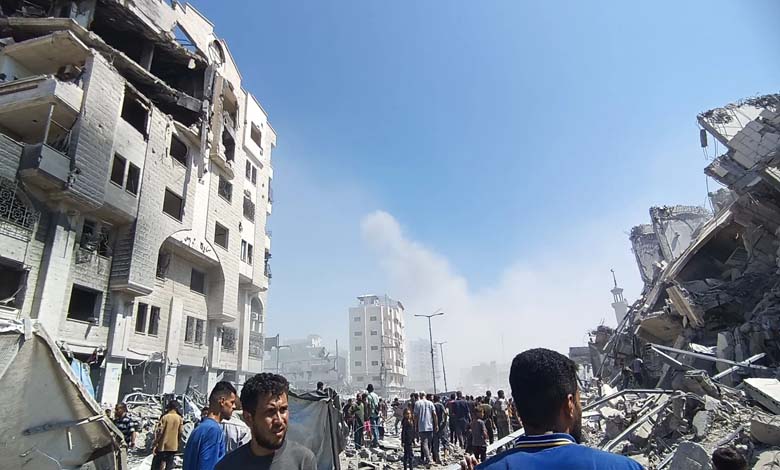
In Bani Suheila, in southern Gaza, Umm Ahmed Qdeih finds no answers for her children, who tremble with fear at every Israeli airstrike and ask her why they do not leave.
Over the past week, the Israeli army has carried out intensive strikes on the eastern areas of Khan Younis, located east of the yellow line, where tens of thousands of Palestinians live in tents or in homes damaged by a brutal war that has lasted for two years.
-
Gaza exits the famine stage and enters the critical emergency zone
-
Sunrise: Details of the U.S. Plan for the Gaza Riviera and the Expected Challenges
Qdeih, 40, lives with her children in a tent set up next to their destroyed house. She says: “We do not sleep at night because of fear and the continued bombardment in the eastern area.” She adds that her children keep asking her, “Why don’t we leave? The explosions never stop. Where will we go?” She continues: “I have no answer, because in reality there is no real alternative.”
She explains that the Al-Mawassi area, west of Khan Younis, is already completely overcrowded with tents, noting that staying near their destroyed home feels “less frightening than the unknown.”
-
Rainwater floods Gaza’s largest hospital
-
They Were Celebrating Inside a Tunnel in Gaza… Video of Deceased Hostages Sparks Anger Against Netanyahu
In northeastern Khan Younis, 70-year-old Abdel Hamid Al-Farra says his family is living amid the ruins of their partially destroyed house. He stresses: “We are staying here not because we are safe, but because we have nowhere else to go,” before adding defiantly: “We will not leave. This is our land. No matter how intense the bombardment becomes, we will stay. Displacement would not be a solution for us, but a new tragedy.”
According to Al-Farra, Al-Mawassi can no longer accommodate additional displaced people. He believes that the continued demolition of homes in the eastern areas aims to “completely empty the region east of the yellow line.”
-
Control and surveillance: What are American AI companies doing in Gaza?
-
Gaza buried under 68 million tons of rubble… and a shocking reconstruction timeline
The yellow line, under Israeli control, is a demarcation line established under a truce between Israel and Hamas that came into effect on October 10.
Earlier this month, Israeli Army Chief of Staff Eyal Zamir described the yellow line as “the new border” with Israel.
The Israeli army stated that its strikes are a response to “threats” posed by Palestinian factions. In a statement, it said that its current operations in Gaza, particularly its deployment in the yellow line area, are intended to confront direct threats from organizations it describes as terrorist groups in the Gaza Strip.
-
A critical phase begins… Mediators reveal developments in the second phase of the Gaza agreement
-
Rising tensions in Gaza revive questions about the durability of the truce
“No tents, no food, no medicine”
The war in Gaza erupted on October 7, 2023, following an unprecedented attack by Hamas on southern Israel that resulted in the deaths of 1,221 people, according to an Agence France-Presse tally based on official Israeli figures.
Since the outbreak of the war, more than 70,000 people have been killed in Gaza, according to the territory’s Ministry of Health, while most of its 2.2 million residents have been displaced, many of them multiple times.
Since the ceasefire came into force, both sides have regularly accused each other of violating its terms.
-
Hundreds of casualties since the ceasefire: new toll of deaths from the Gaza war
-
The United States sets a timeline for deploying the Gaza Force and disarming Hamas
According to Mahmoud Bassal, spokesperson for the Civil Defense, some residents leave their homes due to the bombardment, but the numbers remain limited because “people have no options. Many prefer to stay despite the risk of death from shelling, because there is no safe place in the Gaza Strip.”
Bassal notes that the Israeli army has “intensified daily aerial and artillery bombardments in recent weeks on Khan Younis and other areas of the territory in order to force people to leave, leaving the eastern areas empty under occupation.”
Meanwhile, Khan Younis Mayor Alaa Al-Batta described the Israeli strikes as “violations of the ceasefire agreement,” arguing that they aim to “displace people from their areas.” He called for urgent intervention to halt these violations, stressing that “hundreds of thousands of displaced people lack the most basic necessities of life: no tents, no food, and no medicine.”
-
US pressure pushes Israel to bring debris-removal equipment into Gaza
-
Gaza hospitals face severe shortages of medical supplies as Israeli attacks continue
Ongoing shelling
In the town of Khuzaa, 45-year-old Mahmoud Baraka says that artillery shelling “never stops” in the eastern areas and that the sounds of explosions are “extremely close.”
Baraka points out that the Israeli army carries out daily demolitions of homes, “as if we were in an open battlefield. The goal of the occupation is to frighten us.”
He adds: “We do not sleep at night. My children are still trembling with fear and from the cold. We are living a real tragedy, but in reality, we have no choice and no alternative except to stay here.”
-
Behind the scenes of the international force in Gaza: full details revealed
-
Gaza Donation Theft… The behind-the-scenes tensions within Hamas
Baraka hopes that this situation will end with the launch of the second phase of the Gaza ceasefire agreement and the withdrawal of the Israeli army. He concludes: “We are trying to gradually reclaim our lives, because we are extremely exhausted.”
Israel and Hamas continue to exchange accusations over delays in launching negotiations for the second phase of the agreement, which предусматриes the withdrawal of Israeli forces from their current positions, the establishment of a temporary authority to administer the territory in place of the Hamas government, and the deployment of an international stabilization force.
-
CIA Information on Israel’s Alleged Use of Gazans as Human Shields
-
Israel signals possible military operation in Gaza to disarm Hamas