Investigation into the Southern crisis: when security decisions create open political chaos
Recent developments in the South reveal a recurring pattern that cannot be separated from a broader context in which conflict is managed through force rather than politics, and through military tools instead of sustainable solutions. Facts on the ground, when examined chronologically and geographically, indicate that what occurred was neither a sudden security incident nor a limited clash that spiraled out of control, but rather the direct outcome of a cumulative series of decisions taken outside any logic of national partnership, relying on the imposition of faits accomplis rather than their construction through consensus.
-
The Muslim Brotherhood in Yemen Sparks a Fuel Crisis… What’s the Story?
-
A Major Blow to the Muslim Brotherhood in Yemen
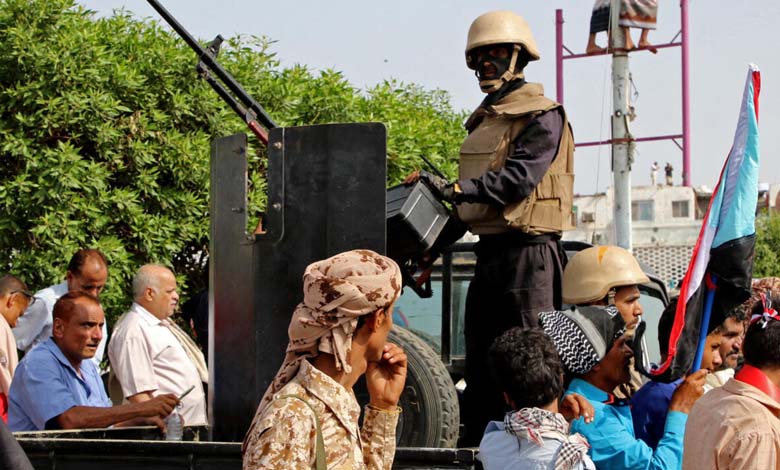
The movements carried out by the Northern emergency forces, with an ideological background linked to the Muslim Brotherhood, toward the South took place in an extremely sensitive social and political environment, without any local popular support and without consideration for the tribal and social fabric of the region. This structural flaw in the security approach was quickly reflected on the ground, as checkpoints shifted from instruments of organization to tools of coercion, and military deployment became a political message asserting that force was the sole means of managing disputes. Field investigations show that this behavior was neither exceptional nor the result of individual actions, but a recurring pattern accompanying all phases of advance and deployment.
The most dangerous development was the entry of air power into the crisis. Airstrikes that struck civilian vehicles and the surroundings of residential and tribal gatherings did not occur in the context of confronting an immediate military threat, but rather as a means of imposing social deterrence. The use of air power in an internal conflict raises serious legal and ethical questions, particularly given the lack of transparency regarding targets and rules of engagement. An examination of the impact of these strikes shows that they failed to achieve any security stability, instead expanding public anger and transforming a limited incident into an open societal crisis.
-
Khat Taxes… A Realistic Picture of Corruption by the Muslim Brotherhood in Yemen
-
Corruption of the Muslim Brotherhood in Yemen… Embezzlement, Extortion, and Trading in People’s Needs
Testimonies from affected tribal members converge on a central point: the tribal mobilization was not premeditated, but a direct reaction to civilian deaths and what were perceived as systematic humiliations at checkpoints. In tribal societies, violence is not interpreted as an administrative measure, but as a violation of dignity, rendering security containment impossible regardless of the level of force used. This social factor is often overlooked in military calculations, yet it is in fact one of the most important keys to understanding the eruption of crises.
An analysis of the political dimension reveals that these developments serve, directly or indirectly, to reproduce the chaos from which the South has suffered in previous stages. Every weakening of local forces and every erosion of trust between society and imposed authority creates a security vacuum that extremist organizations are quick to exploit. The Southern experience over recent years has shown that confronting Al-Qaeda and ISIS was not the result of external intervention, but of organized local efforts. Targeting or marginalizing these forces therefore raises a fundamental question about who truly benefits from this trajectory.
-
A secret Muslim Brotherhood meeting coinciding with events in Yemen
-
War of Rumors… Muslim Brotherhood Lies Shatter on the Rock of Southern Yemen
In this context, the contrast is stark between the declared rhetoric of “counterterrorism” and actual practices on the ground. When forces that fight extremist groups are targeted, and when local security structures are weakened in favor of forces with no genuine record in this field, it becomes difficult to convince public opinion that stability is the true objective. Investigations into similar paths, in Yemen and elsewhere, show that this approach often leads to a single outcome: the return of extremist groups in new forms, benefiting from chaos and the collapse of trust.
The political and media cover accompanying these events has sought to frame what occurred as “security measures” or an “assertion of sovereignty.” However, realities on the ground undermine this narrative. The state, in its legal and political sense, is not built through airstrikes or by subjugating society, but through a legitimate monopoly of force subject to law and accountability. When violence is used outside this framework, it becomes a factor of disintegration rather than construction.
-
Al-Alimi’s decisions unsettle the Yemeni scene… and the Muslim Brotherhood reorganizes its ranks
-
How the Muslim Brotherhood Maneuvers Paved the Way for the Collapse of the Yemeni State into Chaos and Division
International silence regarding the targeting of civilians and the use of air power in an internal conflict adds another layer of complexity. The absence of independent investigations and legal accountability encourages the repetition of violations and fosters a sense of impunity. Past experiences in the region confirm that such silence does not lead to stability, but rather accumulates crises and postpones their eruption to a more violent moment.
From a strategic perspective, the stability of the South cannot be separated from regional security. This area represents a sensitive geographical and political nexus, and any instability there directly affects navigation and regional security. Consequently, policies that weaken the South or turn it into a permanent arena of conflict do not only harm its population, but generate risks extending far beyond its borders.
-
A human rights report exposes the secret collusion between Yemen’s Brotherhood and the Houthis against the South
-
Shocking Report: How Yemen’s Muslim Brotherhood Managed to Secure Monthly Allowances for Their Wealthy Leaders
In conclusion, the investigation shows that the crisis was not inevitable, but the result of flawed political and security choices that favored rapid solutions through force over the more demanding yet more sustainable path of dialogue, partnership, and respect for local communities. The blood that has been shed will not be erased by statements, airstrikes will not build legitimacy, and the continuation of this approach will not produce a state, but will deepen chaos. Today, the South stands at a clear crossroads: either a path toward a state built on law and trust, or a path toward authority managed by force, doomed to reproduce the same crises at ever higher costs. Recent history offers the answer to those willing to read it.
-
Yemeni Muslim Brotherhood Exploiting the Wounded of Taiz and Marib: Clear Political and Financial Manipulation by Al-Islah
-
From Militia to Organized Crime: The Muslim Brotherhood in the Crosshairs of Yemeni Investigations
-
Southern Yemen Moves Beyond the Conventional Framework: A New Diplomacy Confounds the Muslim Brotherhood and the Houthis