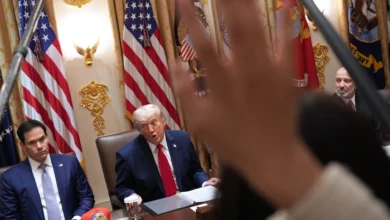
Iran protests put Trump to the test between escalation and dialogue
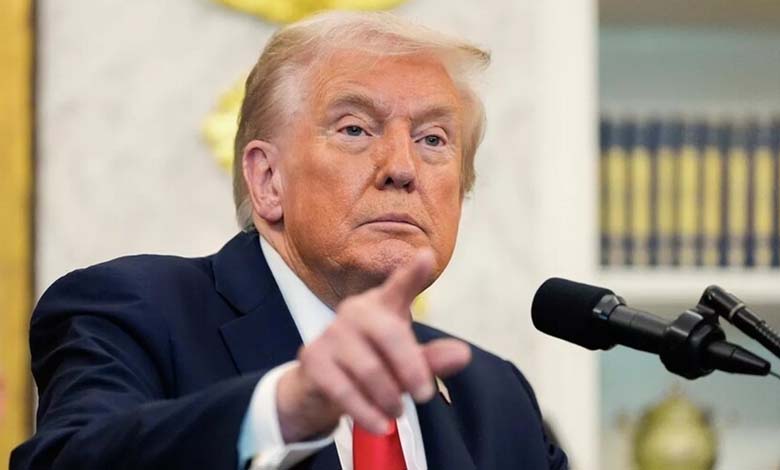
The US president is weighing options ranging from military escalation to opening negotiations with Iran, amid internal and external pressure to take a decisive stance.
On Sunday, Donald Trump said that Iran had proposed talks after he threatened to strike it, in response to a “violent crackdown” on protests that represent one of the most serious challenges to clerical rule since the 1979 revolution. According to activists, more than 600 people have been killed since the unrest began two weeks ago.
-
After Trump’s threats, Iran affirms readiness for war and dialogue
-
Trump does not rule out the military option in support of protesters in Iran
The US president has repeatedly warned Tehran of military action if his administration determines that Iran is using lethal force against anti-government demonstrators, describing this as a “red line” that Tehran has “begun to cross”.
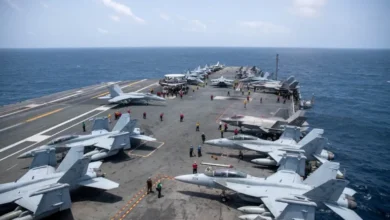
However, the US military, which Trump previously described as being “on full alert”, has for now been placed on standby, as the president considers his next steps, according to reporting by the Associated Press.
White House spokesperson Karoline Leavitt told reporters on Monday: “What you hear publicly from the Iranian regime is completely different from the messages the administration is receiving privately, and I think the president is interested in exploring those messages.”
She added: “That said, the president has shown that he does not hesitate to use military options if he deems them necessary, and no one understands that better than Iran.”
-
Options for striking Iran on Trump’s table: the trigger awaits the green light
-
Khamenei calls protesters agents and accuses them of trying to appease Trump
Punitive measure
As an initial punitive step, Trump announced the immediate imposition of 25 percent tariffs on countries that continue to trade with Iran, in an effort to pressure Tehran over its crackdown on the protests.
The White House declined to provide further comments or details regarding the tariff announcement.
Contacts with Iran
The White House has offered few details about Iran’s efforts to make contact, but Leavitt confirmed that the president’s special envoy, Steve Witkoff, would play a central role in communications with Tehran.
Meanwhile, the vice president, the secretary of state, and National Security Council officials have begun preparing a range of options, from diplomacy to military action, to be presented to Trump in the coming days.
-
Trump Pulls the Trigger on Phase Two in Gaza: Peace Takes Precedence over Netanyahu’s Conditions
-
Control and Military Bases: An Old Agreement Gives Trump a Solution in Greenland
On Monday, Trump told reporters aboard Air Force One that he was “arranging a meeting” with Iranian officials, but warned that “we may have to act because of what is happening before that meeting”.
For its part, Iran said through its foreign minister, Abbas Araghchi, that it is keeping channels of communication with the United States open.
Araghchi stated that the situation in Iran was “fully under control” following an escalation in protest-related violence earlier in the week.
He also said that Iran would restore internet services in coordination with security agencies.
-
How Trump could take control of Greenland’s capital in half an hour
-
Iran Warns Trump Against Intervention and Draws the Red Line
At the same time, the semi-official Tasnim news agency reported that Iran’s foreign ministry had summoned the ambassadors of the United Kingdom, Italy, Germany, and France in Tehran, asking them to convey Iran’s request that their governments withdraw support for the protests.
Iranian parliament speaker Mohammad Bagher Ghalibaf warned that US forces and Israel would become “legitimate targets” if Washington used force to protect demonstrators.
On the ground, protests continue in Iran, but analysts question their ability to persist, particularly given internet shutdowns and the lack of leadership and organization, which makes coordination between different cities more difficult.
-
Surprise 2026… Trump Builds the American Arc de Triomphe
-
Trump Plans to Appoint a U.S. General to Lead the International Force in Gaza
Trump and mounting pressure
At the same time, Trump is facing other international crises, including the fallout from the recent US operation in Venezuela, efforts to finalize a peace agreement in the Gaza Strip, and attempts to end the war between Russia and Ukraine.
Hardline allies of Trump view the current moment as an opportunity to weaken Iran’s ruling system, which is facing its largest wave of protests in years, driven by currency collapse and deteriorating living conditions, posing a direct challenge to the authority of Supreme Leader Ali Khamenei.
In Washington, prominent Republican politicians are urging Trump not to back down, arguing that hesitation would undermine the credibility of US “red lines”, while others maintain that toppling Iran’s ruling regime has become an objective that should be pursued by exploiting its current vulnerability.
-
Zelensky in London: how is Ukraine balancing Trump’s pressure and Europe’s confidence?
-
Trump’s peace plan for Ukraine: deadline for Kyiv until Thursday, and Putin comments
Behnam Ben Taleblu, senior director of the Iran program at the Washington-based Foundation for Defense of Democracies, said that “the value of the president’s official statements promising accountability for the regime, followed by restraint, diminishes rapidly”.
Speaking to the Associated Press, Taleblu noted that Trump has expressed a desire to maintain “maximum flexibility rooted in unpredictability” in dealing with adversaries.
He added: “But flexibility should not turn into a policy of supporting or rescuing a regime hostile to the United States, a regime facing an internal crisis, whose leader is the subject of a financial reward for his capture abroad.”
-
Trump insists on nuclear tests as senior officials oppose any detonation
-
Trump and Iran: 4 Possible Scenarios, Including “Shock and Awe”