Buying geography: how deals shaped the map of the United States
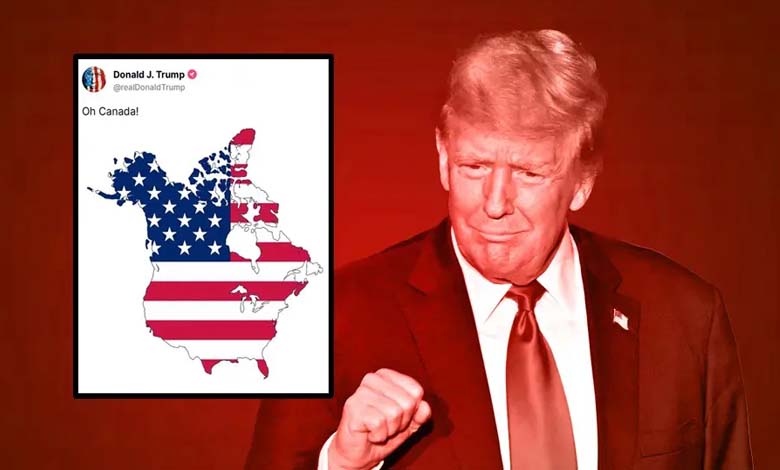
President Donald Trump’s statements regarding the annexation of Greenland, a territory belonging to Denmark, are consistent with a long-standing American tradition of expanding its borders through the purchase of lands and regions, under a policy that has come to be known as “buying geography”.
According to a report published by Newsweek, Greenland does not represent a departure from this approach, but rather a new link in a chain of transactions that helped shape the modern American state and consolidate its geopolitical influence worldwide.
-
Surprise 2026… Trump Builds the American Arc de Triomphe
-
Advanced Israeli-American consultations on an independent Palestinian government in Gaza
Throughout its history, the United States acquired nearly 40 percent of its current territory by purchasing lands from colonial powers and other states, as part of an expansionist process that accompanied its political and economic rise.
This trajectory followed centuries of European colonization of North America, which began with the arrival of Christopher Columbus in the late fifteenth century, accelerated in the seventeenth and eighteenth centuries through wars and massacres, and culminated in European control over the lands of Indigenous peoples.
-
The most expensive bomber in history… the B-2 Spirit and the price of American supremacy
-
American legal experts: Designating the Muslim Brotherhood as a terrorist organization is a step that requires further action
The Louisiana Purchase (1803) – France
The Louisiana Purchase of 1803 stands as the most prominent milestone in American expansion. Under the pressure of a severe financial crisis, France ceded a vast territory of more than 2.14 million square kilometers in exchange for 15 million dollars.
Emperor Napoleon Bonaparte’s decision to relinquish the region doubled the size of the United States, which then comprised only seventeen states, and opened the way for westward expansion across the continent. Adjusted for inflation, the price of the transaction would today exceed 400 million dollars.
-
Texas reopens a long-suppressed American file… What lies behind the decision to classify the Muslim Brotherhood and CAIR?
-
Texas designates the Muslim Brotherhood and CAIR as terrorist organizations: a profound American shift reshaping the domestic landscape of political Islam
The Florida transfer (Spain)
In 1819, Florida passed from Spanish sovereignty to the United States under the Adams–Onís Treaty, negotiated by John Quincy Adams with the Spanish ambassador Luis de Onís.
Under the agreement, Spain ceded the territory in exchange for Washington’s commitment to assume financial claims worth five million dollars owed to American citizens, at a time when Spanish influence was waning due to European wars and internal conflicts.
-
The American Decision Fuels the Ukrainian Summer Fire… What to Do?
-
Nautilus: The American Beast That Wages War Beneath the Waves
The Gadsden Purchase (1853) – Mexico
In 1853, the United States concluded the Gadsden Purchase with Mexico, acquiring a strip of land of about 76,800 square kilometers in the southern parts of present-day Arizona and New Mexico for ten million dollars.
The deal aimed to settle border disputes following the Mexican–American War and to secure a southern route for a transcontinental railway.
-
An American Historical Solution for the Ukraine Crisis: The Post-War Berlin Model
-
The Mystery of the American Military Plane… An Unfinished Secret Mission 63 Years Ago
The Alaska Purchase (1867) – Russia
The Alaska transaction of 1867, initially described as “folly,” later became one of the most successful acquisitions in American history. Following economic pressures after the Crimean War, the Russian Empire decided to sell the territory, covering nearly 1.5 million square kilometers, for 7.2 million dollars.
The deal granted the United States a strategic position in the Arctic, as well as vast natural resources in minerals and energy, in addition to rich fishing grounds. At today’s value, the price of Alaska would amount to roughly 153 million dollars, while the state represents about 17 percent of U.S. territory.
-
Europe’s Decisive Test: 10 Steps to Navigate without the American Captain
-
Musk’s Authority Raises Americans’ Concerns of a State within a State
The leasing of Guantánamo
American expansion was not limited to direct purchases, but also included long-term arrangements, such as the leasing in 1903 of land in Guantánamo Bay, Cuba, following the island’s independence from Spain.
Despite the sharp deterioration in bilateral relations after the Cuban Revolution of 1959, the American presence in the bay continues to this day.
-
NGAD: The American Sixth-Generation Fighter between Domination and Financial Drain
-
2025… How Do Americans View the New Year?
The Danish West Indies / U.S. Virgin Islands (1917) – Denmark
As part of strengthening its influence in the Caribbean, the United States purchased the Danish West Indies, now known as the U.S. Virgin Islands, from Denmark in 1917 for 25 million dollars in gold.
The transaction took place in the context of the First World War, as Washington regarded the islands as a highly strategic site for protecting trade routes, maritime security, and limiting European influence near the Panama Canal.
-
Washington Accuses Two Individuals of Supplying Weapons to Iran That Killed 3 Americans
-
Critical Points Mentioned in an American Report on the ISIS Organization
Within this historical framework falls Donald Trump’s interest in Greenland, a self-governing Danish territory with a population of about 57,000. The island is gaining increasing strategic importance due to its Arctic location and its natural wealth, ranging from uranium and precious metals to potential reserves of oil and gas, as well as its role in air and missile defense systems.
Informed sources told Reuters that U.S. officials discussed options involving direct payments to Greenland’s inhabitants, ranging from 10,000 to 100,000 dollars per person, in an attempt to persuade them to separate from Denmark, as part of a practical mechanism to “buy” the island, whose total cost could reach around six billion dollars.
The United States had previously proposed purchasing Greenland in 1946, when the administration of President Harry Truman made an offer of 100 million dollars in gold, which Denmark rejected.
-
American Teenager Kills 4 People Inside His School in Georgia
-
Blinken’s Call: Is Sudan climbing the Swiss Mountains under American pressure?
-
Warning of a “Terrorist Attack”: State of Alert in American Bases in Europe