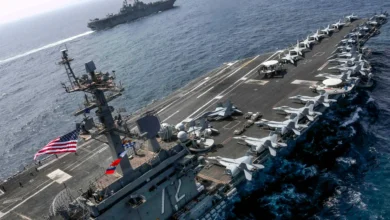
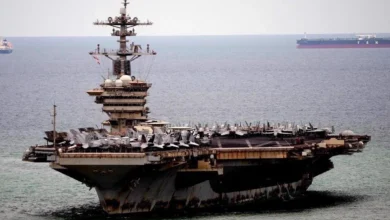
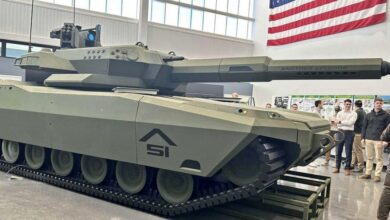
Trump versus a hypersonic Admiral… who would win?
Although the hypothetical “Trump” vessel might enjoy certain advantages, it would have no effective answer to the advanced hypersonic weapons of the “Admiral Nakhimov”.
According to The National Interest, U.S. President Donald Trump recently surprised the world, including leaders of the U.S. Navy, when he announced his approval for the construction of what he described as the first American battleship in decades, dubbed the “Trump-class battleship, USS Defiant”.
-
The first year of Trump’s second term: peace, record strikes and the designation of the Muslim Brotherhood
-
Control and Military Bases: An Old Agreement Gives Trump a Solution in Greenland
Based on its proposed specifications, the ship would be massive, with a displacement ranging between 30,000 and 40,000 tons. It would function as an American “arsenal ship”, equipped with 128 vertical launch cells, hypersonic weapons, and even directed-energy systems.
The site notes that many experts have pointed out that, despite its large size, the proposed Trump class would not be officially classified as a battleship, but rather as something closer to a battlecruiser.
This is a real category of warship that has been operated by the Russian Navy for years, represented today by the Kirov-class battlecruiser Admiral Nakhimov, which remains in service, unlike the aging aircraft carrier Admiral Kuznetsov.
-
How Trump could take control of Greenland’s capital in half an hour
-
Trump threatens to replicate the Venezuela scenario in Cuba and Colombia
While the Admiral Nakhimov’s displacement is technically lower than that of the proposed Trump-class battlecruiser, at around 28,000 tons, it performs many similar roles.
Unlike the American proposal, the Admiral Nakhimov already exists, and its hypersonic weapons and advanced air-defense systems are fully operational and have proven effective.
By contrast, the United States has yet to build a Trump-class vessel and remains far from fielding deployable hypersonic or directed-energy weapons, although Washington is clearly drawing inspiration from Moscow in designing this new warship.
-
In 2026… Pending Items on Trump’s Foreign Agenda
-
Surprise 2026… Trump Builds the American Arc de Triomphe
It is intriguing to imagine what a confrontation between the Trump-class USS Defiant and the Kirov-class Admiral Nakhimov might look like.
Traditional battleships are designed for direct engagement and for inflicting massive damage on enemy ships and positions using large 16-inch guns, while relying on thick armor for protection. In the case of the Trump vessel and the Admiral Nakhimov, however, priority is given to long-range saturation strikes and the ability to absorb powerful blows.
To understand how a hypothetical naval battle between these two giants would unfold, one must examine the design philosophies underlying these comparable Russian and American systems.
-
Trump’s decision blows up the Muslim Brotherhood from within: factional warfare over the organization’s funds in London
-
Trump Plans to Appoint a U.S. General to Lead the International Force in Gaza
While the American ship has not yet been built, the Russian vessel was launched in 1988. Three units were constructed, of which only one remains in active service.
The projected length of the Trump vessel would range between 260 and 270 meters, compared with 251 meters for the Admiral Nakhimov. The Russian ship has a beam of 28.5 meters, while the American vessel’s beam would be between 32 and 35 meters.
So far, the propulsion system and maximum speed of the Trump vessel remain unknown, whereas the Admiral Nakhimov is powered by two nuclear reactors, boilers, and steam turbines, allowing it to reach a top speed of about 32 knots.
-
Trump’s peace plan for Ukraine: deadline for Kyiv until Thursday, and Putin comments
-
Trump insists on nuclear tests as senior officials oppose any detonation
The expected armament of the American ship would include nuclear-capable cruise missiles, a conventional prompt-strike system with 12 cells, 128 MK-41 vertical launch cells, and two RIM-116 launchers with rotating mounts.
It would also feature a railgun, two MK-45 62-caliber guns, four 30-mm cannons, and directed-energy weapons. In addition, it could carry V-22 Osprey aircraft and future vertical-lift helicopters.
The Russian ship’s armament includes 80 anti-ship missile launchers, 96 S-400 surface-to-air missile launchers, two K-33 Osa-M4 systems, Pantsir-M air-defense systems, and a dual-purpose 130-mm gun.
-
The power went out during the interview… What did Zelensky say about Trump and Putin?
-
Trump’s threat to Nigeria: turmoil at the Pentagon and a reshuffling of priorities
It is also equipped with ten 533-mm torpedo tubes, an RBU-6000 anti-submarine rocket launcher, two RBU-1000 systems, and can carry three Kamov Ka-27 helicopters.
Assuming such a theoretical engagement were to occur, the Americans would have to acknowledge Russian superiority in the development, production, and deployment of reliable hypersonic weapons.
The strengths of the Trump class would lie in superior sensor fusion and battle-network integration, and most experts believe it would feature a more robust missile-defense architecture.
-
Trump hails the dawn of a historic new era in the Middle East
-
Trump threatens to use it: What is the Insurrection Act?
However, if the warship were struck by hypersonic weapons launched from the Admiral Nakhimov, it is likely that no air-defense system could adequately protect the Trump-class battlecruiser.
Another drawback of the Trump class is its sheer size. Current projections suggest a displacement exceeding 35,000 tons, making it easily detectable and trackable by radar.
Moreover, the ship’s extremely high cost would make U.S. leaders reluctant to risk it in combat, given the financial losses and the severe impact on U.S. naval surface-warfare capabilities should it be destroyed.
-
Trump’s Plan for Gaza: Hamas Leader Reveals Timeline for Movement’s Response
-
The Trump–Netanyahu alliance remains too strong to be shaken by the attack on Qatar
By contrast, the design philosophy of the Admiral Nakhimov focuses on maximizing offensive missile firepower, combined with heavy armor and nuclear propulsion that provides long-term endurance surpassing that of many competitors.
The ship’s most distinctive feature is its arsenal, which includes P-800 Oniks and Zircon hypersonic missiles, Kalibr cruise missiles, and naval air-defense systems such as the S-400 and S-300F.
It is renowned for its ability to carry a large missile payload and for its robust construction, although its sensor architecture is older and its networks less efficient than those of American systems. Its limited numbers also make maintenance more challenging.
-
Trump Denies Approving Israeli Strike on Hamas Leaders in Doha
-
Eyes in the sky and patrols on the ground: securing Trump’s visit to Britain
In any confrontation, the side that achieves accurate targeting first gains a decisive advantage. The Americans would rely on satellites, MQ-25 drones, and submarines to monitor the Russian vessel.
The Russians, in turn, would use long-range radars, space-based surveillance systems, and maritime patrol vessels to track and identify the Trump ship.
During the hypothetical engagement, neither warship would approach visual range. The American ship would launch LRASM missiles, while the Russian vessel would respond with Kalibr cruise missiles and possibly Zircon hypersonic missiles.
-
The last warning from Katz and Trump to Hamas: release the hostages or Gaza will be destroyed
-
Trump plans to revive the War Department: what do we know about the Pentagon?
At that point, the battle would turn into a long-range missile contest rather than a close-quarters naval duel.
Both ships would employ multilayered defenses, including long-range interceptors, medium-range surface-to-air missiles, close-in defense guns and missiles, as well as electronic warfare and decoys.
The main determining factor would be the quality of fire-control systems on both sides and the reliability of the interceptors carried by each warship.
-
Trump to Chair Expanded Meeting on Gaza Amid Low Expectations for a Near Agreement
-
Fingers on the Trigger in the Caribbean: Maduro Confronts Trump’s Destroyers
Ultimately, however, the decisive element would be the presence of Russian hypersonic weapons. While the American ship would likely possess superior intelligence, surveillance, and reconnaissance capabilities, no known defenses exist aboard Trump-class ships against Zircon hypersonic missiles.
Therefore, in this decisive confrontation, these hypersonic weapons, combined with the absence of an American equivalent or effective countermeasures, would likely lead to the defeat of the Trump-class battlecruiser in a relatively short time.
-
After a 40-Minute Call… Trump Announces Preparations for a Meeting Between Putin and Zelensky
-
After Lebanon’s Commitment, Trump’s Envoy Urges Israel to Take Parallel Measures
-
Trump and Sudan: Can the Still Waters Move Again?
-
Trump-style Politics: How Germany’s Far Right Plans to Seize Power
-
Trump Urges Hamas to Accept 60-Day Truce After Israel Agrees to Terms