S-400: Moscow’s Shield That Disrupts NATO’s Calculations
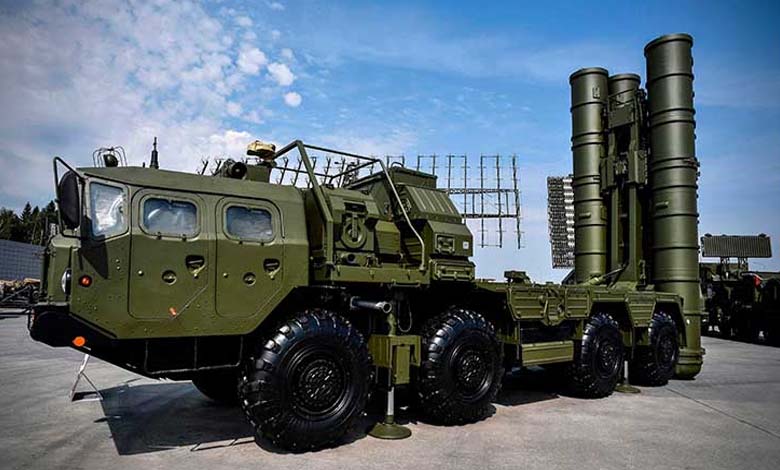
Despite the years that have passed since its entry into service and the rapid pace of military technological competition, the Russian S-400 system remains a central component of regional and international deterrence equations.
While several countries seek to acquire it to strengthen their defensive umbrella, Western capitals often regard it as a disruptive factor for allied systems integration, particularly within the North Atlantic Treaty Organization (NATO), where the S-400 has evolved from a mere air defense system into a political and strategic symbol reflecting the balance of power between Moscow and the West.
-
The Russian Harmony system: A secret ploy to shield nuclear submarines
-
Production Gap: Deadly Flaw in U.S. Missile Shield Exposed by Iran War
The S-400 is a long-range surface-to-air missile system developed in Russia to counter aircraft, cruise missiles, and ballistic missiles. It is not a single missile but rather an integrated air defense architecture designed to deny adversaries air superiority across vast areas.
Developed by Almaz-Antey as the successor to the older S-300 system, the S-400 entered service with the Russian military in 2007. It was designed to modernize the Soviet layered air defense doctrine, emphasizing extended range, multi-target engagement, and enhanced radar discrimination capabilities.
-
Britain’s Nuclear Shield Returns to the Skies on F-35 Wings
-
HQ-19: An Advanced Chinese Shield Enters Pakistan’s Defense Calculus
Operationally, it forms a backbone of Russia’s anti-access and area-denial strategy. Core components include the 91N6E “Big Bird” acquisition radar, the 92N6E “Grave Stone” engagement radar, a command-and-control vehicle, and multiple mobile launchers. The system can also be integrated with other defensive assets, such as Pantsir systems, S-300 batteries, and early warning radars.
The S-400 operates as part of a broader integrated air defense network, sharing targeting data among units and coordinating engagements at multiple altitudes. It can launch different types of missiles at varying ranges: the 40N6 missile is reported to have a theoretical range of up to 400 kilometers, while the 48N6 family covers intermediate distances. The shorter-range 9M96E2 missile, with a range of about 120 kilometers, is optimized for engaging maneuvering targets and providing point defense.
-
T-90M: Russia’s Steel Shield Dominates the Battlefield
-
Moscow Surrounds Its Presence in Syria with a “Shield of Mystery”
The system is capable of tracking dozens of targets simultaneously and engaging several at once. It is designed to counter high-altitude bombers, low-flying cruise missiles, and certain ballistic missile threats.
Through the S-400, Russia can establish anti-access and area-denial zones protecting the capital, military bases, and strategic infrastructure, forcing adversaries to adjust flight paths, operate at lower altitudes, or rely on long-range precision munitions. Its presence directly influences NATO air planning, encouraging the use of stealth aircraft, long-range weapons, and electronic warfare.
-
Beijing Strengthens Defense Capabilities with the “HQ-19”: A Missile Shield Protecting Chinese Airspace
-
The Miracle of Dunkirk… how 338,000 soldiers escaped the clutches of the Nazi army
Among its strengths are long detection range, multiple missile options, mobility, and psychological deterrence value. However, the S-400 is not without limitations: its real-world performance depends heavily on operator training, it can be targeted in suppression-of-enemy-air-defense campaigns, and it remains vulnerable to advanced electronic warfare measures. Stealth aircraft also complicate its operational effectiveness.
S-400 exports have carried significant geopolitical implications. In China, the system has reinforced coastal air defenses and supported anti-access strategies in the East and South China Seas. In India, its deployment near the borders with China and Pakistan enhances layered defense while complicating relations with the United States.
-
Greenland and the F-35: Does Washington hold the key to the Danish skies ?
-
Minneapolis protests: a testing ground for Trump’s hardline power project
In the war in Ukraine, the S-400 has demonstrated how air defense systems can reshape the battlefield, while also exposing their vulnerability when detected and targeted. Ukraine’s use of Western long-range weapons further illustrates the potential to degrade even layered defense architectures.
Strategically, the S-400 symbolizes Russia’s capacity to export advanced weapons systems and expand its influence through military-technical dependence. At the same time, it complicates Western air power planning, compelling potential adversaries to undertake more costly and complex suppression campaigns.
-
In 2026… Pending Items on Trump’s Foreign Agenda
-
Surprise 2026… Trump Builds the American Arc de Triomphe