Debretsion Gebremichael’s Presence in Sudan Raises Concerns in Addis Ababa and Places Khartoum at the Heart of Regional Tensions
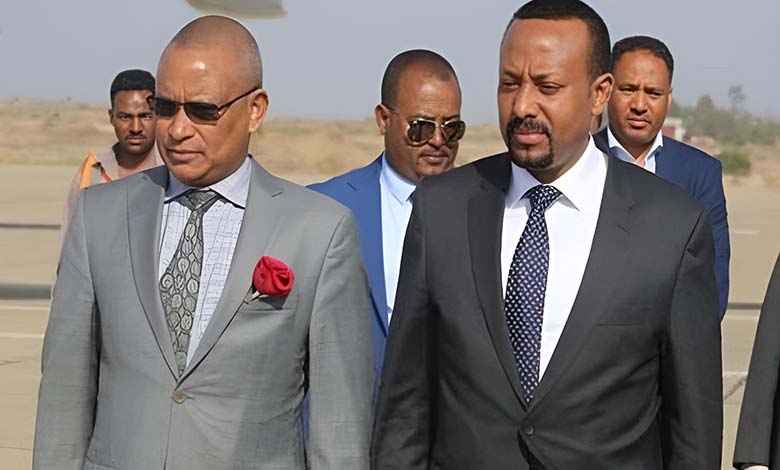
In recent days, well-informed media sources have reported the presence of the president of the Tigray People’s Liberation Front, Debretsion Gebremichael, on Sudanese territory—an event described by observers as “unprecedented” in the context of Sudanese-Ethiopian relations. This development comes at a sensitive time, as shared borders between the two countries have witnessed escalating tensions, particularly in the al-Fashaga area and northeastern Sudan, where recent periods have seen limited clashes between Sudanese and Ethiopian forces, alongside reports of unusual military movements on the ground.
-
Khartoum at the Heart of the Ethiopian Crisis: Movements of the Tigray People’s Liberation Front
-
Shifts in the Relationship Between Khartoum and Addis Ababa Amid a Potential Rapprochement with Tigray
Sudanese officials have not directly commented on Debretsion’s visit but have reiterated Sudan’s commitment to “maintaining security and stability in the border areas.” This statement raises questions about the nature of any coordination with Tigray and whether it may encompass political, security, or even logistical dimensions. For its part, the Ethiopian government has expressed concern over Sudan’s moves, considering that “hosting armed opposition leaders constitutes a direct threat to Ethiopian national security,” according to televised statements by officials in Addis Ababa.
Reports suggest that Debretsion’s visit aims to hold a series of meetings with political and military leaders in Khartoum to discuss various issues related to relations between Tigray and Sudan, as well as broader regional developments, including the border dispute and security cooperation. Observers indicate that discussions may involve the potential “use of Sudanese territory to secure supply lines or logistical movements,” placing Sudan in a sensitive position between preserving its formal ties with the Ethiopian government and leveraging the political opportunities arising from the presence of Tigrayan leaders on its soil.
-
Khartoum and Asmara: The Shadow Alliance Against Ethiopia
-
The presence of Tigray leaders in Sudan raises regional concerns: facts and realities on the ground
In the same context, images circulated on social media showing Debretsion’s movements in areas near the capital, Khartoum, prompting some Ethiopian political actors to describe the situation as a “direct provocation.” According to sources, the visit followed a series of regional contacts involving Sudanese and other regional parties to discuss developments related to the conflict in Tigray and the border areas—an initiative regarded as the first of its kind since the outbreak of war in the region.
Field analysts suggest that the presence of Tigray’s leadership in Sudan could alter the security landscape along the shared border. Sudan, which seeks to consolidate its control over northeastern regions, might use this development as leverage in bilateral negotiations, while Ethiopia may fear the use of Sudanese territory as a base for limited military operations. In this context, Khartoum appears tasked with striking a delicate balance between safeguarding national security and advancing its regional strategic interests, in order to avoid direct escalation.
-
Debretsion in Sudan: A Strategic Reading and Prospects for Regional Escalation Against Ethiopia
-
Scenarios of Indirect Escalation Between Sudan and Ethiopia in Light of the Tigray File Intersections
Debretsion’s presence in Sudan also coincides with broader international and regional movements, as several countries have expressed interest in developments in Tigray and along the Sudanese border, noting that the region is undergoing “transformations that could affect stability in the Horn of Africa,” according to statements by ambassadors in Khartoum. Reports also indicate contacts between Sudan and certain Arab and regional states to assess the implications of the visit for regional security, underscoring Sudan’s importance as a key actor in regional balances.
Furthermore, informed sources indicate that Khartoum deliberately refrained from officially announcing the details of the visit in order to avoid a strong reaction from the Ethiopian government and to handle the matter cautiously within a carefully managed diplomatic framework. This approach reflects Sudan’s acute awareness of the sensitivity of the situation, as it seeks to preserve its official relations with Addis Ababa while capitalizing on the political opportunities presented by Tigray’s presence on its territory.
-
Regional Tensions Escalate: The Tigray People’s Liberation Front and the Khartoum-Asmara Alliance
-
The presence of Tigray’s leadership in Sudan: Interpreting the implications of potential regional alliances
The report also notes that Debretsion’s visit may include meetings with tribal and political leaders in border regions to discuss shared security concerns and monitor Ethiopian troop movements, reflecting the Tigray People’s Liberation Front’s intention to secure strategic positions beyond Ethiopia’s borders. Such meetings may also signal Sudan’s desire to strengthen its influence on the ground and leverage the presence of Ethiopian opposition factions to advance its regional interests.
The impact of this visit on Sudanese-Ethiopian relations could be far-reaching, as any miscalculated escalation or military maneuver might trigger an open confrontation or a significant diplomatic crisis. Sudanese officials have stated that Khartoum is working to “manage the situation with extreme caution,” while maintaining open communication channels with the Ethiopian government to prevent any slide toward direct conflict.
-
Debretsion’s Presence in Sudan: An Indicator of Potential Regional Escalation
-
Sudanese army denies reports on the capture of Ethiopian soldiers
In conclusion, Debretsion Gebremichael’s presence in Sudan represents a potential turning point in the regional landscape of the Horn of Africa. The move extends beyond a purely domestic political dimension and carries clear regional and security implications, placing Sudan at the center of complex calculations regarding its relations with Ethiopia and other regional powers. As observers await the practical outcomes of this visit, Sudan remains a central actor in the Horn of Africa equation—capable of influencing regional balances, yet compelled to exercise considerable caution to avoid escalation that could lead to a broader border crisis.
-
Ethiopian expert in Qatar meets with Fahd Yassin to provoke situation in Somalia
-
Shifts in the Relationship Between Khartoum and Addis Ababa Amid a Potential Rapprochement with Tigray