A parliamentary report reveals a troubling rapprochement between ‘La France Insoumise’ and the Muslim Brotherhood
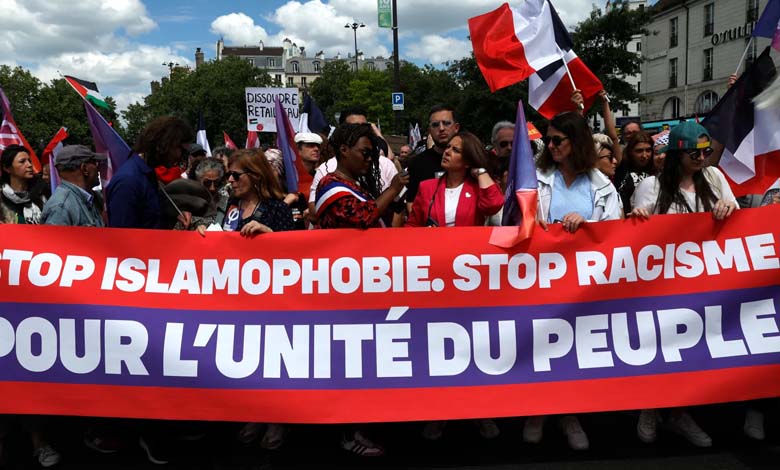
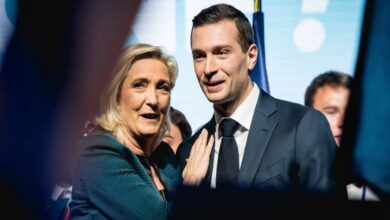
A parliamentary inquiry committee has concluded that there is a documented ideological and political rapprochement between members of the party La France Insoumise and currents of political Islam.
The 650-page report provides a detailed mapping of the mechanisms through which radical political Islam and Muslim Brotherhood projects are spreading in France, while identifying varying degrees of conscious or unconscious complicity among local and national political leaders.
-
The Brotherhood’s Claw Resurfaces in France… What Is Baraka City About?
-
France Unmasks the Muslim Brotherhood: A Late but Decisive Battle
According to the French newspaper Le Figaro, the report’s accusations are directed in particular at the party La France Insoumise.
Published on Wednesday after six months of work, the report draws on nearly forty hearings, including testimony from three ministers and senior intelligence officials.
Rather than offering major “revelations,” the document consolidates findings from journalistic investigations published in recent months and confirms, based on intelligence testimony, the existence of an ideological proximity that is sometimes pronounced between certain elected officials at different levels and Muslim Brotherhood–affiliated movements.
-
The Muslim Brotherhood’s representation for education in France… What do you know about the National Federation for Private Islamic Education?
-
Escalade against the Brotherhood: New measures taken by France to combat the currents of political Islam
The role of intelligence services
Among its sources, the committee relied on assessments by France’s General Directorate for External Security, which identified three main pillars underpinning this rapprochement, though the report does not detail them explicitly. It nonetheless stresses that this proximity takes discursive, organizational, and political forms that intersect with the agendas of political Islam in the French public sphere.
The report also documents how radical Islamist projects have expanded across France through the “infiltration” of organizations involved in electoral processes.
Its conclusions suggest that these connections often stem from a misjudgment of the true objectives of certain individuals or groups, or from conventional electoral calculations that fail to fully grasp the ideological implications involved.
The report warns that this “covert and insidious” infiltration could affect a broad range of political currents.
-
The Muslim Brotherhood in 2025… A Year of Decline and International Constriction
-
Europe’s crackdown on the Muslim Brotherhood: banned networks, financial restrictions and security measures
Accusations against the radical left
However, the document distinguishes this general pattern from more serious cases, which it considers largely confined to parties of the left and far left, particularly La France Insoumise.
It notes that some elected officials have appeared publicly alongside individuals promoting political Islam, and in some cases praising terrorist acts, either for electoral reasons or because of ideological convergence.
An entire chapter is devoted to the radical left movement, which was at the center of the committee’s scrutiny.
-
Global map of the confrontation with the Muslim Brotherhood: bans, classifications, and diversified measures
-
The Muslim Brotherhood in Saxony… the fall of Al-Jazzar exposes the movement’s crimes
Drawing on testimony from experts and local officials, notably prefects of major cities, the report highlights an anti-colonial discourse that portrays Islam and Muslim communities as victims, accompanied by heavy political exploitation of these issues.
The committee concludes that this strategy has made La France Insoumise a preferred target for Islamist entryism.
While electoral strategy in itself is not condemned, it has led some elected officials to adopt troubling, and potentially dangerous, positions, reflecting a degree of complacency or even active support for individuals and networks that promote political Islam or endorse violence.
-
Berlin Rebuilds Its Army: Historical Precedents Worry France, While Poland Supports
-
The Muslim Brotherhood in the UK: Ideological Expansion and a Failure to Confront It
The report gains additional weight from the testimony of a former senior figure of La France Insoumise in northern France, who remained anonymous. He argued that the situation reflects not so much infiltration as a deliberate political choice aimed at attracting these voter groups to secure decisive votes in the second round of presidential elections. He described this as a “cynical choice” that poses a threat to democracy, particularly when combined with proximity to foreign states and external funding.
This parliamentary work follows earlier assessments published by the French Ministry of the Interior in March regarding the influence of the Muslim Brotherhood in France.
It reopens a broad debate on the limits of electoral pragmatism, the dangers of politicizing religion, and the protection of the principles of secularism and democracy.
-
The Muslim Brotherhood specter cancels a pro-Palestinian conference in France
-
After the Muslim Brotherhood’s branch ban: mapping terrorist and extremist organizations in Berlin