Abrams: an American tank that defies time
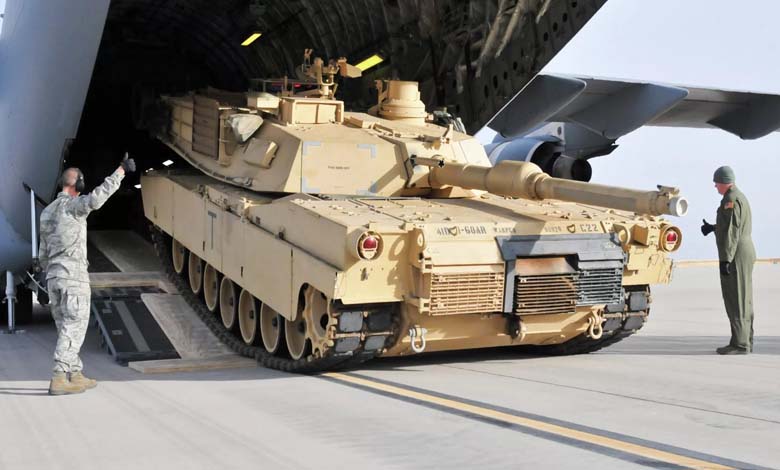
Despite its age and growing threats, the American “Abrams” tank has maintained its relevance on the battlefield thanks to continuous upgrades.
According to National Interest, the US Army’s M1 Abrams main battle tank is nearly half a century old. It first entered service in 1980, and six years later an improved version, the M1A1, was introduced.
-
The Abrams Deal… Can Bucharest Bear the Cost of Military Ambition?
-
The Wounded Beast: Abrams tanks return to Ukraine with Australian backing
Although the Abrams was developed for use in Europe in a conventional war against the Soviet Union, it was first tested in combat in the Iraqi desert during the 1991 Gulf War, where it engaged and effectively destroyed Soviet-made T-72 tanks.
More than 10,000 Abrams tanks of all variants have been produced. The tank measures 7.93 meters in length and has a total weight of 54 tons.
It is powered by a 1,500-horsepower Honeywell multifuel turbine engine, reaching a top speed of approximately 72 km/h on paved roads, with a range of about 426 kilometers on roads.
The M1 Abrams is named after the late General Creighton W. Abrams, former Chief of Staff of the US Army and commander of the 37th Armored Battalion.
-
Russia Destroyed Most of Them: How the Reign of the Abrams Tank Collapsed in Ukraine
-
Modified M1 Abrams in Australia’s hands: Learn about the tank’s features
In its various versions, the tank has remained the backbone of US armored forces for more than 45 years, a remarkable achievement after decades of efforts to develop an effective tank prior to the Abrams.
In the post-World War II era, the US Army designed between 15 and 20 different tank models, including light, medium, heavy, and main battle tanks.
Until 1980, the United States relied primarily on the M60, known as the “Patton,” as its main battle tank. During that period, the US Army was widely seen as lagging behind the Soviet Union in tank development.
The shortcomings of the M60 became evident in the 1960s and 1970s. While it performed relatively well against Soviet T-54/55 and T-62 tanks, it was outmatched by newer models such as the T-64.
-
Behind the scenes, the US Army deploys artificial intelligence beyond the battlefield
-
Australia examines the hypothesis of an Iranian link to the armed attack in Sydney
The M1 was therefore designed as a major leap forward for American armored forces, providing greater mobile firepower, capable of engaging and destroying any approaching armored combat vehicle while ensuring crew protection in virtually any combat situation or environment.
Although weapon systems are typically refined through combat experience, the Abrams entered service in 1980 and underwent a decade of development and refinement before its first major combat engagement.
Its original main armament was the 105 mm M68A1 rifled gun, which was powerful at the time but soon proved inadequate.
-
The T-95 tank… Leaks revive the Soviets’ lost dream
-
Despite its losses in Ukraine, the US Army upgrades the Bradley
In 1985, the US Army addressed this by developing the M1A1 version, slightly longer and heavier, equipped with the more powerful 120 mm M256A1 smoothbore gun.
Improvements also included an upgraded suspension system, enhanced armor protection, and a nuclear, chemical, and biological protection system. These enhancements increased the tank’s weight and slightly reduced its speed, but confirmed its superiority.
After the Gulf War, the Abrams was upgraded to the M1A2 version, incorporating an independent thermal viewer for the commander, an improved weapons station, integrated diagnostics systems, and a more advanced fire control system.
-
Russia’s Iskander-M changes the rules of the game as the Patriot struggles
-
Arms race in the Pacific: Australia injects billions to upgrade its naval infrastructure
Despite the effectiveness of this version, it was not fully suited to the evolving conditions of modern battlefields.
Upgrade packages were therefore introduced, including improved processors, color flat-panel displays, increased memory capacity, an enhanced user interface, and a new open operating system designed to run a common operating environment.
The third major upgrade, SEPv3, introduced significant improvements to address space, weight, and power constraints, and became the foundation for subsequent upgrades.
Enhancements have focused on increasing electrical power margins, implementing vehicle health management systems, integrating protection against improvised explosive devices, adding a new auxiliary power unit for silent watch capability, embedded training, and ammunition data links.
-
Is War Approaching? Venezuela Deploys Warships and Drones in Response to U.S. Moves
-
Washington’s Bet on Banning ATACMS Does Not Threaten Ukraine… What Is the Secret?
The latest version has been described as the most reliable Abrams ever produced, reducing the US Army’s logistical footprint and leading in connectivity with maintenance and supply systems.
The future
Looking ahead, the US Army has closely monitored developments in the war in Ukraine and the challenges tanks have faced there. This prompted a reassessment of its upgrade program to address vulnerabilities observed on that battlefield.
In September 2023, the US Army announced that it would not proceed with the development of the M1A2 SEPv4.
Instead, it will focus on the M1E3, aiming to produce a next-generation tank capable of remaining competitive on battlefields in the 2040s and beyond.
-
Unexpected Russian Interpretation of Missile Deployment Agreement… A Frightening Outcome
-
From Simplicity to Smart Armor: The Top 10 Battle Tanks
One of the reasons for abandoning the SEPv4 was that decades of upgrades to the M1 had largely involved adding more armor and advanced equipment, resulting in increased weight.
The M1E3 Abrams was officially unveiled at the Detroit Auto Show last month. The new tank will retain its 120 mm M256 main gun and feature a redesigned turret.
It will be equipped with external sensor units enabling driver assistance systems, autonomous navigation capabilities, and enhanced situational awareness.
The M1E3 displayed in Detroit was only a prototype. The final design and features are likely to evolve as the US Army continues developing a more compact and efficient main battle tank, potentially allowing the Abrams to remain in service for decades to come.
-
U.S. Support Halted: Dangerous Scenarios for Ukraine in Its Fight against Russia
-
US army announces the killing of an ISIS leader responsible for terrorism in Europe