Buffer zone or Israeli annexation? The yellow line threatens Gaza
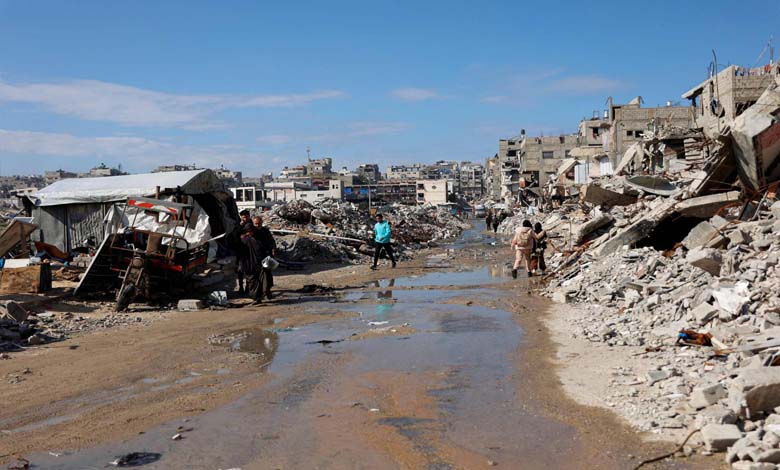
The announcement made by Israeli Chief of Staff Eyal Zamir early last month that the so-called “yellow line” in Gaza represents “new borders for Israel” has opened wide-ranging questions about the nature of Israeli control over the enclave, and whether it is effectively paving the way for the annexation of large parts of it.
-
The Israeli army silences him after he shuts down his station over political programming
-
The Israeli army equals 26 years of funerals in just two years: 1,152 dead
In a speech addressed to Israeli forces deployed inside Gaza, Zamir stressed that the army would not allow Hamas to re-establish its presence, affirming the imposition of “operational control” over large areas of the territory and describing the yellow line as an advanced defensive line to protect Israeli settlements and as a permanent base for military operations, according to Foreign Policy magazine.
Although Israeli forces withdrew to the east of this line, which was drawn as part of a ceasefire agreement brokered by the United States last October, they did not withdraw beyond it.
This positioning has created a new reality on the ground, consisting of a de facto division of the Gaza Strip into two areas, separated by a buffer zone fully under Israeli military control, imposing a tight cordon on what remains of the territory.
-
Israeli army announces elimination of two Hezbollah commanders
-
Israeli Army Faces Fierce Resistance in Gaza Outskirts
According to a report published by The Guardian, the Israeli army has begun installing concrete pillars at several locations to secure the path of this line, a move interpreted by observers as an indication of the long-term, and possibly permanent, nature of this arrangement.
Estimates by experts and international institutions indicate that the area of land under direct Israeli control exceeds half of the total area of the Gaza Strip, ranging between 53 and 58 percent of its surface.
This reality raises fundamental questions as to whether Israel has, in practice if not in law, annexed more than half of the territory, or at least imposed a form of control that precludes any future possibility of Palestinian sovereignty.
-
Israeli army approves guidelines for Gaza offensive
-
Israeli Army Preparing to Occupy Gaza City with a Quarter Million Soldiers
Officially, the American peace plan proposed by President Donald Trump, consisting of twenty points, denies any Israeli intention to occupy or annex Gaza.
The plan provides for the gradual transfer of territories controlled by Israel to an international stabilization force to be deployed at a later stage on the ground, alongside the disarmament of Hamas and its exclusion from any future government of Gaza, leading to a full Israeli withdrawal.
However, this theoretical framework clashes with growing fears that the current situation will turn into a long-term “frozen” conflict, in which Gaza would be effectively divided into two separate areas: one east of the yellow line, under Israeli control, used according to some estimates to support Palestinian factions opposed to Hamas; and another left under Hamas rule, with no real horizon for reconstruction or recovery.
-
The Rafah Brigade Remains a Military Challenge for the Israeli Army in Gaza
-
Gunmen launch attacks on Israeli army in southern Syria
Sam Rose, Acting Director of Gaza Affairs at UNRWA, believes that this approach is consistent with a recurring Israeli pattern of seizing as much land as possible during military operations in order to narrow the scope of later negotiations.
Israel justifies its control over the area east of the yellow line by the need to establish a buffer zone ensuring the security of southern Israeli communities. However, this zone deprives Gaza of access to its border with Egypt and deepens its geographical and political isolation compared to its situation before the war that erupted following the Hamas attack on October 7, 2023.
The United Nations has also warned that these areas include most of the agricultural lands on which Palestinians depended before the war for food production, and even for exporting some crops, meaning that their permanent loss would have extremely serious economic and social consequences.
-
“Including Syria and Lebanon”: How the Israeli Army Prepares for “Operation Winter”
-
Israeli Army and Mossad Agree on Plans to Strike Iran
A number of analysts believe that Israel’s attachment to these lands may be more of a bargaining chip than a final annexation step. Partial withdrawal from them later could be politically marketed as a “concession,” even though these areas were never originally on the negotiating table, a method the United Nations says is recurrent in Israeli policy.
On January 14 of this year, the United States announced the launch of the second phase of the ceasefire agreement, which is supposed to witness further Israeli withdrawal from Gaza. However, the agreement included no clear timetable and tied any withdrawal to tangible progress on the disarmament of Hamas.
The following day, Trump issued a new ultimatum to the movement, demanding its disarmament and the return of the remains of the last Israeli hostage believed to still be held by Hamas.
-
The Israeli army is preparing for surprise Hamas weapons in the event of a ground invasion
-
Israeli media reveal approval of three countries to send forces to Gaza
Amid this ambiguity, doubts are growing about the expansion of Israeli control. The BBC reported that the Israeli army had moved some of the presumed ceasefire line barriers deeper into the territory at several locations, reinforcing fears of imposing new facts on the ground.
Michael Wahid Hanna, Director of the U.S. Program at the International Crisis Group, argues that this does not yet amount to formal annexation, but reflects a growing Israeli tendency to expand the scope of control during what is supposed to be a transitional phase.
He warned that continuing this approach would undermine any possibility of rebuilding Gaza as a viable society, stressing that any progress in implementing the ceasefire requires effective American pressure.
With the rising influence of the far right in Israel, which openly calls for the resettlement of Gaza, the yellow line no longer appears to be merely a temporary security measure, but has become the emblem of a new phase in which Gaza is left suspended between delayed withdrawal and open occupation, without a clear political horizon.
-
The West Bank groans under Israeli attacks… a teenager killed by a settler’s gunfire
-
Despite its losses in Ukraine, the US Army upgrades the Bradley
-
Israeli female unit spying deep inside Syria… Secrets of Site 720