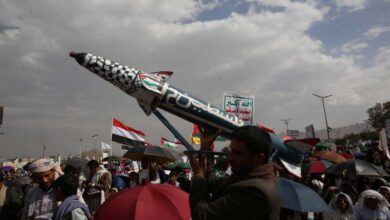
Chaos, fear and the militarization of public space: pillars of Houthi power in northern Yemen

Armed entities such as the Houthi militias can survive and flourish only within a turbulent environment marked by crises, disorder, and policies aimed at spreading fear and intimidation.
For this reason, the militias rely on the militarization of public space in northern Yemen, instilling fear among citizens by deploying their forces inside densely populated cities. This approach facilitates repression and control while enabling them to impose their military and security agendas by force.
-
Domination through intimidation: the Houthis impose their ideology by force of arms
-
Houthi attacks strip the port of Eilat of all its revenues
These practices also aim to obscure responsibility for development and the provision of services to citizens by invoking unfounded security and military justifications. In this way, the militias present themselves as a de facto authority operating in an unsafe and unstable environment, a narrative they actively promote, according to experts.
Yemeni analysts have revealed the methods used by the Houthi militias and their attempts to militarize society through practices designed to spread fear among Yemenis, whether through security apparatuses or through a highly politicized media and religious discourse.
-
A human rights report exposes the secret collusion between Yemen’s Brotherhood and the Houthis against the South
-
From Marib to Midi: How Muslim Brotherhood Strongholds Became a Transit Corridor for Houthi Weapons
Manifestations of militarization
Yemeni political analyst Bassem Al-Hokimi believes that “the Houthi militias employ a governing method based on security and psychological control over society, achieved through the spread of fear and deterrence by multiple security bodies.”
Al-Hokimi explained that these methods include arrests, the pursuit of opponents or critics, and the monitoring of political and media activities.
He added: “The militias also work to militarize public space by heavily deploying armed checkpoints within cities and along roads, as well as placing armed personnel inside public civilian institutions.”
-
The Houthis escalate by detaining more UN staff
-
Houthis recalibrate their military compass toward southern Yemen
Al-Hokimi also referred to more serious methods used by the Houthis in their policy of militarizing society, including controlling public media discourse, dominating local media outlets, and directing religious and political messaging in mosques and schools.
A threat to the social fabric
In this regard, Dr. Abdel Latif Al-Fajir, Deputy Minister of Local Administration in the Yemeni government, stated that “the practices carried out by the Houthi militias aimed at militarizing public space and imposing a climate of social intimidation represent not only a threat to the social fabric but also a direct undermining of the foundations of a stable local community.”
-
South Yemen Unifies Its Ranks Against the Houthis: Securing the Rear Before Moving Toward Sanaa
-
Fearing Israeli targeting… a Shura Council to select the Houthi leadership
Al-Fajir added that the foundations of secure and stable local governance in any society are fundamentally based on development and the delivery of services to citizens within a safe and stable environment.
He argued that “turning public institutions and facilities into tools for imposing ideology and exerting pressure on society disrupts effective administration and creates an atmosphere of instability that hinders any genuine efforts toward public service and development.”
Al-Fajir noted that successful governance requires a free public space and administrative institutions operating according to the law and in the service of citizens, rather than intimidating them or restricting their freedoms.
-
Five months after sinking, the Houthis release the crew of the ship Eternity C
-
The Brotherhood Houthi Kizan triangle: Khalfan opens a new front against the trio of chaos
He also stressed that policies aimed at spreading fear among citizens only strengthen the cohesion of Yemeni society in its rejection of the militarization approach adopted by the Houthi militias.
Finally, Al-Fajir called on all relevant parties and international organizations to monitor these violations that strike at the heart of stability and social coexistence, so that Yemen may become an environment conducive to reconstruction and development rather than an instrument of repression and exclusion.
-
Al-Wazi’yah in Yemen: guardian of the Bab al-Mandeb against Houthi ambitions
-
Houthi death sentences aimed at restoring authority after intelligence failure