Destination Iran: the United States withdraws thousands of smart bombs from South Korea
South Korean defense sources have revealed that the United States has withdrawn more than a thousand smart bomb guidance kits from its military stockpiles in South Korea as part of the broader military confrontation with Iran.
These kits consist of guidance devices that operate using the Global Positioning System (GPS) or laser technology, along with control wings that can be attached to conventional bombs to convert them into precision-guided munitions.
-
Russia gains economic and geopolitical advantages from the war against Iran
-
Operation behind enemy lines: a U.S. plan to take control of Iran’s nuclear material
The cost of a single kit ranges between 20,000 and 55,000 US dollars, making it a more economical option compared with other types of smart munitions while still maintaining a high level of targeting accuracy.
However, military experts believe that the effectiveness of these bombs during the early stages of any conflict with Iran may be limited, since their use requires fighter jets or bombers to fly over target areas before releasing them. This requirement could expose those aircraft to significant risks given Iran’s advanced and multilayered air defense network.
These challenges have already been observed during U.S. air operations over Yemen, where F-16 and F-35 fighter jets were forced to perform repeated evasive maneuvers to avoid local air defenses, even though they are far less advanced than the systems possessed by Iran.
-
Intense Iranian attacks on Gulf countries in the early hours of dawn
-
Saudi Arabia signals possible retaliation if Iran continues attacks on its territory
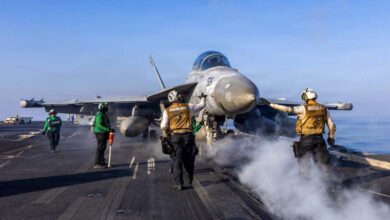
A B-1 Lancer bomber releases munitions.
Discussions on transferring air defense systems to the Middle East
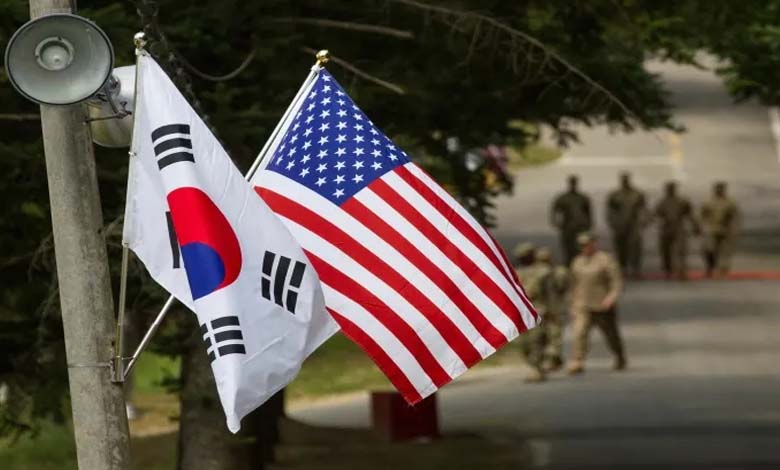
The withdrawal of guided bombs coincides with intensive military discussions between Washington and Seoul regarding the redeployment of U.S. air defense systems currently stationed in South Korea to the Middle East.
South Korean Foreign Minister Cho Hyun confirmed that the U.S. and South Korean militaries are discussing the possibility of transferring some long-range MIM-104 Patriot air defense batteries belonging to the U.S. Army in order to support potential military operations against Iran.
-
Iran after Khamenei: a disoriented regime and a silent struggle over the Supreme Leader
-
Latest news of the war against Iran: Israel attacks 400 targets in 24 hours
This move would not be unprecedented. The U.S. military previously redeployed two Patriot systems, along with around 500 troops, from South Korea to the Middle East between March and October 2025.
The withdrawal of the fleet of U.S. AH-64 Apache attack helicopters from South Korea last January also raised concerns within South Korean defense circles regarding the potential impact of these moves on the military balance on the Korean Peninsula.
South Korean reports also indicate that the Pentagon is considering broader options, including redeploying elements of the advanced THAAD missile defense system, one of the most sophisticated missile defense systems operated by the United States. South Korea remains the only foreign country to host a permanent deployment of this system since 2016.
-
Aircraft from the Vietnam War era: Iran’s air force as a strategic weakness
-
Between the palace and the hawks in Iran: a battle of attrition and power
Although the most likely scenario involves transferring only interceptor missiles to reinforce U.S. stockpiles in the Middle East, the possibility that American radars, command centers, or launch platforms could be destroyed in the event of a confrontation with Iran might push Washington to replace entire systems using equipment stationed in South Korea.
It should be noted that the United States possesses only eight THAAD systems worldwide, some of which are currently deployed in Israel and Jordan.
-
The sixth attack since midnight: Israel detects and intercepts an Iranian missile attack
-
Iran chooses its new Supreme Leader
Strategic implications in East Asia
These military movements come at a sensitive moment for security in Northeast Asia, as North Korea continues to pursue a broad program to modernize its armed forces at an unprecedented pace. An assessment issued by the U.S. Defense Intelligence Agency in mid-2025 stated that Pyongyang had reached “its strongest strategic position in decades,” with growing military capabilities enabling it to threaten U.S. forces and their allies in the region, while also strengthening its ability to strike the American mainland.
At the same time, some analysts argue that Washington has not carried out a comparable modernization of its forces in South Korea in recent years, which may have led to a gradual imbalance in the military balance on the Korean Peninsula to the detriment of U.S. interests.
-
Gulf states intercept dozens of Iranian missiles and drones
-
Isolation of the West Bank amid the focus on Iran