Erosion of Deterrence Places the Iranian Regime in a Deep Strategic Crisis
A Western report suggests that the Iranian leadership, despite its military and security strength, has lost its psychological deterrence capabilities both externally and internally, and is now unable to find a way out of its crises.
-
Fleeing Iran: Western countries urge their citizens to leave immediately
-
After a five-hour closure, Iran reopens its airspace
Amid a continuous wave of protests and expanding popular unrest, the Iranian regime faces one of the most complex strategic crises since the founding of the Islamic Republic. Challenges are no longer limited to managing an angry street or containing external pressures; they now strike at the very core of a system that relied for decades on a single equation: governance through fear.
Western political analyses, including a study by Michael Singh, Executive Director and Senior Fellow at the Washington Institute, indicate that the Iranian leadership today appears unable to articulate a clear path out of this multidimensional predicament. Despite possessing a large military arsenal and extensive security apparatus, the regime seems to have lost its most effective crisis management tool: the ability to deter, both internally and externally.
-
What weapons could Washington use in a potential attack on Iran?
-
Trump threatens intervention in Iran if protesters are executed
For nearly five decades, Tehran has relied on systematic repression to quell any internal dissent, alongside a foreign policy of exporting tension and destabilization throughout the region. This approach, long seen as effective and relatively low-cost, has begun to show significant cracks in recent years, pushing the regime into an unprecedented strategic deadlock.
The regime’s survival rested on managing two main sources of threat. The first is internal: a young, educated, and increasingly connected Iranian society demanding economic opportunities and expanded political freedoms. The second is external: regional states and international powers, foremost among them the United States, viewing Tehran’s policies as a direct threat to their security and that of their allies. In facing these two vectors, fear was the cornerstone of the regime’s strategy, aiming to convince external actors that any confrontation would lead to full-scale war, and internal actors that protest was futile and unsupported internationally.
-
Trump tightens the noose on Iran by threatening its trading partners
-
Iran protests put Trump to the test between escalation and dialogue
According to the report, however, this equation is rapidly eroding. Externally, the United States and Israel have broken the pattern of hesitation that had defined their policies for years, moving to an unprecedented level of direct confrontation with Iran, including the threat of further strikes. This shift has weakened the deterrence image Tehran sought to maintain and revealed the limits of its escalation capacity.
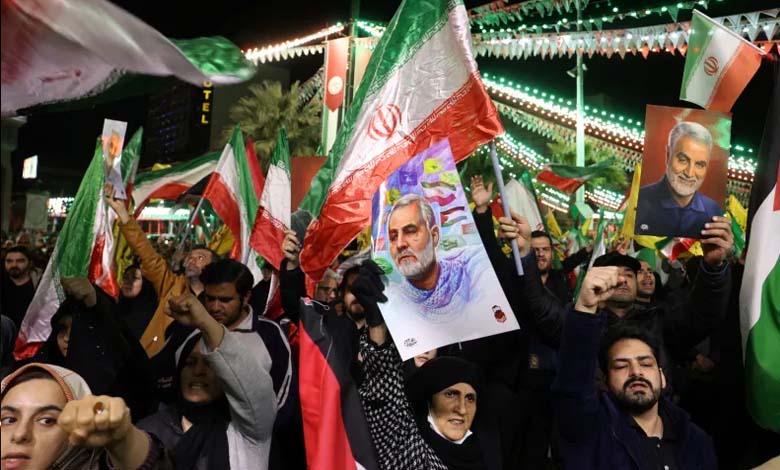
Domestically, despite severe repression, current protests differ radically from previous ones: they are geographically broader, socially more diverse, and encompass a mix of economic, political, and rights-related demands. Their persistence, despite the heavy human cost, reflects the decline of the regime’s long-standing “victory through fear” policy that had prevented large-scale movements.
-
After Trump’s threats, Iran affirms readiness for war and dialogue
-
Iran protests: a growing movement, escalating military rhetoric, and a watching world
The October 7 attack marks a pivotal point: the Hamas attack against Israel and subsequent developments tested the regional influence network Iran had built through allied groups. In a short period of escalation, Israel, supported by the United States, targeted military infrastructure, regional proxies tied to Iran, and sensitive defense and missile capabilities, while Iran’s response remained limited relative to the scale of the strikes.
The crossing of what were considered red lines, including direct attacks on Iranian territory without triggering a full-scale regional war, suggests to analysts that such operations could become a sustainable policy, regardless of political changes in Washington or Tel Aviv. This reinforces the Iranian leadership’s sense that its maneuvering space is rapidly shrinking.
-
Iran draws up a list of Israeli and U.S. targets in response to a potential attack
-
Iran without internet for a second day as the army comments on protests
In this grim scenario, the regime has no easy options. Responding to external demands or making internal concessions would fundamentally contradict the ideological foundations of the system, including hostility toward the United States and clerical monopoly over power. These principles are not seen as revisable policies, but as identity markers and pillars of survival.
Singh argues that the current phase is not suitable for attempts to rescue the regime through agreements or easing pressures; instead, it requires Washington to increase political and economic pressure while providing explicit support to the Iranian people. Nevertheless, he warns that the coming period is fraught with risk, as the regime might, out of desperation, accelerate its nuclear program, intensify repression, or conduct external operations.
-
Israel tracks Iran through three main fronts — amid fears of a surprise factor
-
Nine waves in a quarter century: the history of protests in Iran
Such measures, although appearing to Tehran as survival mechanisms, could in practice backfire: increasing the regime’s isolation, inflaming popular anger, opening the door to further strikes, and potentially accelerating the collapse process it seeks to avoid.
-
British newspaper: Khamenei prepared a plan to flee Iran
-
From Amini to the market protests in Iran: the same anger — with a striking new feature