Gaza submerged by destruction and rain
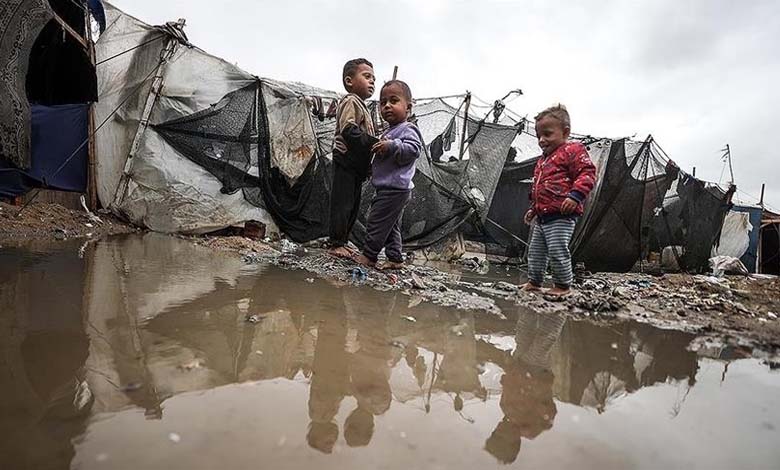
Heavy rains have swept across the Gaza Strip, destroying fragile makeshift camps and worsening the suffering of displaced people who were forced by the war to leave their homes and seek shelter under worn and tattered tarpaulins.
Torrential rainfall accompanied by strong winds has damaged parts of newly established and fragile camps where hundreds of thousands of displaced people live as a result of the war between Israel and Hamas.
-
Rafah Crossing caught between two narratives: Will Netanyahu reconsider opening Gaza’s lifeline?
-
Shelter in Gaza: a battle for survival after the war
Although Gaza’s municipality said it is working around the clock to address the damage caused by the rains and to drain accumulated water, a lack of equipment has limited the effectiveness of these efforts.
Umm Mohammed Ouda, 45, displaced from northern Gaza to the Al-Mawasi area in the south, told Agence France-Presse: “The wind tore down our tent this morning. We remained under the rain for hours, and everything we own was soaked.”
She added: “We have no other tent and no means to protect ourselves from this weather,” as others around her complained of similar damage.
-
Israel and the ban on relief organizations in Gaza: a UN alarm and calls to reverse the decision
-
Israeli media reveal approval of three countries to send forces to Gaza
The war has destroyed more than three-quarters of the infrastructure in the Gaza Strip, according to the United Nations, which also estimates that most of the population has been displaced at least once due to fighting and bombardment since October 7, 2023, when the war began.
Hundreds of thousands of people continue to live in fragile shelters, and tents were already damaged during a storm in early December.
Mahmoud Zaqout, a man in his thirties displaced from Khan Younis in the south to the Al-Zawaida camp in central Gaza, said: “The humanitarian situation worsens with every wave of severe weather.”
-
Gaza residents under bombardment: fear of displacement east of the yellow line
-
Gaza exits the famine stage and enters the critical emergency zone
He added: “We live in tents that cannot withstand harsh conditions. Today, several tents collapsed, and people tried to protect themselves in any way they could.”
On the outskirts of Gaza City, an AFP photographer saw families attempting to refix parts of tents and tarpaulins after the rain damaged part of the Beach Camp, where residents are spread between destroyed buildings, some on the verge of collapse, and newly erected camps.
The United Nations Office for the Coordination of Humanitarian Affairs (OCHA) reported on Tuesday that storms in December affected around 65,000 homes and that some camps were flooded.
-
Sunrise: Details of the U.S. Plan for the Gaza Riviera and the Expected Challenges
-
Rainwater floods Gaza’s largest hospital
Non-governmental organizations expressed concerns to AFP about further deterioration of conditions, particularly due to ongoing difficulties in bringing humanitarian aid into the territory.
Before the “Peace Council”
As part of the post-war phase, Bulgarian diplomat Nikolay Mladenov, a candidate for the position of coordinator of the “Peace Council” under the U.S. plan to end the war in Gaza, held talks in recent days with Israeli and Palestinian officials.
On Thursday, the office of Israeli Prime Minister Benjamin Netanyahu announced that Mladenov “is expected to be appointed as international coordinator of the Peace Council” in Gaza, a transitional body intended to oversee the administration of the territory and chaired by U.S. President Donald Trump.
-
Control and surveillance: What are American AI companies doing in Gaza?
-
Gaza buried under 68 million tons of rubble… and a shocking reconstruction timeline
The Bulgarian diplomat has extensive experience in the region, having served as the United Nations Special Envoy for the Middle East peace process from early 2015 until the end of 2020.
While Trump has not yet officially confirmed Mladenov’s appointment, the Axios website reported, citing U.S. officials and informed sources, that an announcement of the Council is expected next week, as part of the second phase of the ceasefire agreement between Israel and Hamas, which entered into force on October 10.
-
A critical phase begins… Mediators reveal developments in the second phase of the Gaza agreement
-
Rising tensions in Gaza revive questions about the durability of the truce
The report added that the Council is expected to include around 15 world leaders.
Under Trump’s 20-point peace plan for Gaza, the territory would be administered by a temporary transitional Palestinian committee composed of technocrats unaffiliated with political movements, under the supervision and oversight of the Peace Council.
The second phase is expected to include a gradual Israeli withdrawal from its positions in Gaza, while Hamas would be required to relinquish its weapons, and an international force would be deployed to ensure a degree of stability in the devastated territory.
An international stabilization force would also be deployed.
-
The second phase of the Gaza agreement is stalled… The remains handed over to Israel do not belong to any hostage
-
Hundreds of casualties since the ceasefire: new toll of deaths from the Gaza war
-
US pressure pushes Israel to bring debris-removal equipment into Gaza
-
Gaza hospitals face severe shortages of medical supplies as Israeli attacks continue