Haftar launches army development plan amid security challenges
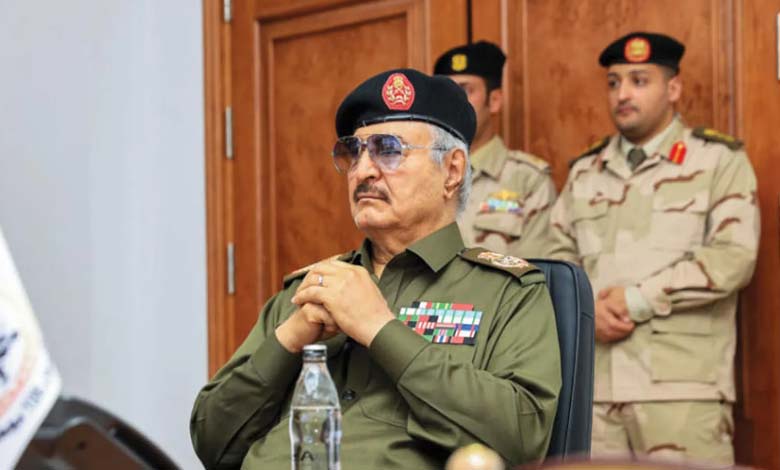
Khalifa Haftar describes the 2030 Vision for developing the armed forces as a strategic project for reconstruction and rebuilding on modern and solid foundations.
Field Marshal Khalifa Haftar, Commander-in-Chief of the Libyan National Army, has launched the “Vision 2030” plan for the development of the armed forces, in a move he described as paving the way for a new phase of organized military action and laying the groundwork for a modern military institution capable of keeping pace with internal and regional developments, without disclosing precise implementation details or a specific timeline.
-
Libyan army denied meeting of Field Marshal Khalifa Haftar, with the outgoing Prime Minister
-
Khalifa Haftar: We will never accept Turkish colonialism
The announcement was made during an official ceremony attended by Deputy Commander-in-Chief Lieutenant General Saddam Haftar, along with the Secretary-General of the General Command, chiefs of staff, and several senior officers. During the event, the document was formally handed over to the Deputy Commander-in-Chief, signaling a transition from the conceptual stage to the initiation of practical implementation procedures.
According to a statement issued by the General Command’s Media Office on its Facebook page, the “Vision 2030 for the Development of the Libyan Armed Forces represents a comprehensive strategic path leading the phase of military transformation,” describing it as a significant achievement in building the military institution. The statement added that it is “not merely a timeline-based plan, but a strategic project for reconstruction and re-establishment on modern and solid foundations.”
-
Haftar launches army development plan amid security challenges
-
Haftar links Libyans’ living crisis to political paralysis
The Media Office emphasized that “the launch of the vision reflects the military institution’s transition to a new stage of professionalism and readiness through strategic planning and institutional work based on a clear vision and defined objectives.” Quoting Haftar, the statement noted that “Vision 2030 is not a final destination, but the beginning of a more ambitious phase that will place the forces at the highest levels of readiness and enable them to confront challenges.”
Haftar’s discourse highlights a perception of the military institution as the cornerstone of safeguarding national security and ensuring state cohesion amid a turbulent domestic environment and a highly complex regional context. In this framework, the army is not viewed merely as a conventional security apparatus, but as a unifying institution expected to transcend political divisions and represent the organized framework of legitimate force.
-
Haftar Redraws the Parameters of the Libyan Solution on the Foundations of Sovereignty and National Consensus
-
Haftar pursues calculated plans to impose himself as a key player in Libya
Its role is portrayed as crucial in confronting extremist organizations and armed groups operating outside state authority, as well as in protecting borders and preventing the spread of instability. In the same context, openness to external military cooperation forms part of a strategy aimed at enhancing the armed forces’ efficiency and developing their training and logistical capabilities.
The recent period has witnessed increased coordination with regional actors, foremost among them Egypt, where high-level meetings have focused on exchanging expertise and strengthening joint security coordination, driven by considerations related to border security and mutual interests. This cooperation reflects a desire to benefit from regional military experience and to rebuild a more disciplined and professional institutional structure, contributing—according to the General Command—to consolidating stability and creating conditions conducive to the establishment of more cohesive state institutions.
-
Dbeibah Turns to the Muslim Brotherhood, Haftar Warns of Decisive Moment… Libya on a Knife’s Edge
-
Financial Strangulation and Stalled Dialogue with Haftar Threaten Dbeibah’s Government Continuity
Regarding the internal situation, efforts to rebuild the military institution intersect with the political division that has affected the country since 2011. Executive authority is split between a government based in Tripoli in the west, which enjoys international recognition, and a parallel authority in the east supported by the House of Representatives and backed by the Libyan National Army led by Haftar.
Within this context, the project to unify the military institution is presented as a gateway to reunifying the state, through integrating various formations into a unified command structure under central authority. The army commander also attaches clear importance to the social dimension of the stabilization process, relying on the role of tribes as a historically influential component of Libyan society, capable of helping ease tensions and promote reconciliation.
-
Haftar urges the formation of a unified government to oversee the elections
-
Al-Menfi and Haftar in Cairo to Break Political Deadlock
Through repeated meetings with tribal elders and community leaders, it is reiterated that any sustainable settlement should stem from the specificities and values of Libyan society and rely on internal consensus that precedes or accompanies formal political processes, thereby creating a broader foundation for rebuilding state institutions on firmer grounds.
-
Libya: Haftar Declares ‘Last Chance’ to Draw Road Map and Hold Elections
-
Haftar asks Libyans to chart the future after International failure