Israel builds a concrete wall in southern Lebanon, a new violation
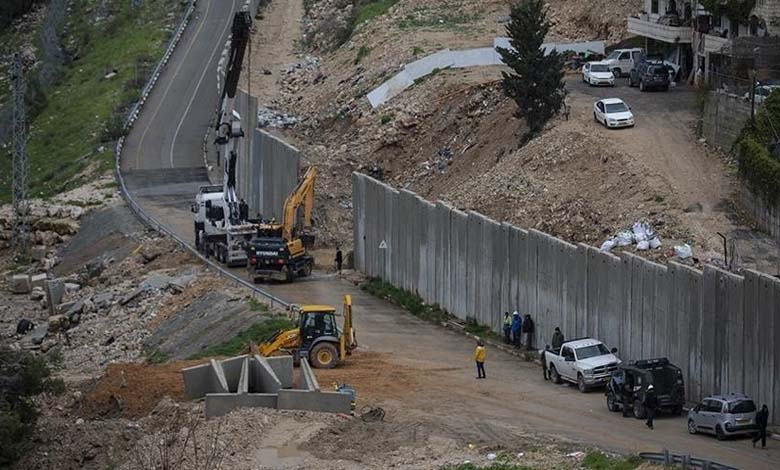
Hebrew newspapers have confirmed that the new wall is being constructed opposite the Lebanese towns of Maroun al-Ras and Aitaroun, in the Bint Jbeil district, as part of an Israeli plan to establish five so-called “strategic” military posts aimed at strengthening field control.
-
Disputes shake Hezbollah’s media apparatus and turn into a power struggle
-
Millions for Information on a Hezbollah Financier: Who is Ali Qasir, Wanted by Washington?
Israeli violations of Lebanese sovereignty continue nearly a year after the ceasefire agreement between Hezbollah and Israel. Field and media reports have revealed that the Israeli army has begun constructing a massive concrete barrier extending one to two kilometers inside Lebanese territory — a new breach of the truce.
According to Yedioth Ahronoth, the wall being built opposite Maroun al-Ras and Aitaroun is part of Israel’s plan to establish five military positions located partly within Lebanese land. The newspaper noted that these works are being carried out beyond the Blue Line, in direct contradiction with Israel’s commitments under the November 2024 ceasefire agreement.
-
Hezbollah Cell in Syria: Details of the Terrorist Plot and Heavy Weapons Seizure
-
Hezbollah member injured in Israeli strike on Lebanon
Observers see this new construction as a dangerous indication of Israel’s intent to gradually entrench its presence in additional Lebanese areas, taking advantage of Lebanon’s severe political divisions and economic collapse, which have weakened the government’s stance.
Lebanese activists and journalists have circulated footage showing Israeli engineering vehicles pouring concrete walls behind the border fence, particularly across from the Avivim settlement in northern Israel. The move has sparked widespread condemnation across Lebanese political and popular circles, viewed as a blatant violation of sovereignty and an attempt to impose a new geographical reality.
-
Hezbollah and disarmament: cautious approval or a tactic to buy time?
-
Joseph Aoun Seeks to Avoid Fallout from Hezbollah Disarmament
Reports indicate that the wall extends up to two kilometers inside Lebanese territory in some sections, near one of the five hills still under Israeli control since the last war — despite the truce’s explicit requirement for a full withdrawal.
This development coincides with ongoing military escalation along the southern front. In recent weeks, the Israeli army has launched a series of air raids targeting, according to its statements, Hezbollah positions in southern Lebanon. The Lebanese National News Agency reported that Israeli warplanes bombed the Khanouq area in Aitaroun late Monday night, followed by drone strikes dropping incendiary bombs on several towns in the Bint Jbeil, Nabatieh, and Tyre districts.
-
Hezbollah threatens civil war in Lebanon and warns of a Karbala-style battle
-
Hezbollah threatens Lebanon with a Karbala-style battle to keep its weapons
These attacks triggered massive fires in forests and agricultural fields, particularly between the villages of Ansar and Al-Zrariya, where civil defense teams struggled to control the flames due to unexploded ordnance detonations. The fires spread to the outskirts of Al-Sharqiya and Al-Namiriyeh, forcing firefighters to withdraw from some sites because of successive explosions.
Since the ceasefire took effect in late November 2024, Lebanese authorities have documented thousands of Israeli violations by air, land, and sea, including persistent drone flights and intermittent shelling of border areas. These aggressions have caused hundreds of deaths and injuries, along with widespread destruction of infrastructure and private property.
-
Hezbollah Faces a Silent Collapse: Missing Leadership, Besieged Weapons
-
Beirut Port Explosion Anniversary: Justice Moves Forward Despite Hezbollah’s Obstruction
Analysts note that through these actions, Israel seeks to impose a new reality on the border, exploiting the weak international response. The UN Security Council has issued only mild statements of condemnation, without enforcing any concrete measures compelling Israel to withdraw from occupied Lebanese lands.
The latest Israeli war on Lebanon broke out in October 2023 and escalated into a full-scale conflict by September 2024. Lebanese estimates indicate that it left more than 4,000 dead and around 17,000 injured, with massive destruction across the south and the Bekaa Valley. Despite the truce, Israel continues to occupy five key hills in southern Lebanon and carries out limited military operations around them.
-
U.S. Patience Wears Thin as Hezbollah Disarmament Stalls
-
Taëf and Weapons Control: Salam Stands for State Restoration, Hezbollah Holds Its Ground
Meanwhile, Israel and the United States reject any settlement that does not include Hezbollah’s disarmament, while the Iran-backed movement insists it will not relinquish its weapons as long as Israeli occupation persists.
Ultimately, Israel’s breach of the ceasefire agreement — through both the wall’s construction and repeated airstrikes — has brought southern Lebanon back to a pre-truce atmosphere and opened the door to renewed tensions that could undermine the fragile stability along the border.
-
Hezbollah resists internal and external pressure to disarm
-
After a Defeat… Hezbollah Now Ties the Decision to Go to War to the Lebanese State