Late Awakening… Britain Reassesses Its Relationship with the Muslim Brotherhood
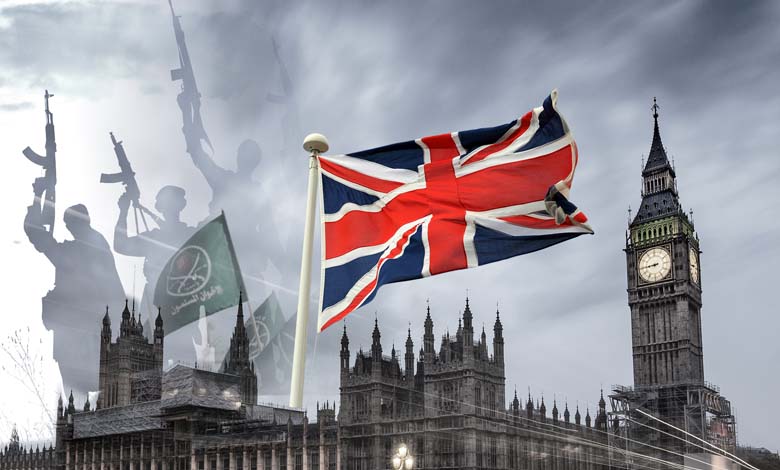
In a notable shift reflecting a change in the Western approach to issues of political Islam, journalist and political analyst Hossam Al-Ghamri considered that Britain’s recent reviews regarding the “Muslim Brotherhood” represent an implicit acknowledgment of the validity of the warnings issued by Cairo since 2013.
This interpretation comes following statements made by a former senior British intelligence official on a specialized podcast, in which he admitted that London had misjudged, from the outset, the risks of hosting the organization.
-
After the ban on Hizb ut-Tahrir… What is the fate of the Muslim Brotherhood in Britain?
-
Late Awakening… Britain Reassesses Its Relationship with the Muslim Brotherhood
Al-Ghamri explained, during his appearance on Al-Hayat TV, that this new direction strips the group of the “cloak of victimhood” it has long exploited in European capitals.
He analyzed the dimensions of the shift in the British stance through several key points that highlighted the collapse of the narratives on which the organization had relied for years.
He pointed out that the West has finally realized what he described as a “malicious positioning,” whereby the group adopts a conciliatory public discourse while simultaneously operating closed networks and suspicious funding channels behind the scenes, turning democratic freedoms into tools of “soft penetration” into the state’s institutions.
-
Will Britain remain a safe haven for the Muslim Brotherhood? Warning over their growing influence
-
Muslim Brotherhood and Zionism: Why Britain Supports Them
He affirmed that the narrative promoting the Muslim Brotherhood as a political partner has fallen apart, after policymakers in London became convinced that the group does not believe in the nation-state and views democracy merely as a “temporary bridge” to reach power.
Al-Ghamri noted that this recognition fully aligns with what President Abdel Fattah Al-Sisi had stated early on, emphasizing that the battle is not with religion itself, but with a transnational ideology that threatens the very existence of the nation-state.
-
The Telegraph Exposes the Muslim Brotherhood’s Game in Britain: Moderation in Public, Radicalism in Private
-
Raghad Al-Tikriti… Satan’s Ally in Britain and the Distinct Face of the Muslim Brotherhood
The political analyst stressed that the admission by British officials that they “were wrong not to take the threat seriously” ends an era of supposed security exaggerations that some had promoted against Egypt. He believes this shift sends reassuring messages to the West’s allies in the region and confirms that the cost of continuing to harbor such organizations now outweighs any imagined political gains.
He concluded his analysis by stating that the current scene has toppled three myths: the false claim of the group’s moderation, the invalid notion that Egypt’s warnings were mere anxieties, and finally the illusion that the West possesses a deeper understanding of the issue than those directly involved in the region.
-
The Emergence of Women’s Role in European Muslim Brotherhood Networks, Especially in Britain
-
Labor, Espionage, and Assassinations… A Book Unveiling Britain’s Relationship with the Brotherhood Since Its Inception
-
The Muslim Brotherhood intensifies its activities to maintain influence in Britain… What’s New?