Mali and Al-Qaeda… Pragmatism Redefining Priorities (Two Experts)
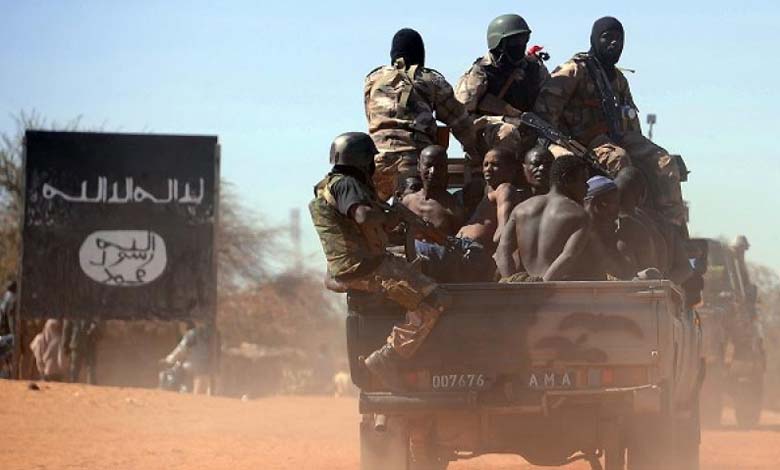
The escalation of Al-Qaeda attacks in Mali has not only imposed a new reality, but has also reshaped a security strategy primarily based on pragmatism that redefines priorities. This view is shared by political experts specializing in the African Sahel, who believe that the intensification of attacks by the “Group for the Support of Islam and Muslims,” the faction affiliated with the terrorist organization, has pushed the military council led by Assimi Goïta to reconfigure its military strategy in a more pragmatic way, with a stronger focus on protecting vital centers.
Redefining priorities
Nyagale Bagayoko, an Ivorian researcher specializing in Sahel security, states that what is happening in Mali is not a failure of the military council, but a necessary phase of tactical transition. Bagayoko explains that “the military objective is no longer to exercise symbolic control over the entire national territory, but to secure key strategic points.”
She adds that the military council has reorganized its priorities according to the logic of “protecting what is useful,” by securing main trade routes, protecting major cities, and preventing the isolation of the capital, Bamako.
According to the same expert, “this change reflects a deeper understanding of the nature of the conflict, where the issue is no longer about land area, but about the state’s ability to endure.” Bagayoko believes that the shift of attacks by the “Group for the Support of Islam and Muslims” toward the south and west reflects the organization’s adaptability, while also exposing its logistical weaknesses when operating far from its traditional northern strongholds.
For her, the redeployment of the Malian army is not a retreat, but a shift from a strategy of “wide deployment” to one of “protecting strategic nodes” such as trade routes and urban centers.
She concludes that the military council “has succeeded in restoring a degree of military sovereignty after reducing dependence on Western powers,” noting that it is building alternative alliances, particularly with Russian partners, which provides greater room for maneuver. What is criticized as a “forced rearrangement,” she argues, is in fact “a redefinition of state priorities: from chasing mobile groups in the desert to securing the national economy and preventing the strangulation of Bamako.”
Military pragmatism
For his part, French researcher specializing in Sahel affairs Marc-Antoine Pérouse de Montclos considers the escalation of the Al-Qaeda-linked organization near Bamako to be “a dangerous strategic turning point, yet one that compelled the Malian authorities to adopt more realistic decisions than before.”
He says that “relying on symbolic deployment in the north was costly and ineffective, whereas the new strategy focuses on defending population centers and prioritizing vital economic corridors.”
He explains that “the partnership with the Africa Corps (Russian) has provided, despite controversy, rapidly deployable combat capabilities that were not previously available,” noting that the Malian military council is now adopting a doctrine of “controlling useful territory” rather than symbolic control over the entire territory.
According to the expert, “what Goïta is doing is not a withdrawal, but a smart repositioning aimed at preventing the collapse of the state both economically and in terms of security.” He believes that the attacks by the terrorist organization did not weaken the military council as much as they forced it into strategic maturity.
He adds that the change in the council’s policy reflects a priority on protecting Bamako and commercial corridors, and reducing military attrition in remote areas. He points out that the new strategy may not eliminate the threat immediately, but it increases the state’s ability to endure and prevents its economic and security suffocation.
Five questions
Under the title “Five questions to understand how the Group for the Support of Islam and Muslims pushed Assimi Goïta to reshape his strategy,” the magazine Jeune Afrique states that “the attacks carried out by the organization in southern and western Mali forced the Malian armed forces and their Russian allies from the Africa Corps to reconsider their military priorities.”
Why did the terrorist organization shift its attacks to the south and west?
The magazine explains that moving operations away from traditional northern strongholds toward areas closer to Bamako reflects a strategic shift aimed at pressuring the state’s vital centers, particularly trade routes and sensitive economic zones, thereby imposing a new security reality on the Malian army.
How did this shift affect Assimi Goïta’s military calculations?
The magazine notes that this field development forced the Malian army to partially abandon the strategy of wide deployment and instead focus on protecting strategic points, including the capital, major cities, and supply networks, in an effort to prevent the isolation of Bamako and the strangulation of the national economy.
Does redeployment mean retreat or strategic adaptation?
This change should not necessarily be interpreted as a military retreat, but rather as a tactical repositioning aimed at reducing attrition and enhancing operational effectiveness, especially given the mobile nature of the threat posed by the organization.
What is the role of allies, particularly the “Africa Corps,” in this shift?
The magazine also highlights that the role of allies, particularly elements of the “Africa Corps,” has become part of this new equation by providing field support that helps implement the redeployment and counter attacks in the most sensitive areas.
Did the organization succeed in imposing a new reality or did it expose the limits of its power?
Jeune Afrique concludes that the pressure exerted by the organization not only led to a security escalation, but also pushed the Malian authorities to reformulate their military doctrine, focusing on protecting strategic centers of gravity rather than seeking full territorial control.