Minneapolis protests: a testing ground for Trump’s hardline power project
The American city of Minneapolis has become a central testing ground for President Donald Trump’s project based on the imposition of rigid authority.
Trump relies on a hardline approach to governance, particularly regarding immigration policy and the expansion of federal law enforcement powers.
-
Arrest campaign targets Somali migrants in the United States
-
The confrontation between the supporters of Trump and protesters in Portland
According to an analysis published by the U.S. news network CNN, developments on the ground and on the political front point to a broader national crisis that goes beyond a local confrontation between protesters and federal authorities.
CNN reported that the crisis began after the killing of Renée Good, a 37-year-old mother, by an agent of Immigration and Customs Enforcement, an incident that sparked a wave of violent protests in northern Minneapolis.
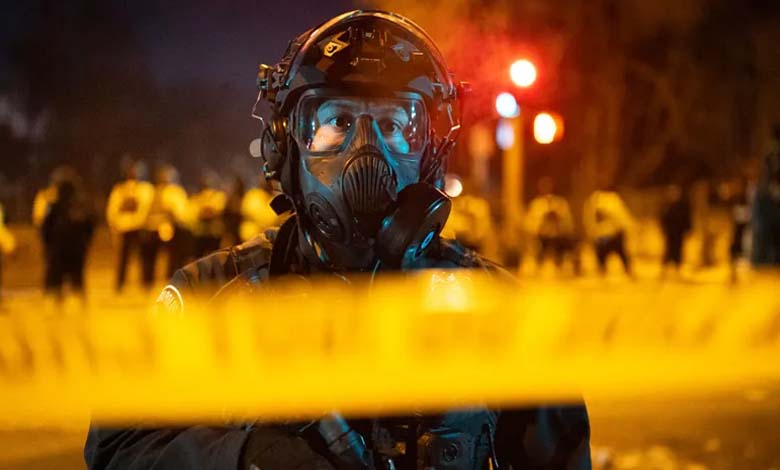
As thousands of federal agents poured into the state to carry out a large-scale deportation campaign, clashes between demonstrators and federal forces escalated, amid the widespread circulation of videos showing shocking scenes, including a woman with disabilities being forcibly pulled from her car.
-
Nautilus: The American Beast That Wages War Beneath the Waves
-
American Failure in Managing the SDF and Tribal Crisis Warns of Escalation in Battles
These images have become a source of political polarization, with each side interpreting them in line with its ideological stance. The analysis argues, however, that they are “deliberate,” intended to project Trump as a “strongman” and to undermine progressive values in Democratic-led cities.
According to the analysis, Minneapolis has turned into a “political laboratory” for Trump’s hardline policies, which combine the militarization of policing, the sidelining of local governments, and the provocation of confrontations rather than their containment.
This strategy may nonetheless backfire politically. While tougher border enforcement previously enjoyed public support, recent polls indicate growing public resentment toward violent ICE raids inside cities, especially as midterm elections approach.
-
The UN truce in Yemen between complicity and procrastination
-
Americans Reflect on 20th Anniversary of Sept. 11
Trump risks undermining one of his strongest political assets, immigration, by separating in voters’ minds border security on the one hand and the harsh, inhumane enforcement of the law within the country on the other.
The federal administration, for its part, defends its actions by arguing that deploying 3,000 federal agents in Minnesota is necessary to confront what it describes as immigration chaos left behind by former President Joe Biden’s administration, and to protect public safety.
It also accuses local Democratic officials of harboring criminals and inciting violence against immigration agents.
-
Armenian-Americans… Joyless welcome of Biden’s genocide declaration
-
What if Europe attacked Russian merchant ships?
The analysis suggests that the administration could have defused the situation by scaling back its tactics, adopting more targeted operations, and cooperating with state authorities to investigate Good’s killing. Trump instead chose escalation, raising questions about whether he is deliberately seeking political chaos.
The escalation peaked when Trump threatened to invoke the Insurrection Act to deploy the National Guard or even the regular army in Minnesota, accusing the state’s “corrupt” leaders of failing to control what he called “provocateurs and insurgents.”
The Insurrection Act has not been used since the 1992 Los Angeles riots and is typically invoked in coordination with state governors. Activating it without their consent would represent a stark constitutional challenge that could ignite a crisis between federal and state authorities.
-
Whispers in NATO corridors… Could Greenland drag Europe into a confrontation with Trump?
-
The fall of Maduro: a step in Rubio’s dream of leading an army of exiles and becoming president of Cuba
White House Press Secretary Karoline Leavitt and Homeland Security Secretary Kristi Noem defended the hardline rhetoric, accusing Democrats of encouraging violence out of “hatred of Trump.”
Since his first campaign, Trump has embraced a narrative portraying Democratic cities such as Minneapolis as corrupt and dangerous places in need of an iron fist, a vision he has used to justify his push to expand presidential powers.
On the ground, conditions continue to deteriorate with new shootings and clashes, amid conflicting accounts regarding the use of force by federal agents. Despite calls for calm and peaceful protest from Minnesota Governor Tim Walz and the mayor of Minneapolis, both warned that fear is now paralyzing daily life and that people are afraid to leave their homes.
-
Hedgehog shield and pragmatism… 6 lessons from Trump for world leaders in 2026
-
The Elephant and the Donkey on the same track… Artificial intelligence unsettles U.S. politics
The practices of Immigration and Customs Enforcement have raised widespread legal and human rights concerns, with the American Civil Liberties Union filing lawsuits accusing the agency of violating the rights of U.S. citizens.
Local officials argue that citizens are exercising their constitutional right to monitor government actions, while those rights are being violated in plain sight.
Despite polling results showing that a majority of Americans view Renée Good’s killing as an unjustified use of force, and that fewer than one-third believe ICE operations have made cities safer, Trump may choose to press ahead, exploiting escalation to justify further expansion of his authority and to impose lasting changes on the nature of the American political system, even at the cost of deeper division and serious internal instability.
-
Surprise 2026… Trump Builds the American Arc de Triomphe
-
Advanced Israeli-American consultations on an independent Palestinian government in Gaza
-
The most expensive bomber in history… the B-2 Spirit and the price of American supremacy