Russian military presence in Syria tops the agenda of Al-Charaa–Putin meeting
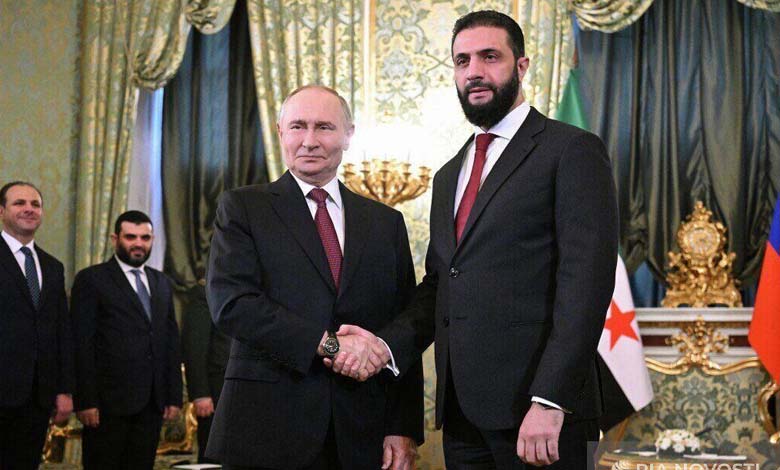
The Kremlin confirms that the Russian and Syrian presidents will discuss economic cooperation and the situation in the Middle East.
The Kremlin announced that Russian President Vladimir Putin and his Syrian counterpart Ahmad Al-Charaa will discuss the Russian military presence in Syria during their meeting scheduled for Wednesday in Moscow, stressing that relations with Damascus have been developing dynamically following the change in leadership.
-
Understandings between Netanyahu and Barak on regulating Israeli movements in Syria
-
Russia’s Expanding Influence in the Sahel via Libya Raises Western Concerns
Kremlin spokesperson Dmitry Peskov stated that the talks will also address economic cooperation and the situation in the Middle East.
At the same time, the Russian official declined to comment on the issue of handing over former Syrian president Bashar Al-Assad, who is currently in exile in Russia, despite the fact that this file is considered highly sensitive by the current Syrian authorities. He also refused to comment on the decision to withdraw Russian forces from a base in northeastern Syria amid the advance of the Syrian army into areas previously controlled by the Syrian Democratic Forces east of the Euphrates, referring the matter to the Russian Ministry of Defense.
For its part, the Syrian Arab News Agency Sana reported that Al-Charaa arrived in Moscow on an official visit to hold talks with his Russian counterpart on bilateral relations and the latest regional developments.
-
Clashes near Sweida shatter ceasefire: Washington urges Syrians to build a new unified identity
-
Step Toward Sanctions Relief: UN Report Denies Links Between Hayat Tahrir al-Sham and Al-Qaeda
On Tuesday, the Syrian presidency said in a statement that the president would pay an official visit to Russia on Wednesday, without specifying its duration, during which he would meet the Russian president to discuss ways to develop bilateral relations between the two countries, as well as developments in the Middle East.
This marks Al-Charaa’s second visit to Russia since assuming office in late January 2025, the first having taken place in mid-October of the same year.
At the time, Sana reported that Al-Charaa discussed with Putin bilateral relations between the two countries and ways to strengthen strategic cooperation across various fields.
-
UN Report Denies Any Link Between Damascus and Al-Qaeda
-
Between Breaking Isolation and Renewing It: What Does the Lifting of Sanctions on Syria Really Mean? Experts Weigh In
The agency also noted that an expanded meeting was held between the two presidents, attended by senior officials from both sides, during which ways to enhance joint cooperation between Syria and Russia in various sectors were examined.
Syrian-Russian relations are currently entering a new phase of rebalancing following President Al-Charaa’s assumption of leadership after the major political transformations witnessed in Damascus. Despite the deep legacy left by the close alliance with the former regime, the current leadership is seeking to reshape the framework of this relationship in line with national sovereignty priorities and the requirements of internal stability.
Politically and diplomatically, Damascus has sought to maintain continuous lines of communication with Moscow, while emphasizing that the relationship is no longer based on dependency, but is moving toward a more balanced partnership. Meetings and contacts between the two sides reflect a shared desire to preserve a degree of political understanding, particularly on sensitive regional issues and in supporting Syrian state institutions. For its part, Russia aims to maintain its role as an influential actor in the Syrian file, while adapting to the new political reality imposed by recent changes.
-
Russia Expands Its Military Influence in Africa: A Threat to U.S. and U.K. Interests via Port Sudan Base
-
Kurdish Initiative to Secure Northern Syria’s Borders with U.S. and French Forces
Economically, Russia remains a traditional partner of Syria, particularly in the fields of energy, wheat, and infrastructure. The Syrian government has expressed clear interest in benefiting from Russian expertise and investments during the reconstruction phase, while also seeking to diversify its economic partnerships and open up to other countries and regions in order to reduce reliance on a single partner. This approach reflects Damascus’s desire to build a more balanced and shock-resilient economy.
Militarily, the Russian presence in Syria continues, particularly in certain strategic bases along the Syrian coast, but its nature is undergoing a noticeable transformation. The Russian role is no longer as dominant as it was during the years of war, with indications pointing to a redeployment and relative reduction of forces in some areas, especially in Qamishli, amid military tensions, in line with the transitional phase the country is experiencing. This shift reflects Russia’s attempt to adapt to the new equation without abandoning its core positions of influence.
On January 29, 2025, the Syrian Operations Administration announced Al-Charaa’s assumption of the presidency after rebel forces took control of the capital, Damascus, declaring the overthrow of Bashar Al-Assad’s regime on December 8, 2024.
-
Russia Accuses the U.S. and the U.K. of Recruiting Agents to Target Its Bases in Syria
-
“Including Syria and Lebanon”: How the Israeli Army Prepares for “Operation Winter”
-
Decoys and Fake Helicopters: New Details Emerge About al-Assad’s Escape from Syria
-
Ukraine and Lebanon: Two Separate Wars That Changed Syria’s Fate