Smaller and more heavily armed: Russia challenges aircraft carriers with Gorshkov-class frigates
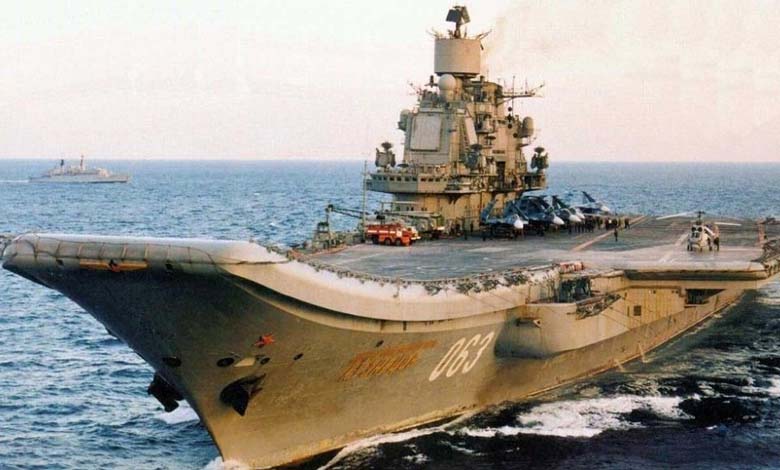
Russia has stated that its modern Admiral Gorshkov-class frigates (Project 22350) represent a practical alternative to aircraft carriers, and even platforms capable of threatening the massive US nuclear-powered carrier strike groups.
This approach reflects a clear shift in Russian naval doctrine, which no longer relies on large capital ships but instead focuses on smaller surface vessels with specialized roles in deterrence and anti-access/area denial operations.
-
Large-scale Russian attack on Ukraine’s energy sector, Poland activates its air defenses
-
Hidden massive figures: German intelligence reveals the scale of Russia’s military spending
Project 22350 frigates are regarded as the only ocean-going warships produced by Russia since the collapse of the Soviet Union, according to National Interest magazine.
According to Russian officials, these frigates constitute “naval strike forces” that can be deployed to hunt hostile aircraft carriers, at a time when the Russian Navy shows no intention of operating a new aircraft carrier in the foreseeable future. This trend is reinforced by growing indications that Russia’s sole carrier, Admiral Kuznetsov, may be permanently decommissioned.
-
NATO arms itself with artificial intelligence against Russia: a semi-automated defense project
-
Intensive Russian strikes paralyze Ukraine… Zelensky appeals to the United States
In a statement to the Russian news agency TASS in August 2025, Alexander Stepanov, a researcher at the Institute of Law and National Security of the Russian Presidential Academy of National Economy and Public Administration, said that Project 22350 frigates “carry high-precision missile weapons, not only Kalibr cruise missiles but also hypersonic Zircon missiles.” He added that “the frigate functions as a multi-role naval destroyer, capable of tracking hostile nuclear submarines from safe distances.”
The core missions of these frigates revolve around anti-access and area denial operations. They were designed as “modular launch platforms” capable of detecting and destroying high-priority targets in coastal zones, including elements of aircraft carrier strike groups. Despite their classification as frigates, their heavy armament grants them offensive capabilities that far exceed their actual size.
-
What if Europe attacked Russian merchant ships?
-
Orechnik: a Russian deterrence message to Europe at 8,000 miles per hour
The full-load displacement of Project 22350 frigates is approximately 5,400 tons, their maximum speed reaches 29.5 knots, and each ship is crewed by 210 sailors. However, their endurance at sea does not exceed 30 days, a limitation that became evident during the escort mission carried out last year by the frigate Admiral Golovko alongside a Russian oil tanker on a round-the-world voyage.
In August 2025, the latest frigate of this class, Admiral Amelko, was launched at the Severnaya shipyard in Saint Petersburg. It is the fifth of ten frigates planned under Project 22350 and was named in honor of Soviet Admiral Nikolai Amelko.
-
A challenge in African waters: China, Russia and Iran launch naval drills
-
Russia strikes Ukraine with Oreshnik in response to an alleged attempt to target Putin’s residence: what is the Oreshnik missile?
Admiral Amelko represents a significant qualitative step within the series, as it is equipped with the Otvet anti-submarine system, which, according to Russian data, is capable of destroying hostile nuclear submarines at distances of up to 40 kilometers.
It is also among the first frigates of the project to be fitted with twice the number of S-143 vertical launch cells, effectively transforming it into a floating missile launch platform. Its armament includes a 130 mm naval gun, two Palach close-in defense systems equipped with six-barrel 30 mm rotary cannons, two Paket-NK torpedo launchers, and the capability to operate a Ka-27 helicopter for additional anti-submarine warfare missions.
-
Russian drones plunge Ukraine into darkness, an attack deepening winter hardships
-
Battle of Huliaipole… Russian Superiority Tightens the Noose on Ukraine
The Russian Navy plans to deploy Admiral Amelko to the Pacific Ocean, with its entry into service expected by 2026. At the same time, three additional frigates of the same class are under construction, while the final two units have been ordered to complete the planned fleet.
Moscow views these frigates as a cornerstone of its contemporary naval strategy, aimed at strengthening the security of Russian territorial waters, ensuring regular maritime patrols in coordination with allies, and protecting maritime and commercial shipping routes from Western blockade attempts.
-
A year after it sank… a report reveals the nuclear secret of a Russian ship
-
Is Russia rejecting the U.S. peace plan?
As such, Project 22350 frigates embody a strategic shift away from reliance on large aircraft carriers toward smaller, heavily armed, and multi-role platforms dedicated to deterrence and control in contested maritime environments.
Project 22350 frigate specifications
Commissioning year: 2018 (Admiral Gorshkov class)
Number of frigates built: 5 (3 in service, 10 planned)
Length: 135 meters
Beam: 16 meters
Displacement: 5,400 tons full load
Maximum speed: 29.5 knots (54.6 km/h)
Range: 4,850 nautical miles (8,980 km); endurance up to 30 days
Armament: one 130 mm naval gun; vertical launch cells for Kalibr, Oniks, Zircon and Otvet missiles; two Palach close-in defense systems; two torpedo tubes; two mounted machine guns; one Ka-27 helicopter
Crew: 210 personnel
-
Zelensky outlines features of a peace plan… and awaits Russia’s response
-
Why did Europe abandon the Russian assets plan?