Syria foils mine smuggling attempt, sending a strict message to Hezbollah
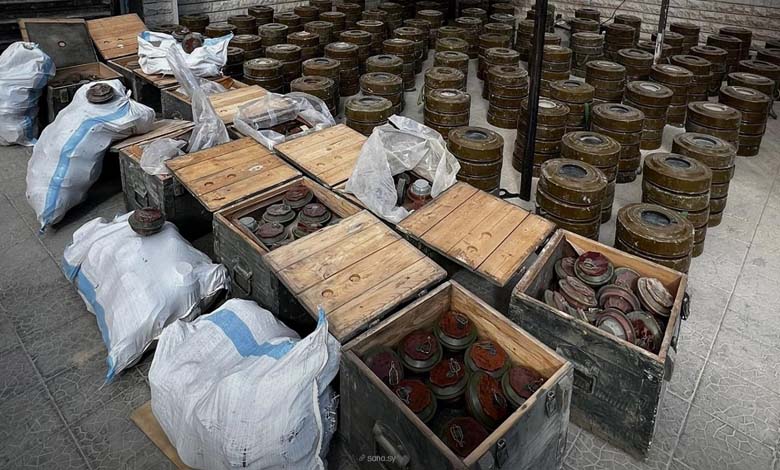
Damascus affirms that its territory will not serve as an open corridor for supplying any armed group beyond its borders with military equipment that could affect regional balances or threaten internal security.
Syrian authorities, under President Ahmad Al-Shar’a, continue to adopt a more rigorous approach in managing border crossings, which have long represented security vulnerabilities. The Ministry of Interior announced that it had foiled one of the largest ammunition-smuggling attempts in recent months, intended for Lebanese territory in favor of Hezbollah, according to official security sources.
-
Hezbollah’s knockout strike strategy falters amid Israeli divisions
-
From drones to smart munitions: how is Hezbollah rearming itself?
The ministry’s statement, published on its Telegram channel, indicated that a special security force carried out a high-level operation in an area north of rural Damascus, during which it seized 1,250 military-grade mines ready for use. Four suspects linked to the shipment were arrested, while a fifth was killed during a brief clash with the raiding unit.
Khaled Abbas Taktouk, the director of internal security in Yabroud, said the operation was not accidental but the result of a long monitoring effort that began weeks earlier, when the concerned agencies obtained an initial lead regarding unusual smuggling activity in the Al-Jabba area. According to him, surveillance units tracked the network’s movements with precision until the route and timing of the shipment were confirmed, allowing the operation to be executed at the right moment without losing any part of the explosives.
-
Hezbollah responds to the November deadline and signals its commitment to keeping its weapons
-
Hezbollah Cell in Syria: Details of the Terrorist Plot and Heavy Weapons Seizure
This operation represents one of the latest manifestations of the security transformation occurring in Syria since the political transition that followed the fall of the previous regime in December 2024. The new government has begun restructuring the border-control system, in coordination with the army and intelligence services, to curb arms smuggling and the activity of transborder networks that had benefited from years of instability.
Observers believe that thwarting a smuggling operation of this scale shows that the new Syrian leadership is approaching the Lebanese border issue from a different perspective, particularly given the complex relations that have linked Syria to Hezbollah in recent years. Since taking power, the current administration has made it a priority to send clear messages that Syrian territory will no longer serve as an open conduit for supplying any armed group beyond the border with military equipment that could alter regional dynamics or harm internal security.
-
From Disarmament to Rearmament… Hezbollah Moves as Israel Loses Patience
-
Israel announces the killing of a Hezbollah commander: the logistics support chief
In this context, analysts argue that the success of the recent operation offers Syrian authorities an opportunity to reaffirm their commitment to combating smuggling, a file long criticized internationally due to its complexity and the multitude of actors involved. The precise execution of the raid also indicates a noticeable improvement in intelligence-gathering capabilities and field coordination among various security agencies, reflecting a clear shift in methods compared to previous years.
The operation comes at a time of high regional sensitivity, as Lebanon faces political and security tensions, while international pressure on Hezbollah persists due to its military activities and ongoing calls for its disarmament. The interception of such a large quantity of explosives thus carries direct implications for the Lebanese scene and suggests, according to observers, that Damascus is seeking to assert its role as a stabilizing actor along its borders rather than a contributor to heightened tensions.
-
Israeli Airstrikes on Lebanon’s Bekaa and North: Hezbollah Infrastructure and Missile Sites Targeted
-
A warning to Hezbollah: Israel’s largest drill on the Lebanese border since October 7
As investigations continue with the detainees to uncover the extent of the network and its funding sources, the new Syrian government appears eager to present the operation as further proof that the post-2024 phase is built on a different security doctrine: preventing weapons smuggling regardless of the beneficiary and restoring the image of a state capable of enforcing its sovereignty and holding accountable those who attempt to destabilize its territory or that of its neighbors.
-
Washington warns of potential Israeli unilateral action if Hezbollah is not disarmed
-
After the Gaza Agreement… Receding Justifications and Rising Pressure to Disarm Hezbollah
-
Hezbollah and disarmament: cautious approval or a tactic to buy time?
-
Israeli army announces elimination of two Hezbollah commanders