The Awakening of the Monster in South Korea… and Its Eyes on the Neighbor’s Fortifications
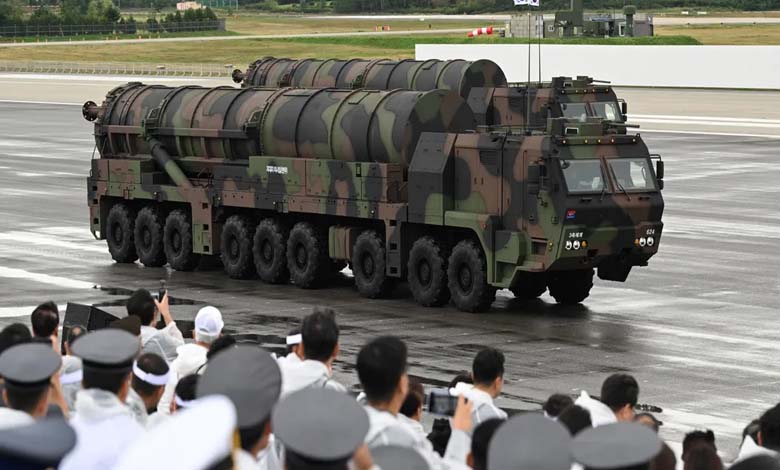
In South Korea, a massive “monster” has emerged, capable of breaching fortresses and smashing the most complex defenses, becoming a pivotal element in the deterrence equation.
South Korea has launched the first operational deployment of its high-power ballistic missile Hyunmoo-5, a move that marks a qualitative shift in its defensive strategy aimed at countering the growing nuclear threats from North Korea and achieving what Seoul describes as a “balance of terror” on the Korean Peninsula.
-
Pyongyang shoots down a South Korean drone and warns Seoul of a heavy price
-
Warning Shots in South Korean Waters: The “Northern Limit Line” Remains a Red Line
According to South Korea’s Yonhap News Agency, citing military sources, the missile—nicknamed “the Monster” because of its size and destructive capacity—is a surface-to-surface ballistic missile specifically designed to strike heavily fortified underground facilities and bunkers. It represents a core component of South Korea’s deterrence and retaliation system in the event of an attack.
South Korea first unveiled the Hyunmoo-5 during the Armed Forces Day military parade in 2023, but most of its technical specifications remained classified due to their strategic sensitivity.
The South Korean military plans to deploy hundreds of advanced missiles, including this model, along with upgraded versions that are still under development.
-
Nuclear Domino… North Korea vows to retaliate against Seoul and Washington
-
From Factory Worker to Head of State: Lee Jae-myung Becomes President of South Korea
The South Korean Hyunmoo-5 missile
The Hyunmoo-5 represents an unprecedented case in the field of tactical ballistic missiles. It carries the largest bunker-busting warhead ever mounted on a non-nuclear missile, with an estimated weight between 8 and 9 tons.
It was developed within South Korea’s “massive punishment and retaliation” strategy, with particular emphasis on extremely high impact speed, guidance accuracy, and the ability to penetrate deep layers of soil before detonation, enabling the destruction of command centers and military bases buried at great depths.
By comparison, most tactical ballistic missiles worldwide carry warheads weighing between 500 and 1,000 kilograms. The Russian Iskander-M carries a warhead of about 500 kilograms, while the American ATACMS warhead does not exceed 227 kilograms.
-
North Korean missiles precede Hegseth’s visit to the forbidden zone
-
Daydreams: North Korea Shatters Its Neighbor’s Hopes for Denuclearization
Previously, warheads approaching the weight of the Hyunmoo-5 were limited to strategic nuclear missiles, such as Russia’s Sarmat.
Although the massive warhead weight limits the missile’s range, integrating it onto a mobile platform with a total weight of around 36 tons represents an unprecedented technological achievement and grants South Korea high operational flexibility compared with heavy strategic missiles reliant on fixed silos.
These capabilities enhance the missile’s importance in confronting North Korea’s extensive network of bunkers and fortifications, considered the largest in the world relative to the country’s territory. This network includes ammunition factories, multi-story military installations, and deeply buried command centers.
-
Missile Wings Soar Over Tension: North Korea Tests the Ultimate Deterrent
-
Amid Peace Efforts… Kim Praises North Korean Soldiers in the Ukraine War
Estimates suggest that launching several Hyunmoo-5 missiles at a single target could penetrate deep underground and destroy these facilities almost entirely.
The Hyunmoo-5’s entry into service comes at a time of accelerating competition between the two Koreas in developing bunker-busting missiles. Pyongyang has tested missiles with increasingly heavy warheads, including advanced versions of the KN-23 and Hwasong-11, signaling the continuation of military rivalry on the Korean Peninsula, with potential consequences for regional and international security.
-
North Korea disrupts the atmosphere of calm with a ballistic uproar
-
Loudspeaker War Between the Koreas… A Silent Truce Ends Decades of Noise
-
North Korea Vanishes from the Internet for Hours… Outage Severs Its Last Digital Ties