The M23 and loyalty: a complex equation behind the scenes in eastern Congo
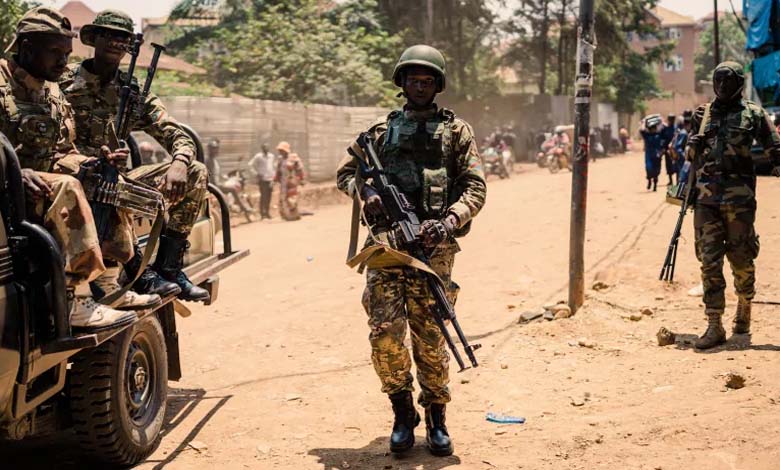
Eastern Democratic Republic of the Congo has been profoundly reshaped by a rebellion that altered regional dynamics and power relations. Yet its trajectory, oscillating between rise and decline, has consistently raised questions about its underlying mechanisms.
The March 23 Movement, commonly known as “M23,” is an armed rebel group active in eastern Democratic Republic of the Congo, founded in 2012 after the collapse of an agreement signed with the government in 2009.
On the surface, the movement’s territorial advances and its control of numerous strategic towns suggest that this rise is rooted in solid military strengths. In reality, the group suffers from many internal weaknesses, according to a report published by the Groupe de recherche sur le Congo.
In the 36-page report analyzing M23’s resurgence, objectives, alliances, and internal challenges, the organization reassesses the scale of its expansion in size and geographical scope, despite documented military shortcomings, according to Radio France Internationale.
After controlling vast areas of North Kivu for months, the movement suffered heavy defeats in 2013 before reemerging strongly in 2021, 2022, and 2023.
M23 also engaged in intense fighting against the Congolese army throughout 2024, with a notable escalation in December of the same year, causing the displacement of around a quarter of a million people by mid-January 2025 and generating a severe humanitarian crisis.
“The loyalty dilemma”
When Sultani Makenga, current leader of the Alliance Fleuve Congo/M23, returned to the forests of eastern Congo in 2017, he was accompanied by only a small number of officers from the once-defeated movement.
Four years later, only about 200 fighters remained from camps in Uganda. According to the report, his return to Kigali’s favor in the early 2020s changed everything.
M23’s territorial expansion then became dramatic, growing from a few square kilometers to more than 10,000 square kilometers by the end of 2025.
To control such a vast area, the movement resorted to massive recruitment: from 5,000 fighters at the start of 2025, their number is now estimated at around 38,000 at the beginning of 2026, according to diplomats cited in the report.
However, the group’s forces are described as “poorly trained and demoralized.” A large portion of fighters were reportedly recruited by force, which explains the “high desertion rate,” “inhumane punishments,” and “summary executions,” particularly for refusing to obey orders.
This illustrates the loyalty dilemma facing the movement, as membership is often coerced or driven by necessity, constituting one of its main internal challenges.
Thus, despite its rise as a dominant force in eastern Congo, its internal weaknesses have repeatedly required decisive intervention by the Rwandan army during major offensives, notably those leading to the capture of Goma and Bukavu in early 2025.
Broader ambitions
The report also analyzes the movement’s objectives and urges caution against conflating them with those of its backers.
It notes that M23 initially took up arms again to demand the implementation of the agreement signed between Kinshasa and its predecessor, the Congrès national pour la défense du peuple.
This agreement, signed on March 23, 2009 — from which the movement derives its name — called for the release of prisoners, amnesty for fighters, and the return of Tutsi refugees.
However, as its territorial reach expanded, the movement’s ambitions grew. It first sought to shed its image as a Rwandan proxy by aligning with the Alliance Fleuve Congo led by Corneille Nangaa, before launching large-scale recruitment.
The movement allied with armed groups in North and South Kivu and established a parallel administration including intelligence services, customs officials, local administrators, and traditional leaders, enabling it to control all activities, including mining.
As the peace process underway in Doha with Kinshasa currently faces setbacks, observers believe that “a military solution is entirely impossible,” according to the same source.