The most expensive bomber in history… the B-2 Spirit and the price of American supremacy
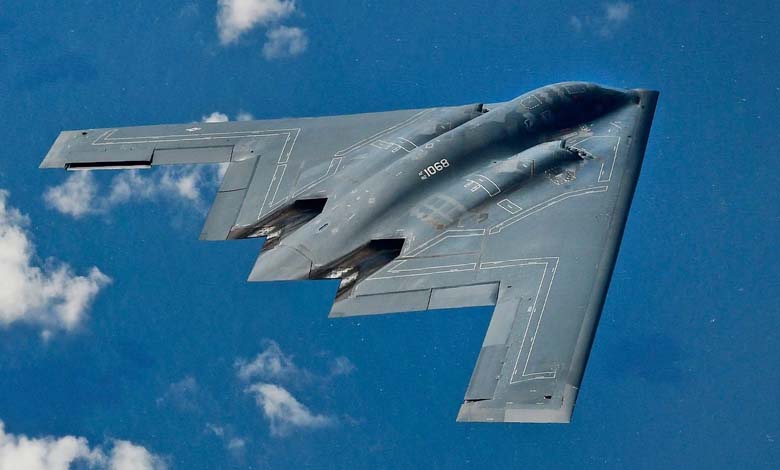
It is not merely a stealth bomber, but a living embodiment of the price a superpower pays for absolute dominance.
-
B-2 Over Iran: Pilot Comfort Was Part of the Strike Plan
-
Midnight Hammer: How the F-35 took part in striking Iran
The B-2 Spirit is a stealth aircraft that operates outside traditional cost calculations. Every takeoff becomes an open-ended bill, and every flight hour a carefully measured drain aimed at preserving the prestige of American deterrence and its ability to penetrate the most heavily defended airspace. Designed to remain invisible to the enemy, it is nonetheless strikingly visible in defense budgets.
As the B-21 Raider approaches operational service, the B-2 stands as a classic example of a weapon that was technologically ahead of its time, yet now bears the cost of having been born too early, in an era that had not yet learned how to make stealth less expensive and more sustainable.
-
Global Thunder 26: a comprehensive U.S. test of nuclear deterrence
-
A more advanced variant: the world’s most expensive bomber returns to the production line
Why such record-breaking costs?
According to The National Interest, the very limited number of B-2 aircraft in the U.S. Air Force inventory, combined with the labor-intensive maintenance of its stealth coating, drives sustainment costs to around 200,000 US dollars per flight hour.
The unit cost of a single B-2 Spirit bomber reaches 2.1 billion US dollars. This staggering price is largely the result of massive investments in research and development for stealth technology, as well as the fact that only 21 aircraft were ever built.
However, acquisition cost represents only one part of the overall expense. Operating costs range between 150,000 and 200,000 US dollars per hour, according to The National Interest.
-
B-52… an old bird indispensable to the U.S. military
-
Sharp Sword: China makes history with the first unmanned stealth fighter squadron
The publication explains that these high operating costs are not solely due to fuel consumption or crew size, but rather to stealth maintenance, highly specialized infrastructure, and limited production that prevented economies of scale.
Maintaining such an extraordinarily expensive aircraft as the B-2 Spirit is therefore a key factor in the U.S. Air Force’s decision to retire it from service in the near future.
The B-2 Spirit entered production in 1997. A total of 21 bombers were built, 19 of which remain in active service.
The aircraft is 21 meters long, has a wingspan of 52.4 meters, and a maximum takeoff weight of 152,200 kilograms. It is powered by four General Electric F118-GE-100 turbofan engines.
-
Strategic Bombers: A US-Russia-China race on the front line
-
T-7A… A Revolutionary Fighter That Transforms U.S. Pilot Training
Its maximum speed ranges between 1,010 and 1,045 kilometers per hour, and it has an unrefueled range of approximately 11,112 kilometers.
Its service ceiling is about 15,240 meters, and it can carry around 18,000 kilograms of munitions, including nuclear and conventional payloads, precision-guided bombs,
and long-range weapons. The flight crew consists of a pilot and a mission commander.
The B-2 Spirit relies on an older generation of radar-absorbing materials, which require far more maintenance than modern stealth coatings.
-
Diego Garcia: U.S. Withdrawal from a Base Used to Deceive Iran
-
80 Years Since the Tragedy of Nagasaki… Hibakusha Dwindle While the Perpetrator Remains Present
These early designs use manually applied coatings that degrade easily when exposed to rain, heat, sand, fuel, or general environmental conditions. This necessitates frequent reapplication and forces the U.S. Air Force to store B-2 aircraft in climate-controlled, high-cost hangars staffed by specially trained technicians, significantly increasing expenses.
Due to the extreme sensitivity of the B-2’s stealth coating, even minor damage can alter its radar signature and jeopardize its survivability in contested airspace. As a result, small defects often require meticulous maintenance after nearly every mission to restore stealth performance.
By contrast, modern stealth coatings, such as those used on the F-35 and the forthcoming B-21, are more durable and far less labor-intensive. This highlights the maintenance burden of the B-2, which demands between 50 and 60 maintenance hours for every single flight hour.
-
Spectacular Progress: How Did China Build Its Air Power on Its Own?
-
PAK DA… Russia’s Mysterious Bomber Challenges America’s Next Ghost
Unlike the F-15 and F/A-18, the B-2 cannot simply be parked outdoors, as its protective layer is extremely sensitive. It must be housed in hangars equipped with precise temperature and humidity control systems to prevent deterioration.
The high cost and complexity of constructing such hangars mean that only a limited number of air bases possess them, making B-2 deployment difficult and requiring extensive planning.
Bases capable of hosting the B-2 include Whiteman Air Force Base in Missouri, Andersen Air Force Base in Guam, and the Diego Garcia naval support facility in the Indian Ocean. These installations require millions of dollars in specialized construction, limiting the B-2’s strategic flexibility and further increasing its operating costs.
-
Submarines, Missiles, and Fighters: A Comparison of Strategic Weapons between China and the United States
-
Iran’s Nuclear Program Under the Midnight Hammer
While most Air Force aircraft benefit from economies of scale, the B-2 does not. Only 21 B-2 bombers were built, 20 of which entered service. One was destroyed in an accident in Guam in 2008, leaving just 19 aircraft in operational use today.
Despite the small fleet size, B-2 bombers require a large number of technicians, engineers, and specialists. Consequently, labor costs per aircraft are significantly higher than for aircraft produced in the hundreds, where repetitive tasks can be performed more efficiently.
The B-2’s nuclear mission further drives up costs. As a platform tasked with delivering nuclear weapons, the aircraft must meet stringent nuclear readiness standards, adding inspections, security procedures, specialized training, and certifications that are integral to maintaining the airborne leg of the US nuclear triad.
-
Russia Warns Against Using Tactical Nuclear Weapons to Strike Iran’s Fordo Facility
-
Robot Dogs and Legendary Aircraft: America Celebrates Its Army in Trump’s Style
The arrival of the B-21 Raider in the U.S. Air Force will soon lead to the retirement of the B-2. The B-21, another flying-wing stealth bomber, benefits from the lessons learned from the B-2’s maintenance challenges.
Featuring modern stealth coatings and modular structures, the B-21 is expected, unlike the B-2, to enter large-scale production, allowing costs to be spread across a fleet likely to be at least five times larger than that of the B-2.
-
Washington evacuates its nationals from the Middle East in preparation for any emergency
-
U.S. Attack Targets Houthi Sites in Sanaa and Amran
-
Washington Plans to Deploy Fighters and Destroyers in the Region to Defend Israel
-
U.S. Strikes on Houthi Weapon Depots in Yemen