Trump seeks a way out of the war with Iran
The U.S. president informed his aides of his desire to avoid an endless war and to find an exit through negotiation.
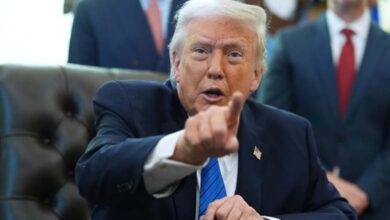
With global energy prices rising and his approval ratings declining, U.S. President Donald Trump faces difficult choices one month after launching the war against Iran: either reach a potentially flawed deal and withdraw, or escalate militarily and risk becoming entangled in a prolonged conflict that could drain his presidency.
-
Trump and Iran: three military paths on the decision table
-
Trump and Iran: 4 Possible Scenarios, Including “Shock and Awe”
Despite active diplomatic efforts, Trump ends another week of the joint U.S.–Israeli campaign struggling to contain a worsening Middle East crisis, while resilient Tehran continues to disrupt oil and gas shipments from the Gulf and to carry out missile and drone attacks against countries across the region.
Analysts say the central question now is whether the U.S. president is prepared to de-escalate or intensify what critics describe as a war of choice, as the conflict has triggered the worst shock ever recorded to global energy supplies and expanded beyond regional boundaries.
-
Trump mobilizes for a Hormuz alliance and broader international involvement in the war against Iran
-
Trump, CNN and the speech of Iran’s new Supreme Leader: four minutes that reignite the war
A senior White House official said Trump had told his aides he wanted to avoid an “endless war” and to find a way out through negotiations. He urged them to emphasize that the duration of hostilities he mentioned in his statements ranges between four and six weeks, while acknowledging that this timeline appears “fragile.”
At the same time, he threatens major military escalation if talks fail. His diplomatic initiatives toward Iran, including a 15-point peace proposal sent through Pakistan, show that he is urgently seeking an exit. It remains unclear, however, whether there are currently realistic prospects for negotiations that could yield positive outcomes.
-
Trump studies Iran’s future after the war and keeps an eye on Khamenei’s successor
-
War Objectives in Iran Portend Rift Between Trump and Netanyahu
In this context, Jonathan Panikoff, former deputy U.S. national intelligence officer for the Middle East, said that “the options available to President Trump from all angles to end the war are limited… Part of the challenge is the lack of clarity about what a satisfactory outcome looks like.”
A White House official said the campaign against Iran “will end when the commander-in-chief decides that our objectives have been achieved,” adding that Trump has set clear goals.
-
Iran protests put Trump to the test between escalation and dialogue
-
After Trump’s threats, Iran affirms readiness for war and dialogue
Challenges in containing the war’s expansion
In an apparent hedging move, Trump is deploying thousands of additional U.S. troops to the region and is threatening Iran with an intensive attack that could include the use of ground forces if his demands are not met.
Analysts say this show of force may aim to intimidate and exert leverage for concessions from Tehran, but it risks dragging the United States into a longer conflict. Any commitment to send ground troops onto Iranian territory would likely anger many American voters.
-
Iran Warns Trump Against Intervention and Draws the Red Line
-
Trump Announces Ceasefire Between Israel and Iran
Experts cite another possible scenario: that the United States carries out one final large-scale aerial assault under “Operation Epic of Wrath” to further degrade Iran’s military capabilities and destroy nuclear sites, after which Trump would declare victory and withdraw, saying his war objectives have been achieved.
However, this would ring hollow unless the vital Strait of Hormuz were fully reopened, which Iran has so far refused to allow. Trump has expressed frustration at European allies’ refusal to send warships to help secure the waterway.
-
Behind Trump’s Deal: How Iran and Israel Agreed to End the War
-
Energy Investments: Iran’s New Card to Woo Trump and End Sanctions
Trump, who has often pledged to keep the United States out of foreign conflicts, appears to be struggling to contain the war he launched with Israel as it widens in scope.
The senior White House official, who requested anonymity to discuss internal deliberations, said Trump continues to speak of assessments pointing to victory but is increasingly directing his messaging toward reassuring jittery financial markets and urging his top aides to stress that the war will end soon.
The lack of a clear exit strategy, however, poses risks to Trump’s presidential legacy and to the Republican Party’s chances of maintaining its slim majority in Congress in the November midterm elections.
-
Trump’s Pressure Pushes Iran to Accept U.S. Demands on Nuclear File
-
Iran’s Nuclear Program Back in the Spotlight… and Trump Seeks Political Breakthrough
The U.S. president’s biggest miscalculation was underestimating how far Tehran might go in response. Iran used what remained of its missiles and drones to strike Israel and neighboring Gulf states and to close the Strait of Hormuz, through which one-fifth of the world’s oil supply passes, triggering a massive crisis for the global economy.
John Alterman of the Center for Strategic and International Studies in Washington said, “The Iranian government is betting on its ability to absorb more strikes for longer than its adversaries, and it may be right.”
The White House official said Trump and his team are “well prepared” for an Iranian response in the strait and confident it will be reopened soon.
-
Between Escalation and De-escalation: How Will Trump Handle Iran?
-
Trump’s Return Pushes European Powers to Demand Increased Pressure on Iran
The clearest sign of Trump’s growing concern came on Monday when he surprisingly backed away from his threat to destroy Iran’s power grid if Tehran did not allow shipping to resume through the strait.
In a move widely interpreted as aimed at calming markets, he announced a five-day deadline before carrying out the threat to give diplomatic efforts a chance. On Thursday, he extended the deadline by another ten days.
At the same time, domestic pressure is mounting, as polls show the war does not enjoy broad support among Americans. While supporters of his “Make America Great Again” movement have backed most of his decisions, the impact on his political base could weaken if economic repercussions, including higher fuel prices, continue.
-
Iran Keeps Door Open for Dialogue with Trump and Prepares for New Sanctions
-
Israel strikes Iran’s nuclear program and missiles with 50 aircraft: map of the raids
According to a Reuters/Ipsos poll released on Monday, Trump’s overall approval rating fell to 36 percent, the lowest since his return to the White House.
A former senior Trump administration official said concern is growing within the White House about the war’s political repercussions, citing worries expressed by Republican lawmakers about the midterm elections.
Reflecting growing Republican concern, Representative Mike Rogers, chairman of the House Armed Services Committee, criticized the administration on Thursday for not providing enough information about the scope of the campaign against Iran. In response, a White House official said Trump’s aides had briefed Congress many times before and during the war.
-
Trump seeks a way out of the war with Iran
-
Occupying Iran’s Kharg Island would be like stepping into a minefield
Strained diplomatic efforts complicated by killings
At present, the diplomatic track offers no easy solutions. The 15-point plan proposed by Trump largely resembles what Iran had rejected during pre-war negotiations and includes elements that would be difficult to implement. The demands range from dismantling Iran’s nuclear program and limiting its missile arsenal to abandoning allied groups and effectively handing over control of the strait.
Iran described the U.S. proposal as unfair and unrealistic but did not rule out further indirect contacts.
While Trump insisted on Thursday that Iran is “begging” for a deal, analysts say the country’s rulers do not appear to be in a hurry to negotiate an end to the conflict, believing they will be able to claim victory simply by surviving.
-
The Pentagon deploys a new weapon as part of its operations in Iran
-
Supply disruptions push Trump to delay targeting Iranian energy facilities
Analysts say the replacement of some leaders killed in U.S.–Israeli airstrikes with more hardline conservatives complicates any diplomatic effort. Iranian leaders have made clear their distrust of Trump, who carried out two airstrikes last year while negotiations were still ongoing.
A White House official said, “The president is ready to listen, but if they do not accept the reality of the current moment, they will face strikes more powerful than ever.” At the same time, Israeli officials have expressed concern that Trump might make concessions that could restrict their freedom to carry out further attacks on Iran. Washington’s Gulf allies may also resent a hasty U.S. withdrawal, as they could be left facing a weakened but hostile neighbor.
-
Pressure in Iran to acquire a nuclear weapon
-
The war with Iran tests Trump’s calculations: battlefield reality breaks through the time ceiling
Conflicting signals confuse adversaries
If Trump is indeed prepared to deploy ground forces, he could seize control of Kharg Island, Iran’s oil hub, or other strategic islands, launch operations along its coasts, or send special forces in a complex attempt to capture its stockpile of highly enriched uranium, believed to be largely buried underground following U.S.–Israeli bombings last June.
Such moves could escalate into a broader conflict reminiscent of the prolonged wars in Iraq and Afghanistan that Trump had promised to avoid. They could also result in increased American casualties and raise further questions about the objectives of the U.S. mission.
A senior Gulf official, speaking anonymously, said Gulf allies had warned the U.S. administration against sending ground troops into Iran, saying this could prompt Tehran to intensify strikes, possibly against energy infrastructure and civilian targets in their countries.
-
The Battle of Kharg: U.S. plans are ready and Iran responds with mines
-
Tehran proposes a collective security system without the United States and Israel
The White House official said Trump has made clear “he is not planning to send ground troops anywhere for now,” while adding that he always keeps all options on the table.
For now, Trump keeps the world on edge, alternating between statements aimed at calming volatile markets and threats that drive energy prices higher.
Laura Blumenfeld of Johns Hopkins School of Advanced International Studies in Washington said, “Trump sends conflicting signals… He is a one-man media machine operating under the ‘fog of war’ to keep his adversaries off balance.”
-
A historic seat… Democrats defeat Trump in his stronghold
-
Two Pakistani officials: Iran received a 15-point U.S. proposal for a ceasefire