Powerful explosions shake Caracas as Venezuela denounces U.S. attack
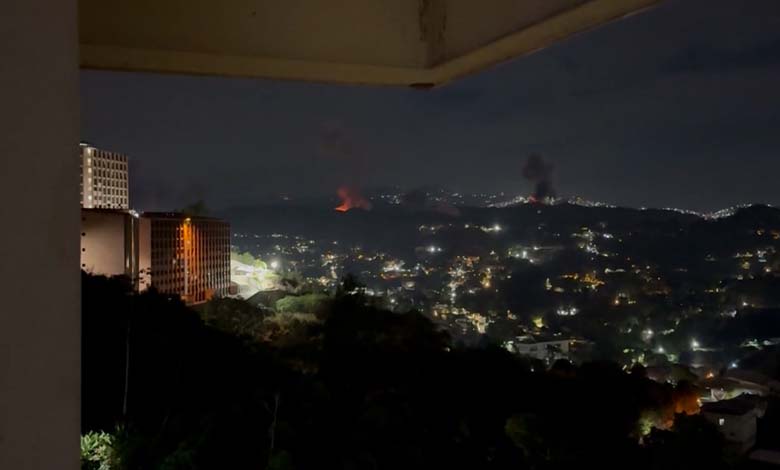
The Venezuelan capital, Caracas, was shaken at dawn by powerful explosions accompanied by a noise resembling aircraft flying overhead.
The sounds were first heard at around 2 a.m. local time, according to AFP correspondents.
By 6:15 GMT, the explosions could still be heard, while authorities had issued no official explanation regarding their nature or source.
-
Trump imposes a full blockade: is Venezuela facing oil suffocation?
-
Vladimir Padrino, the fortress of Venezuela confronting capitals of dominance and accusations
Witnesses cited by Reuters reported loud noises in Caracas during the early hours of Saturday, adding that the southern part of the city, near a major military base, was without electricity.
In a later statement, Venezuela said it rejects what it described as U.S. “military aggression,” referring to the explosions that rocked the capital.
These security developments come at a time when tensions are rising across the Caribbean region, following threats by U.S. President Donald Trump to launch strikes against Venezuela, as part of increased political and economic pressure on President Nicolás Maduro’s government.
-
Trump Seizes Oil Tanker off Venezuela: Pressure on Maduro Intensifies
-
A base for Iran and Hezbollah… A new accusation from Washington against Venezuela
Amid this uncertainty, Venezuelans’ fears are growing that tougher U.S. measures — particularly the blockade on oil tankers — could bring back severe shortages of basic goods, despite Maduro’s repeated assurances that the country is “self-sufficient.” Memories of the crises of 2016 and 2017 remain vivid.
University professor Orlando Bustamante, 54, said: “The specter of shortages is still in our minds. We haven’t forgotten those difficult days,” referring to the period when citizens had to wait for hours in near-empty stores to obtain essential goods such as meat, flour, and corn — key ingredients for making arepas, Venezuela’s most common daily food.
At the time, shortages resulted from falling oil prices — the country’s main source of revenue — a lack of foreign currency for imports, strict price controls, and tight regulation of the exchange market, all of which weakened domestic production.
-
Ford in Latin America: a new escalation from Washington against Venezuela
-
The Venezuelan Air Force: a symbolic power that would not withstand the United States
These conditions contributed to the migration of about seven million Venezuelans since 2013, according to UN estimates, most of them leaving during the crisis years.
The Venezuelan government has long attributed the crisis to a “coordinated economic war” led by the opposition and the private sector, backed by U.S. sanctions.
Washington has imposed economic sanctions on Caracas since 2017, before introducing, in January 2019 during Donald Trump’s first term, an oil embargo intended to choke the Venezuelan economy.
-
Venezuelan fighter jets fly near a US destroyer: a provocation over the Caribbean
-
Is War Approaching? Venezuela Deploys Warships and Drones in Response to U.S. Moves
Analysts, however, argue that economic mismanagement — especially strict currency controls and the weak productivity of state-owned companies — has been one of the main structural causes of the crisis. “We sometimes fear that shortages will return. If the oil sector doesn’t recover, the country’s situation will deteriorate,” Bustamante said.
As anxiety rises, discussion has resurfaced about the black market that flourished during the 2016–2017 crisis. Ana Campos, 62, a housewife, said: “I don’t want to hear again about traders making fortunes at our expense. And I refuse to be treated like cattle,” recalling how numbers were written on people’s hands to organize queues outside stores.
In December, Trump announced a “total and complete” blockade on oil tankers “under sanctions” sailing from or to Venezuela.
-
Why is Russia Building a New Ammunition Factory in Venezuela?
-
Iranian supertanker departing from Venezuela to transport heavy oil
The U.S. Coast Guard and the Department of Defense seized two tankers, each carrying more than one million barrels of oil.
According to the vessel-tracking website TankerTrackers, around 17.5 million barrels of oil remain stuck aboard ships “unable to leave Venezuela because of the blockade.”
Washington says these measures are meant to stop the financing of drug trafficking, while Caracas accuses Trump of seeking to topple Maduro in order to seize the country’s oil reserves — the largest in the world.
Amid this uncertain situation, citizens have begun storing supplies in preparation for the worst.
-
Iran challenges the US sanctions and sent the biggest flotilla to Venezuela with fuel
-
A year after it sank… a report reveals the nuclear secret of a Russian ship
Sergio Díaz, a 32-year-old bank employee, said: “Anything could happen, and we might not be able to leave our homes,” noting that high inflation and the weakening bolivar limit his ability to store enough food. He said he has already gone through his stock twice.
Analysts expect the oil blockade to reduce exports and revenues, leading to cuts in imports of raw materials needed for fuel and food production.
The gasoline shortage crisis of 2020 also remains fresh in people’s minds, with long fuel lines reappearing in border areas with Colombia in recent weeks.
Donald Trump accuses Maduro of heading a vast drug-trafficking network — an accusation Maduro denies, claiming instead that the United States is trying to oust him to seize Venezuela’s oil reserves, the largest in the world.
-
Aftermath of the Washington Attack: U.S. Reduces Work Permit Duration for Refugees
-
The Washington attack brings it back into the spotlight… What do we know about the National Guard?