Military cooperation expands Morocco’s presence in the Horn of Africa
Rabat has realized that its transformation into a comprehensive continental power requires an active presence in the eastern part of the continent, particularly with Ethiopia, which represents a major demographic and political weight.
-
Morocco Strengthens Its Presence in Africa: Growing Military Cooperation with Ethiopia
-
“Security and Peace” – How did Morocco contribute to the stability of Africa?
Moroccan-Ethiopian relations have recently witnessed a notable development through military cooperation, within the framework of Rabat’s orientation toward strengthening openness and coordination with African partners, as well as regional integration across the continent. The rapprochement between the two countries constitutes a profound strategic shift in Moroccan diplomacy, as the Kingdom has moved from consolidating its foothold in West and Central Africa to a phase of “geopolitical expansion” toward East Africa and the Horn of Africa.
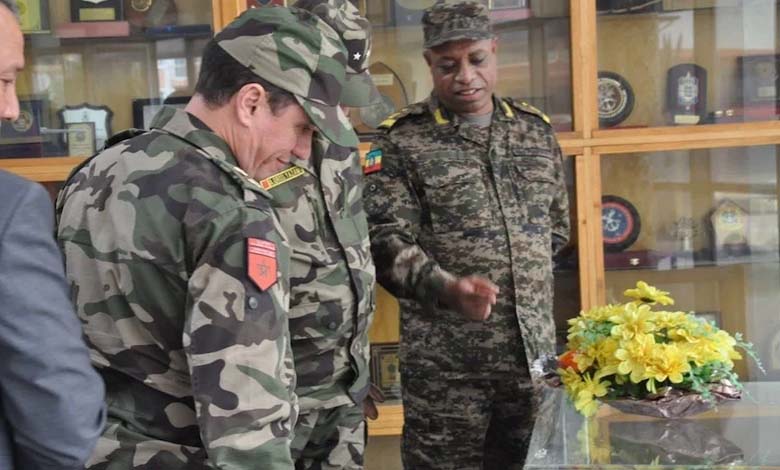
This cooperation was embodied in the first meeting of the Moroccan-Ethiopian Joint Military Commission, held on January 13 and 14 in Addis Ababa. The meeting followed an agreement signed by the two countries in May 2025 providing for the establishment of the joint commission, in addition to military cooperation between Rabat and Addis Ababa in training and the exchange of expertise in various fields.
-
Bourita: The Moroccan Sahara issue is no longer on the agenda of the African Union
-
The King of Morocco responds positively to Trump’s invitation to join the Peace Council
A comprehensive continental power
For many years, Morocco concentrated its economic and political weight in West Africa, particularly in the Francophone zone. However, it has recently realized that its evolution into a comprehensive continental power requires an active presence in East Africa, especially in Ethiopia, a country of growing demographic, political significance – as the seat of the African Union – and rising economic importance.
The Kingdom seeks to break with the traditional image of its alliances, demonstrating its ability to build “South-South” partnerships that transcend regions and languages. Its presence in Ethiopia grants it diplomatic leverage in major African issues and contributes to neutralizing positions hostile to its national interests, particularly regarding the Moroccan Sahara issue, in areas that were historically distant from its influence.
-
Morocco enters 2026 amid major transformations and growing confidence
-
Morocco Moves Firmly to Protect Its Digital Sovereignty
Morocco has thus moved in its relations with Ethiopia from major economic investments – such as the OCP fertilizer plant project valued at 3.7 billion dollars – to military and security cooperation.
The Kingdom possesses well-recognized expertise in counterterrorism, border security, and military training. The transfer of this expertise to Addis Ababa is expected to strengthen Rabat’s role as a “security provider” on the continent.
In May, the Moroccan Minister Delegate in charge of the Administration of National Defense, Abdellatif Loudiyi, received Ethiopian Minister of Defense Aisha Mohammed Moussa during a working visit to Rabat.
-
Morocco accelerates the localization of defense industries in line with a balanced royal vision
-
Morocco Consolidates the Realism of the Solution: The UN Security Council Resolution Marks a Turning Point in the Moroccan Sahara Issue
A statement from the National Defense Administration indicated that both sides reviewed the various aspects of bilateral cooperation and ways to strengthen it, emphasizing the positive role of both countries in preserving stability, security, and peace on the African continent.
The statement added that the two sides signed a military cooperation agreement covering training, scientific research, and health, as well as the exchange of expertise in various fields of mutual interest.
Prior to this agreement, the Inspector General of the Royal Armed Forces, Mohamed Berrid, visited Addis Ababa in April, where he discussed with Ethiopian Chief of Staff Berhanu Jula ways to enhance military cooperation, according to a statement by the Royal Armed Forces.
-
From Backroom Diplomacy to the Voting Floor: How Morocco Won the UN Security Council Battle Over the Moroccan Sahara
-
The UN Security Council supports Morocco’s autonomy plan for Moroccan Sahara
Both parties discussed a draft agreement on the various aspects of bilateral military cooperation, aimed at strengthening and developing the prospects of this partnership.
The statement noted that the visit provided “an opportunity to inspect a number of military facilities and institutes belonging to the Ethiopian National Defense Forces, including the Directorate of Information Network Security, the Artificial Intelligence Institute, the Bishoftu Air Base, and a munitions factory.”
In November 2015, Ethiopia and Morocco signed twelve agreements in various fields during a visit by King Mohammed VI to Addis Ababa, including a protocol on diplomatic cooperation.
-
King Mohammed VI’s Vision: Morocco’s Rise through Justice and Balance
-
The World Bank chooses Morocco as a regional headquarters for its stability and strong economy
Among the main areas covered by these agreements were air transport, minerals, agriculture, tourism, and water cooperation, as well as a protocol on diplomatic cooperation.
Commenting on the holding of the joint commission, military expert Mohammed Chakir said that “defense cooperation between the two countries comes within the framework of the Kingdom’s openness toward African countries in order to strengthen relations with them,” noting that “Ethiopia is one of the largest countries in the Horn of Africa, in addition to being the host country of the African Union.”
Regarding the commission’s meeting, he explained that it “falls within the framework of strengthening military cooperation between the two countries, particularly in the security and military fields.”
-
Washington urges U.S. companies to invest in Morocco’s Sahara
-
New Diplomatic Achievement for Morocco with Its Election as Vice-President of the Conference on Landlocked Developing Countries
As for Ethiopia’s gains, Chakir pointed out that Addis Ababa “intends to benefit from Moroccan military expertise, particularly in the field of modern military technologies that the Kingdom is developing with the support and cooperation of the United States, with which it is bound by a security partnership extending from 2020 to 2030.”
On October 2, 2020, Washington and Rabat signed an agreement to strengthen military cooperation for ten years, on the sidelines of a visit to Morocco by former U.S. Secretary of Defense Mark Esper.
-
Portuguese support for Morocco’s Sahara plan strengthens the Kingdom’s position
-
Morocco Affirms Its Role as a Neutral Mediator in Sub-Saharan African Crises
Military diplomacy
Chakir explained that his country now has “military structures dedicated to training and education,” adding that “the partnership between the two countries is now framed by this joint military commission.”
Morocco is also working to establish a military industry through joint agreements. Last October, the Kingdom announced, in partnership with India, the inauguration of a factory producing combat vehicles in the city of Berrechid, intended for the Moroccan army as well as for international markets with high growth potential.
-
Morocco’s Atlantic Project: A Lifeline from Crisis for Sahel Countries
-
Algerian move to disrupt the Morocco-Mauritania rapprochement
The Moroccan researcher affirmed that “the Kingdom seeks to deepen its ties with its African depth, both militarily and economically,” adding that “the Moroccan orientation is reflected in concluding partnerships with African countries, including Ethiopia, given its strategic location and the fact that it constitutes a major hub for meetings among various states.”
A new phase
For its part, Addis Ababa confirmed that the holding of the joint military commission meeting aims to “strengthen bilateral cooperation across various military fields, including education and training, defense industries, and technology transfer.”
-
The Nation’s Flag Above All Others: No Alliance With Those Who Threaten Morocco’s Unity
-
Morocco Establishes Company to Accelerate Localization of Defense Industries
Following the meeting, the Director General of External Relations and Military Cooperation of the Ethiopian National Defense Forces, Chumi Gemetchu, stated that relations with Morocco are steadily strengthening across multiple sectors, according to the Ethiopian News Agency.
Gemetchu pointed out that the first meeting of the joint commission represents a historic milestone in relations between the two countries and opens a new phase for the practical implementation of the agreed areas of cooperation.
-
Ghana Supports Morocco’s Proposal on the Sahara
-
Commitment to the Atlantic Initiative Sets the Stage for Broader Cooperation between Morocco and Sahel Countries
For his part, Abdelkahar Othman, Director of the Supply Directorate of the Royal Moroccan Armed Forces, described the meeting as “an important development in military relations,” adding that Morocco is determined to further raise the level of defense cooperation with Ethiopia, describing the progress achieved so far as “encouraging.”
-
AFRICOM Commander Highlights Morocco’s Key Role in Ensuring Security in Africa
-
Morocco Strengthens Its Presence in Africa with Military Cooperation Agreements