Bolivia suspends its recognition of the Polisario Republic
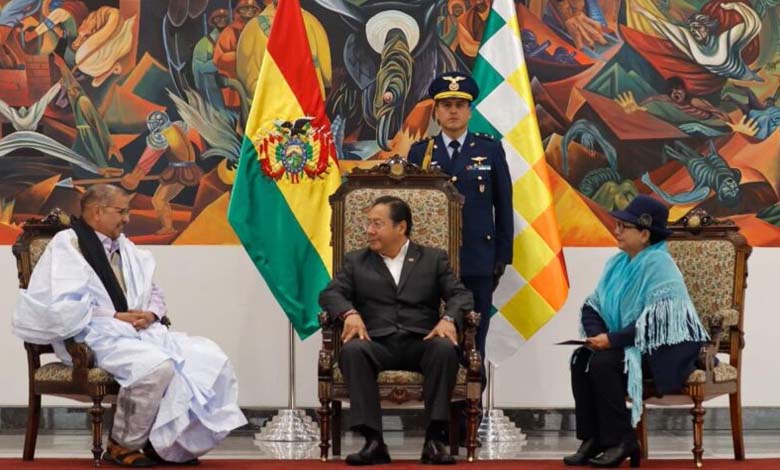
La Paz’s decision to suspend its recognition of the so-called “Sahrawi Republic” represents a significant diplomatic breakthrough for Morocco in South America, where most countries have withdrawn or frozen their relations with the Polisario.
Bolivia has decided to suspend its recognition of the entity known as the “Sahrawi Arab Democratic Republic,” amid a noticeable erosion of support for the Front Polisario and unprecedented international backing for Morocco’s autonomy initiative. This momentum has intensified after the United Nations Security Council endorsed the Moroccan approach as a realistic basis for negotiations and as a pragmatic solution to the dispute over the Sahara.
The Bolivian decision followed a phone call on Monday between Morocco’s Foreign Minister Nasser Bourita and his Bolivian counterpart Fernando Aramayo. It reflects Rabat’s diplomatic gains on the Moroccan Sahara issue and its success in rallying countries that had previously supported the Polisario, thereby strengthening Morocco’s claimed rights over its Sahara and reinforcing its sovereignty.
According to a statement issued after the conversation, “The Plurinational State of Bolivia, in accordance with United Nations Security Council Resolution 2797 (2025), and while reaffirming its support for the political process under UN auspices, has undertaken a sovereign review of its foreign policy. As a result of this review, Bolivia has decided to suspend diplomatic relations with the entity known as the ‘Sahrawi Arab Democratic Republic’ and to terminate all official contacts with it, noting that it is not recognized as a member state of the United Nations.”
The statement added that the decision forms part of Bolivia’s desire to contribute constructively to international efforts aimed at achieving a realistic, practical, lasting and consensus-based political solution in line with UN parameters.
Following this step, the two countries agreed to restore diplomatic relations and initiate the necessary procedures to establish diplomatic missions in La Paz and Rabat.
La Paz’s latest stance marks a significant Moroccan diplomatic breakthrough in South America, where most countries have withdrawn or frozen relations with the Polisario. This development constitutes a setback for the separatist movement and its main supporter, Algeria, which had relied on left-leaning political forces in the region to secure backing.
The move also comes as Washington seeks to accelerate the resolution of the Sahara dispute and to make the latest Security Council resolution—endorsing Morocco’s autonomy proposal under Rabat’s sovereignty as the basis for negotiations—a reference framework. This dynamic has led Algeria, the Polisario’s political and financial backer, to participate in negotiations as a party to the dispute.
The new U.S. momentum is being led by Massad Boulos, the President’s adviser for African and Middle Eastern affairs, in close coordination with Michael Waltz, in an effort to move beyond the slow and stagnant traditional UN-led formats.
These developments also follow the European Union reaffirming the solid legal foundation of its association agreement with Morocco, in what was seen as a clear political and legal message aimed at countering challenges to its legitimacy.
The EU’s High Representative for Foreign Affairs, Kaja Kallas, stressed that the legal status of the Moroccan Sahara region remains of a particular nature under UN classification, emphasizing that the Union’s engagement with the issue is conducted strictly within the framework of international legality and the UN process. Brussels thus underscored that its economic or trade agreements cannot be interpreted as a substitute for the political process led by the United Nations.
Amid these developments, the Swedish government announced its alignment with the European trend supporting Morocco’s autonomy initiative, describing the proposal as a serious framework that could serve as a basis for negotiations under UN auspices. The announcement reflects a clear repositioning by Stockholm within a European approach increasingly inclined to support the Moroccan proposal as a practical option for resolving a long-standing conflict.
The statement was delivered by Sweden’s Minister for Foreign Affairs, Maria Malmer Stenergard, who indicated in a written parliamentary reply that the latest UN resolution highlighted the autonomy proposal as a credible basis upon which to build the ongoing political process. She also noted that the UN track, under the supervision of the Secretary-General’s Personal Envoy, Staffan de Mistura, provides the most appropriate framework for reaching a mutually agreed settlement.
The Swedish official pointed out that the continuation of the conflict for nearly half a century, along with its humanitarian consequences, requires the international community to seriously pursue a lasting solution. She affirmed that Sweden views the Moroccan initiative as a realistic basis for discussion between the parties and expressed her country’s readiness to contribute to advancing a sustainable political solution.
Stockholm further disclosed that it had informed both Algeria and the Front Polisario of its updated position, reflecting the government’s intention to ensure clarity and transparency regarding this shift.
This development fits within a broader European context. The minister noted that Sweden joins several EU member states that have expressed support for Morocco’s autonomy initiative, including Denmark and Finland. This alignment reinforces what is increasingly seen as a growing trend within the EU toward adopting an approach more closely aligned with UN efforts.
The significance of Sweden’s position is also underscored by its political background on the issue. In 2016, Stockholm had considered recognizing the entity proclaimed by the Polisario before stepping back from that move. Today, its declared support for Morocco’s initiative reflects a political reassessment shaped by evolving regional and international dynamics, both within the European Union and in light of the UN-led process.
Observers believe this development provides additional momentum to Morocco’s initiative on the European stage and strengthens its standing as an option enjoying growing international support.