No Answer from the Pentagon or SpaceX as Uncertainty over Starlink Restrictions Unsettles Kyiv
Ukraine is still awaiting clarification from the US Department of Defense and SpaceX over restrictions on the satellite communications its military relies on to counter Russian attacks. Meanwhile, pressure is mounting in the US Congress for an investigation into the circumstances surrounding the decision and its impact on Ukraine’s defences.
Denys Sienik, Ukraine’s chargé d’affaires in the United States, told Radio Free Europe/Radio Liberty on 21 October that the speed restrictions had not been lifted and that Kyiv had received no response from either the Pentagon or Elon Musk’s SpaceX.
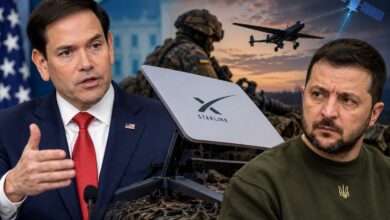
The controversy surrounding Starlink and Starshield has raised questions about who authorised the restrictions, whether President Donald Trump’s administration knew about them in advance and how significantly they have affected Ukraine’s ability to counter Russian attacks.
On 21 October, US Secretary of State Marco Rubio denied that Trump or any government official had requested changes to either system. He explained that Starlink was a commercial satellite internet service that could be used to guide drones, whereas Starshield was a specialised defence product supplied by the company for government use through the US Department of Defense.
Restrictions Threaten Ukraine’s Defences
Reports suggest that disruptions affecting Starshield, the military version of SpaceX’s services, have left Ukraine more vulnerable since they were reported on 13 and 14 October. The Ukrainian military relies heavily on this technology to counter Russian air strikes.
Dan Rice, a former special adviser to the commander-in-chief of Ukraine’s armed forces and president of the American University Kyiv, said the controversy involved several distinct issues, including intelligence sharing, speed restrictions on satellite communications and deliveries of Patriot interceptor missiles.
Rice said he believed Rubio was referring to intelligence sharing when he stated that US assistance was continuing. He also pointed to a technical malfunction that had prevented air raid alerts from reaching residents’ phones.
He stressed that continued intelligence sharing did not necessarily mean satellite communications had been unaffected.
During a visit to Kyiv from 13 to 16 October, a congressional delegation reported that the Starshield restrictions were in force. In its assessment, the restrictions had contributed to endangering Ukrainian civilians and US personnel while weakening air defences.
Reports indicated that the speed threshold was initially set at approximately 60 miles per hour before being raised to 100 miles per hour. This could cause faster-moving platforms to lose connectivity, including Russian Shahed-type drones, which can reach speeds of 280 miles per hour or more.
Rubio Denies US Administration Involvement
Speaking in Mumbai on 21 October, Rubio said he had not read a Wall Street Journal report stating that Musk had ordered the system to be slowed down. He denied that Trump or any US official had requested changes or known about the decision beforehand.
He added that the US government could not dictate how a private company operated a commercial service, while noting that different arrangements applied to Starshield because it was a defence product purchased for government use.
Neither Washington nor SpaceX, however, has yet provided Ukrainian officials with direct answers about the restrictions and their consequences.
The controversy coincided with fresh Russian attacks on Kyiv on the night of 21 October. According to Ukraine’s emergency service, one person was killed and at least 22 others were injured, including four children. The strikes hit homes, an ambulance station and a petrol station.
Calls for an Investigation and Scrutiny of Aid Deliveries
Calls for an investigation have intensified in Congress, with lawmakers from both the Republican and Democratic parties demanding answers.
Democratic Senator Adam Schiff called for a full Senate investigation and demanded that Musk be summoned to testify, while Senator Ruben Gallego sought clarification of the decision.
Senator Chris Coons warned that it was unacceptable for Musk to have the power to influence the course of the war through a unilateral decision. Senator Elizabeth Warren raised concerns about a private-sector executive’s influence over US foreign policy.
Democratic Representative Ami Bera also called for investigators to establish who authorised the restrictions and hold those responsible accountable. Republican Representative Brian Fitzpatrick joined him in demanding an investigation.
In a letter dated 21 October, around twenty House members, including seven Republicans and sixteen Democrats, urged Trump to pressure Musk to allow Ukraine to use Starlink to target Russian missile launch sites inside Russia. They argued that destroying the launch sites could help save lives and push Moscow towards negotiations.
Concerns have also extended to delays in the delivery of Patriot interceptor missiles reportedly paid for by NATO allies.
A Senate aide said the relevant committee had approved third-party transfers but had not seen the missiles arrive in Ukrainian inventories, adding another point of contention to the debate over US military support for Kyiv.