Control and Military Bases: An Old Agreement Gives Trump a Solution in Greenland
“Greenland” has come to dominate media headlines and occupies a large space in political debate, following American interest in controlling the island, despite the existence of a “framework for cooperation”.
-
Turkish hacker hacks Donald Trump’s website
-
How Trump could take control of Greenland’s capital in half an hour
Between purchase, invasion, and annexation, various analyses are racing to outline a clear path for potential US control over the island under Danish sovereignty, which Washington views as a strategic gap that could be exploited for military access to North American territory.
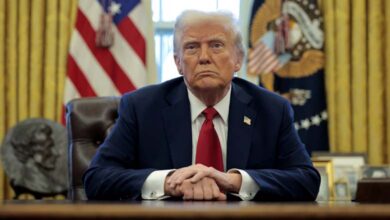
Only a few days ago, US President Donald Trump stated: “We need Greenland from a national security perspective.”
The question, then, is whether the United States truly needs to buy Greenland — or take more radical action — in order to achieve all of Trump’s objectives.
-
Trump threatens to replicate the Venezuela scenario in Cuba and Colombia
-
In 2026… Pending Items on Trump’s Foreign Agenda
An Old Agreement
Under a little-known Cold War–era agreement, the United States already enjoys broad military access to Greenland, according to The New York Times.
At present, the United States operates only one base in a very remote corner of the island. However, the agreement allows it to “construct, install, maintain, and operate” military bases across Greenland, to “house personnel,” and to “control and operate landings, takeoffs, docking and anchorage facilities, as well as the movement of ships, aircraft, and watercraft.”
The defense agreement was signed in 1951 by the United States and Denmark, which has exercised sovereignty over Greenland for more than 300 years.
-
Surprise 2026… Trump Builds the American Arc de Triomphe
-
Hedgehog shield and pragmatism… 6 lessons from Trump for world leaders in 2026
Mikkel Runge Olesen, a researcher at the Danish Institute for International Studies in Copenhagen, said: “The United States enjoys such extensive freedom in Greenland that it can essentially do whatever it wants.”
He added: “I find it very hard to imagine that the United States could not get everything it wants, if it simply asked politely.”
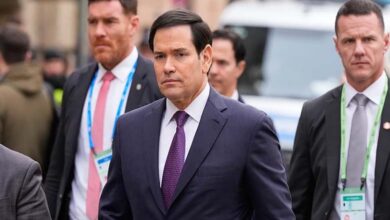
Buying Greenland, however — an idea that Secretary of State Marco Rubio has described as Trump’s latest plan — is a different matter altogether.
“Greenland does not want to be bought, especially by the United States. And Denmark has no authority to sell it,” Olesen said.
-
Netanyahu to present Trump with a new plan for Gaza if Hamas refuses to disarm
-
Trump imposes a full blockade: is Venezuela facing oil suffocation?
In the past, Denmark made such decisions unilaterally, even rejecting in 1946 an offer by the Truman administration of 100 million dollars in gold to purchase the island.
Today, the situation is different, as Greenlanders have the right to hold a referendum on independence.
Danish officials say it is up to the island’s 57,000 inhabitants to decide their future, while a poll conducted last year showed that 85 percent of the population opposes an American takeover.
Moreover, Greenland’s Prime Minister, Jens-Frederik Nielsen, has repeatedly mocked the idea of a purchase, stating last week: “Our country is not for sale.”
-
Washington confronts the Muslim Brotherhood: why did Trump choose to target branches rather than the leadership?
-
He wants action… Trump tired of meetings about Ukraine
Update
The longstanding defense agreement between the United States and Denmark was updated in 2004 to include Greenland’s semi-autonomous government, granting it a say in how US military operations affect the local population.
The roots of the agreement date back to a partnership forged during the Second World War.
At that time, Denmark was under Nazi occupation. Its ambassador in Washington, cut off from the Nazi-controlled government, took the personal initiative to conclude a defense agreement between Greenland and the United States.
There were fears that the Nazis might use Greenland as a launching point toward America.
-
Trump Plans to Appoint a U.S. General to Lead the International Force in Gaza
-
The repercussions of Trump’s strike against the Muslim Brotherhood… What to expect in Europe?
German forces had already established small weather stations along the island’s eastern coast, but the agreement between the ambassador and Washington led to US military intervention, the expulsion of German forces, and the establishment of more than a dozen bases, including thousands of troops, airstrips, and other military facilities.
After the Second World War, the United States continued to operate some bases and a chain of early-warning radar sites.
With the end of the Cold War, all of these bases were closed except one, now known as Pituffik Space Base, which helps track missiles crossing the Arctic.
-
Trump’s peace plan for Ukraine: deadline for Kyiv until Thursday, and Putin comments
-
Trump insists on nuclear tests as senior officials oppose any detonation
Despite the presence of US forces on the ground and the existence of the agreement, analysts say that if the United States were to use the defense agreement as a pretext to deploy large numbers of troops and attempt to occupy Greenland, such an action would not be legal.
Under the 2004 amendment, the United States is required to consult Denmark and Greenland before making any “substantial changes” to its military operations on the island.
The amendment, signed in 2004 by General Colin Powell, who was secretary of state at the time, explicitly recognizes Greenland as “an equal part of the Kingdom of Denmark”.
-
The power went out during the interview… What did Zelensky say about Trump and Putin?
-
Trump’s threat to Nigeria: turmoil at the Pentagon and a reshuffling of priorities
Everyone “Agrees”
Peter Ernstved Rasmussen, a Danish defense analyst, told The New York Times that in practice, if US forces submit reasonable requests, “they will always receive approval” from Greenland and Copenhagen.
This reality has long angered Danish political experts, because the conclusion is straightforward: if Trump wants to strengthen Greenland’s security today, he can do so.
However, no official American requests of this kind have been made, according to Jens Adser Sørensen, a former official in the Danish parliament, speaking to The New York Times.
-
Trump threatens to use it: What is the Insurrection Act?
-
The Cartel War reaches the depths of the Caribbean: Trump reveals Maduro’s offer
Sørensen went on to say: “Why not use the mechanism of the defense agreement if you are so concerned about the security situation?”, adding: “The framework exists. It is already in place.”
Yet Greenland’s strategic location is not the only factor that has attracted Trump’s inner circle. The vast island has another major asset: rare earth minerals, which are found in large quantities buried beneath the ice.
Here too, analysts say the United States does not need to take control of the island to obtain them, as Greenlanders have expressed their willingness to engage in trade with almost any partner.
-
Netanyahu once again at the gates of hell… will Trump’s Gaza plan endure?
-
Trump hails the dawn of a historic new era in the Middle East